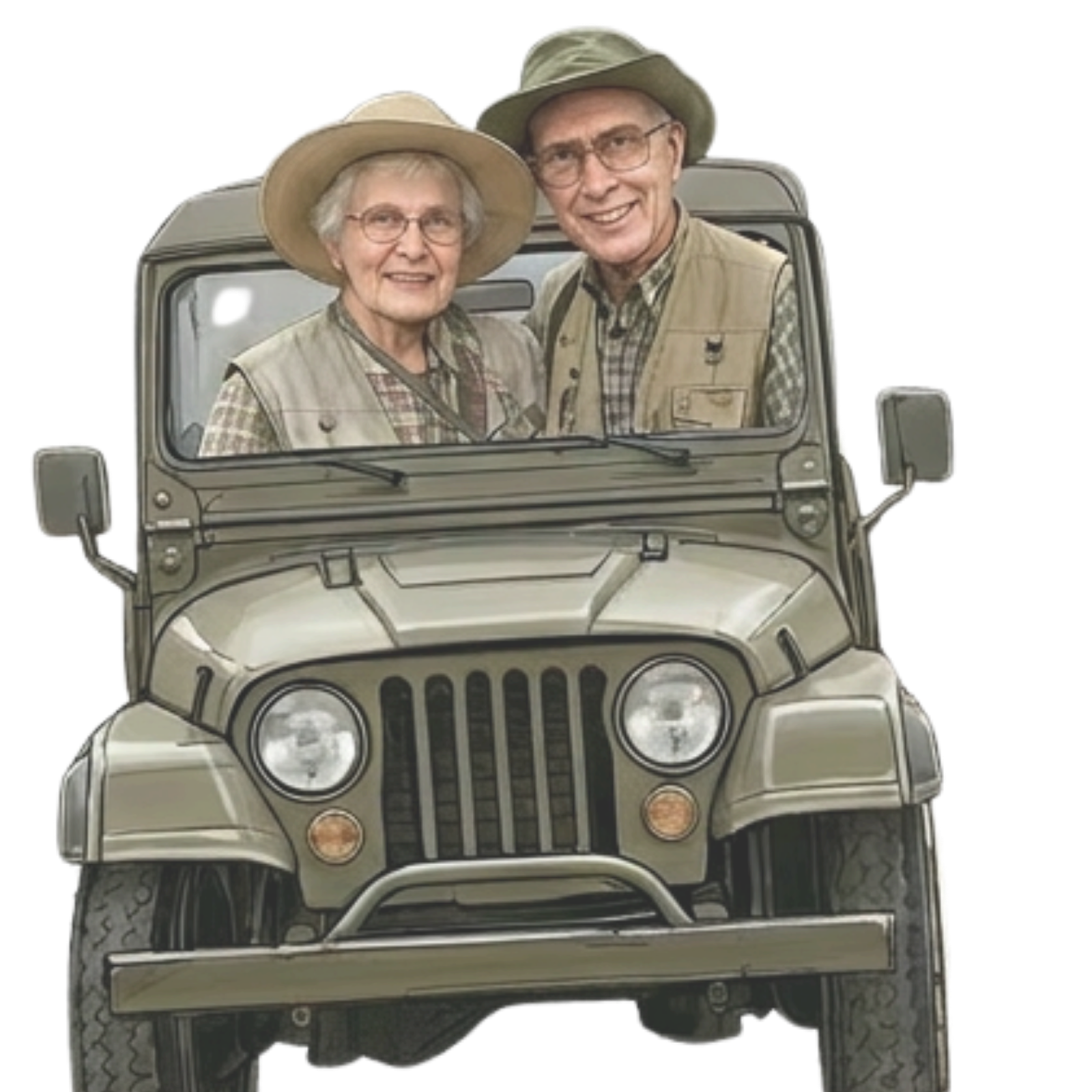
2012 - ICELAND
1996 - SCOTLAND & IRELAND

Go to Table of Contents
Go to Table of Contents
2012 - ICELAND
Waterfalls, glaciers, churches, sheep, and no Northern Lights

Iceland? That’s hardly on anyone’s “bucket list.” But it sounded a little challenging, and maybe a chance to see the Northern Lights. They say Iceland is one of the best places to see them. I started checking out how to get there, and I soon found out that “you can’t get there from here.” With the help of a travel agent, we finally put together four one-way flights with long layovers.
So, many hours later, we landed in Reykjavik, Iceland, minus Al’s suitcase. We had planned to carry our luggage onto the plane, but when they offered free checked baggage, we checked both bags. Now they said they would trace and deliver the missing bag to our hotel the next day.
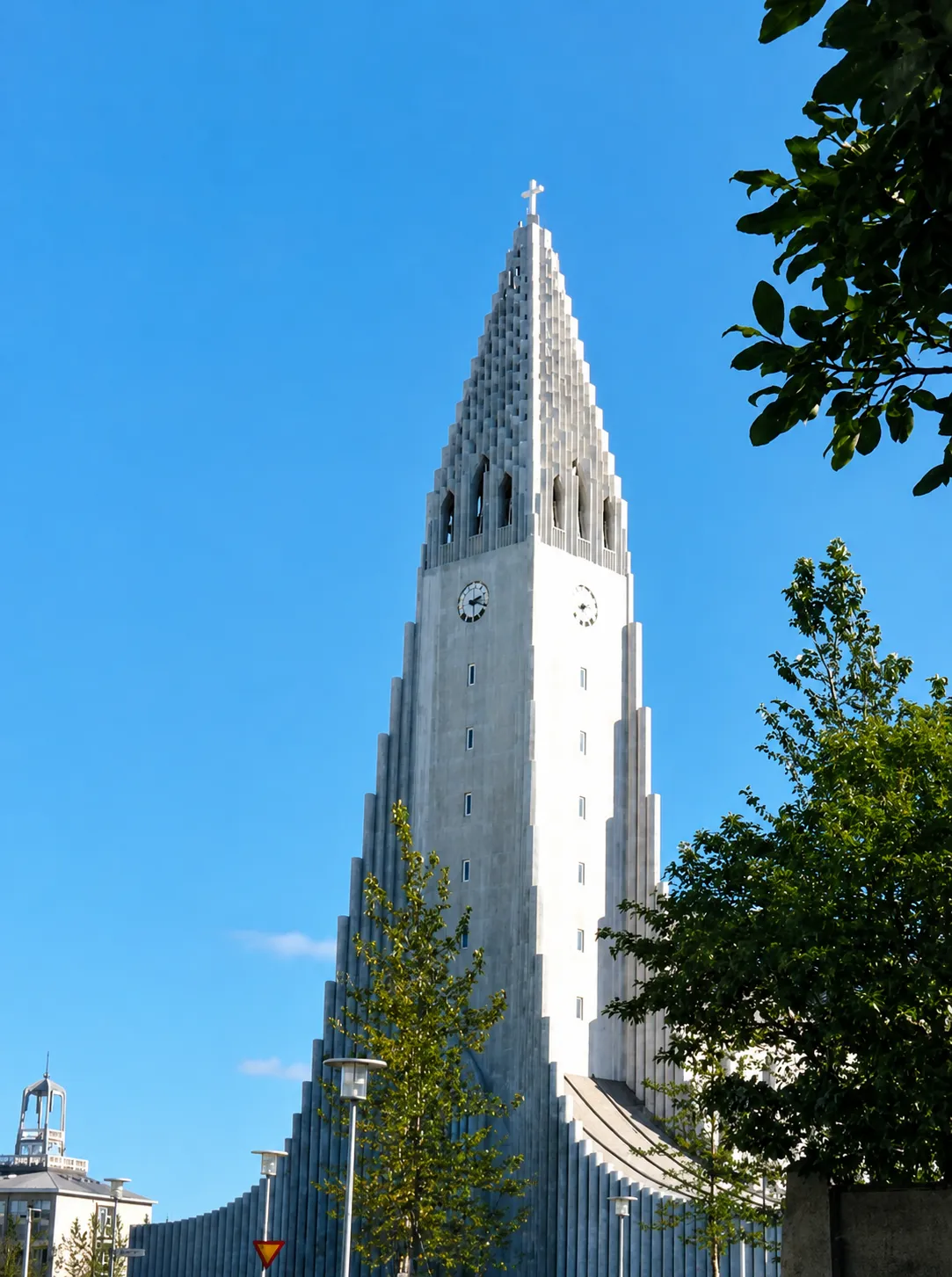
We had made our reservations for Iceland through a local travel agent, and she was waiting for us. She drove us into the city and to our guest house. It was right across from the cathedral and centrally located. Our room was on the third floor, with the WC down the hall and showers nearby. A kitchenette was available for everyone.
After a short nap, we set out to explore the town on a crisp, sunny day. First, the cathedral. It was made entirely of concrete, which made it quite different. But it still had the towering steeple and beautiful interior naves. We took an elevator up to the tower for a great view of the city, and we happened to be there when the big clock chimed the hour.
We were ready to go to bed early after fixing a light supper in our kitchenette. It was raining, cold, and windy. Was this the kind of weather we would have the whole trip? Al had undergone eye surgery three weeks earlier, and now his eye was bloodshot and hurting. His eye drops were in the missing suitcase.
During the night, the wind roared and howled and nearly shook the building while rain pelted against the windows. We missed our morning ritual of hot cappuccino because our little hot pot was in the missing bag. Fortunately, Al had packed a shirt in his small backpack, so at least he had a clean shirt to wear.
The airport said today’s flight was canceled. We hoped his suitcase would arrive tomorrow, so we moved on. We picked up our rental car (part of the package deal), and it included detailed maps. They had made reservations for us at nine places around the island and had programmed the GPS for each one. The map also showed interesting places to visit.
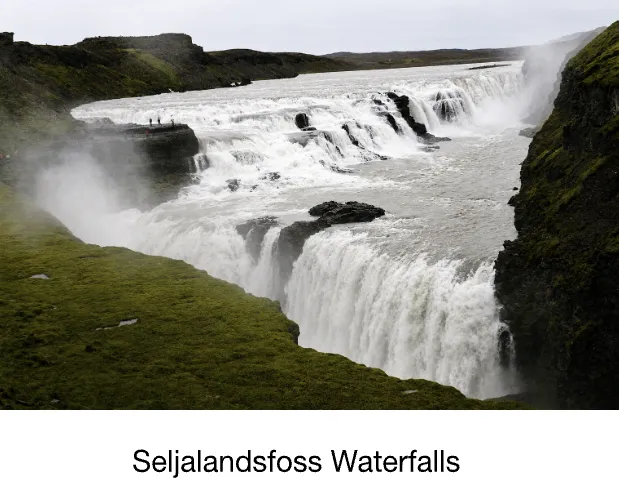
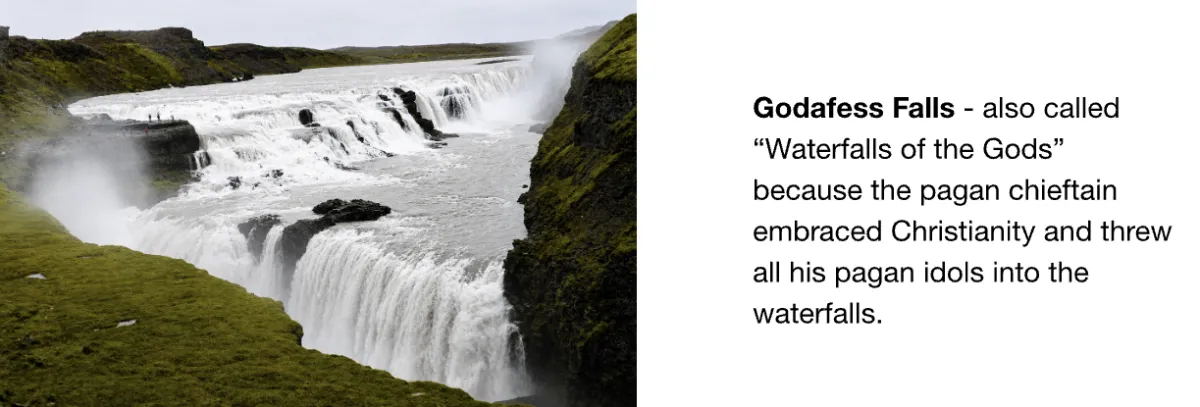
So we started out in the rain. Our first stop was Gullfoss Waterfalls. It was raining hard and very windy. It was a long walk on a boardwalk just to get a glimpse of the falls, followed by many steps down to the bottom. Instead, we drove to a parking area with a good view of the two-level falls.
We continued driving through the beautiful scenery of glaciers, mountains, and crashing surf. But eventually, we had enough rainy sightseeing for one day. The GPS guided us to our overnight lodging, a farmhouse with a separate building for us. It had a living room, dining room, kitchen, and bath with a walk-in shower. Everything was very nice, although the bedroom was up steep stairs on the second floor. The sky was cloudy, so no Northern Lights.
The lady brought breakfast to us: a variety of breads and fruits, eggs, cereal, coffee, and juice.
She had received a call about Al’s suitcase. They were going to send it by small plane to the place where we would be staying the following night.
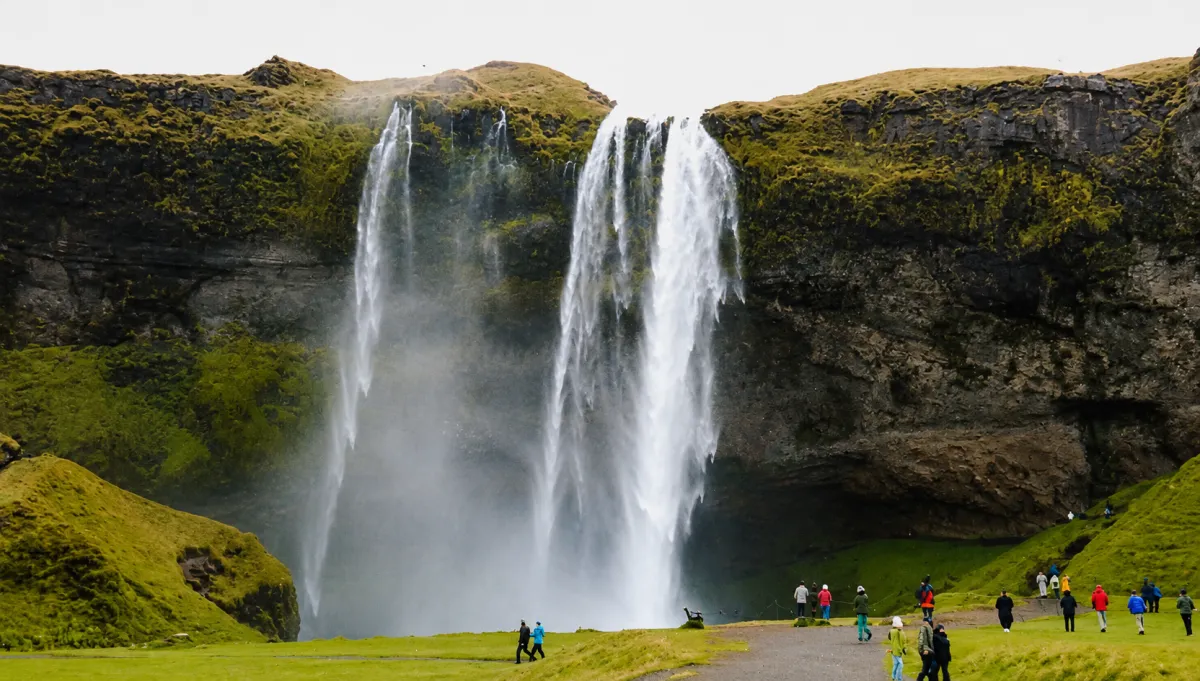
The floors here were all warm, heated by underground steam from the volcanoes. The recent major eruption that made worldwide news was only 35 kilometers from their house, and some of the ash had fallen on their property. The skies were clearing, sunshine at last! We left at 10, ready for a day of adventures.
We could see the spray from the waterfall from a distance. We parked and walked to the falls. The water plunged over a rocky ledge, leaving a large space behind the falls where visitors could walk. The path was a little tricky, but we made it. We stood behind the roaring waterfall while the brisk wind blew some of the spray onto us. It was exciting and quite an adventure.
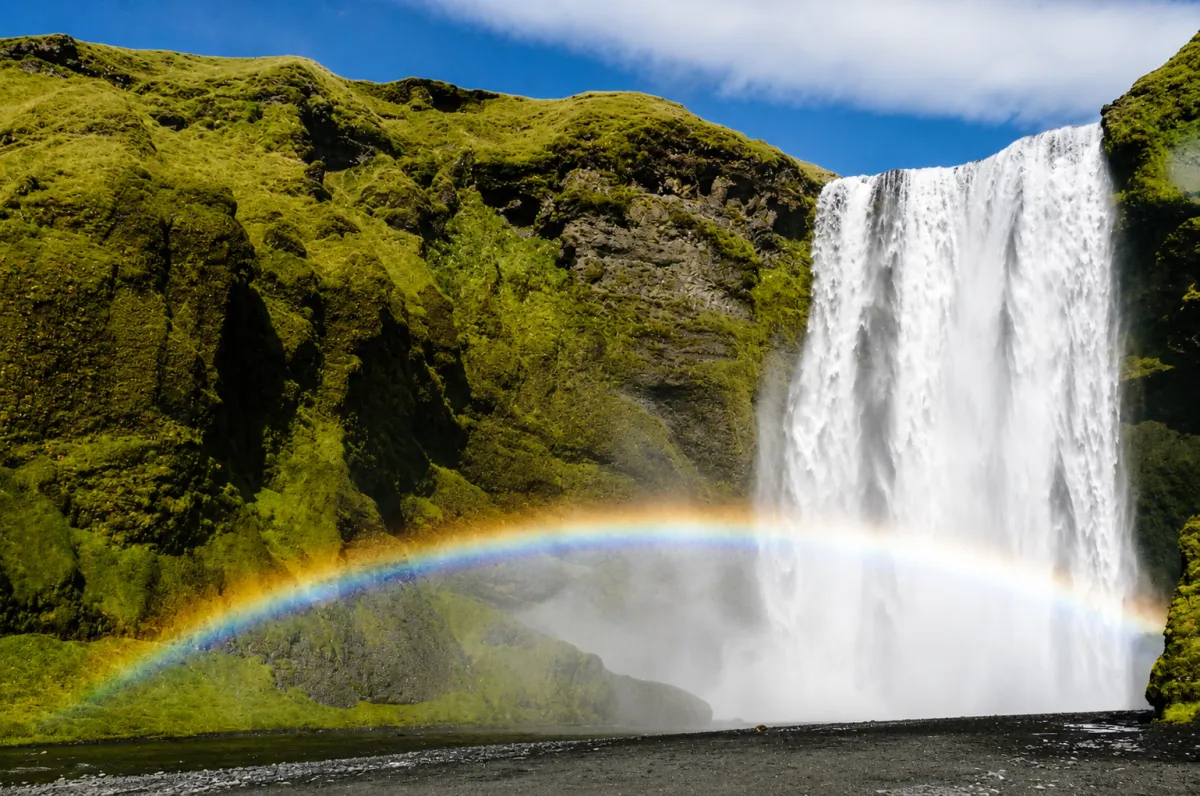
Skogar Falls
We didn’t think it could get any better, but these falls formed a rainbow in the spray and sunshine. The closer we got, the more beautiful it became, waterfalls, blue sky, and a rainbow all together.
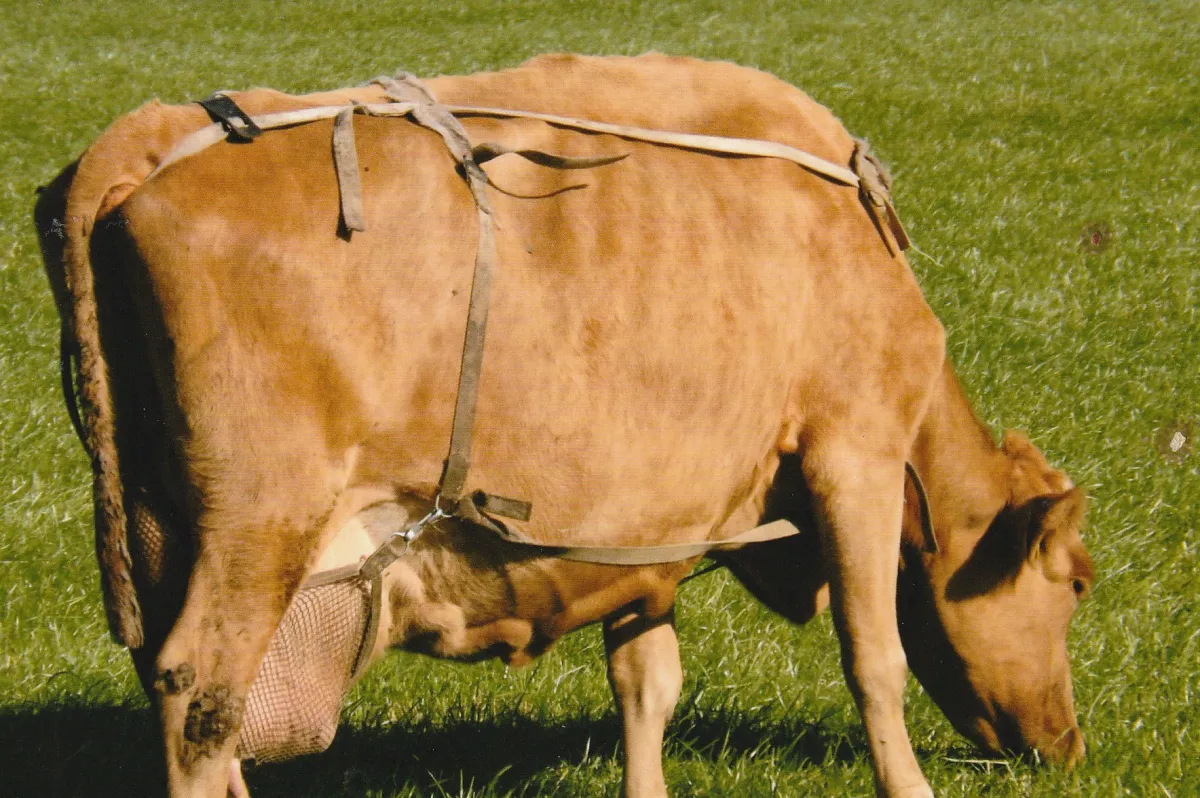
As we continued driving, we saw cows crossing the road. They were wearing support systems to keep their huge udders from dragging on the ground. Imagine cows wearing bras!
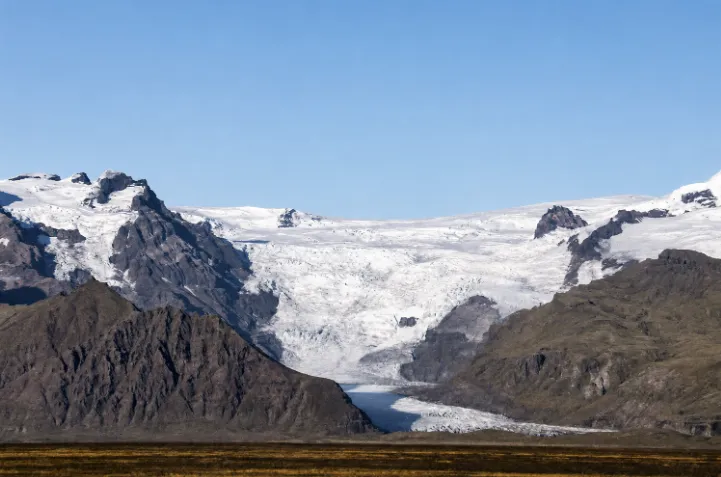
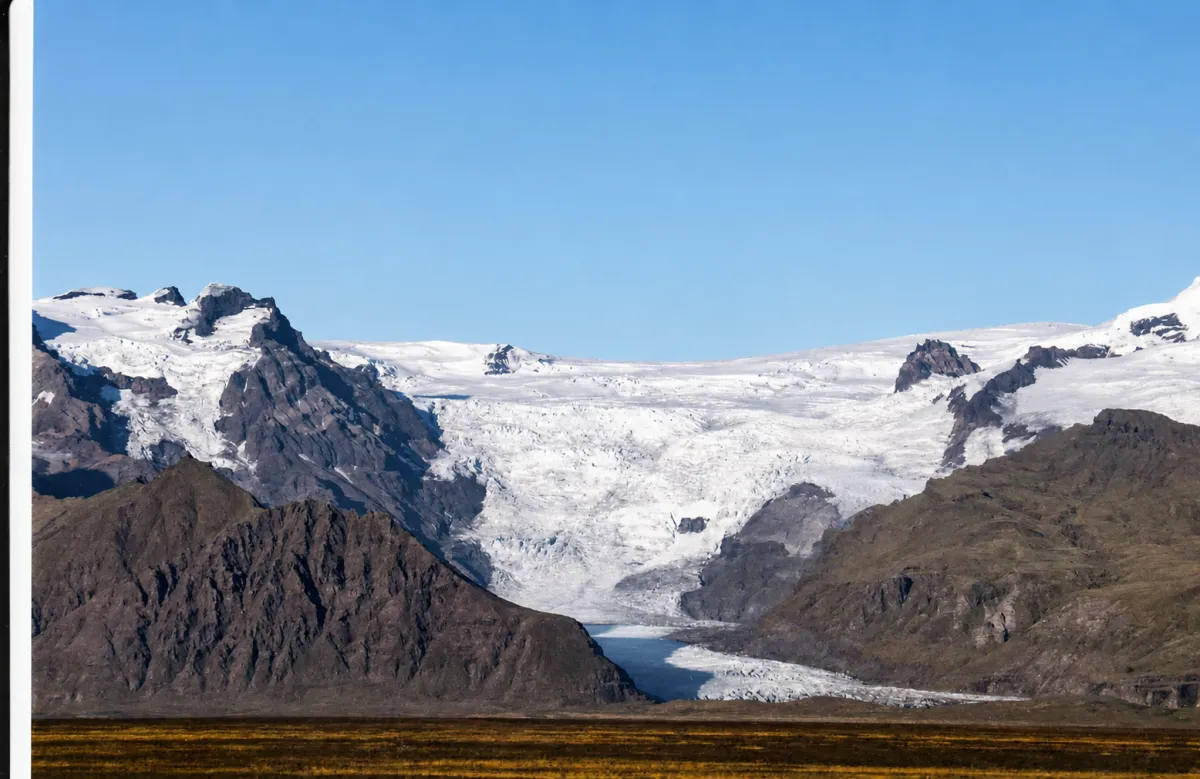
Vatnajokull glacier
At 800 square kilometers, it is the largest glacier in Europe. We drove toward it for miles and miles, and it was very impressive. Glaciers cover 11% of Iceland’s land mass.
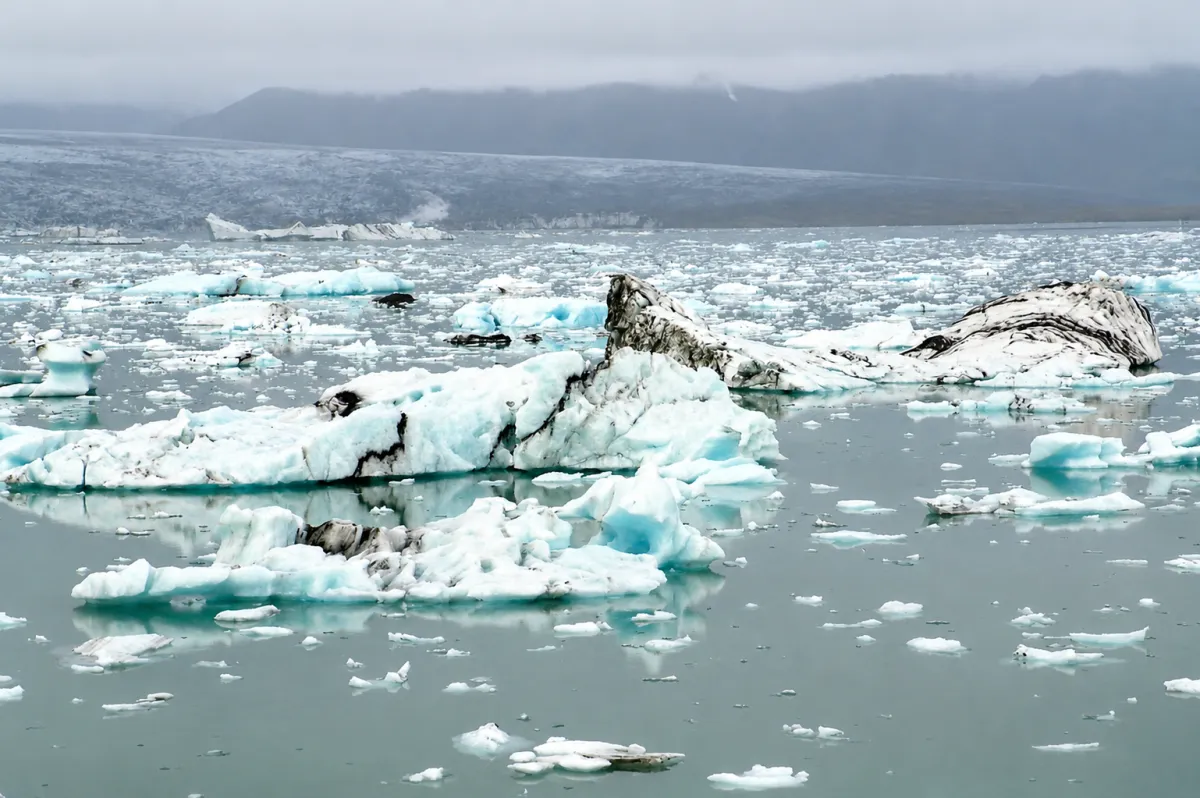
Glacial Lagoon
The lagoon was full of icebergs that had broken off from the massive glacier. Some were enormous, while others were small enough to hold.
We drove for miles with the ocean on our right and the glacier on our left. Then our GPS led us directly to our B&B tourist home. (Cloudy skies.) The facility had three bedrooms with a shared kitchen and bath, but we were the only guests. Breakfast supplies were provided in the kitchen for us to prepare on our own, and at 8 a.m., the lady brought freshly baked bread!
We told the lady about the missing bag, and she immediately got on the phone. It was at their small airport, so we quickly headed there to retrieve it. The first thing we did was take out the small hot pot and make some cappuccino! It went perfectly with the warm gingerbread.
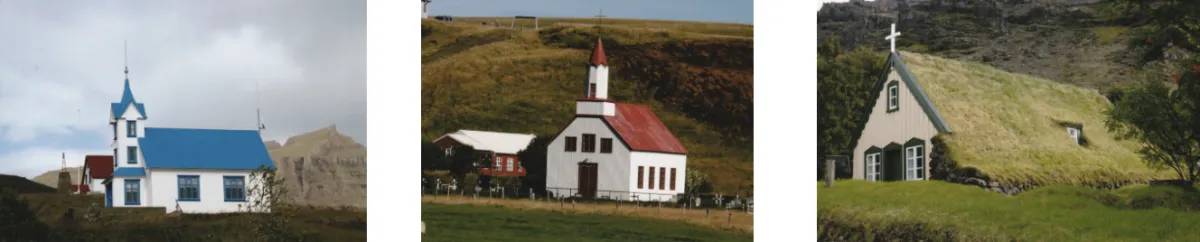
The national church of Iceland is Lutheran. The churches are very colorful, and some even have sod roofs. At our lodging that night, we talked with a couple who said they had seen brilliant Northern Lights two or three nights earlier. We hadn’t seen even a glimmer, and our nights in Iceland were almost over.
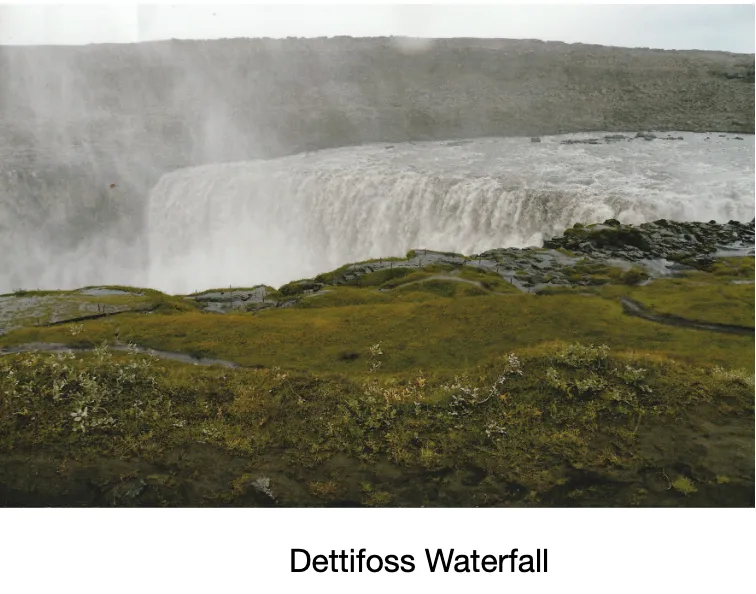
It was quite a hike to see Dettifoss Waterfall, the most powerful waterfall in Europe. With 200 cubic meters of water rushing through every second, it was crashing, roaring, and throwing mist high into the air.
Beautiful drive along the south coast, ocean, and fjords, and the weather was perfect. We entered a long, 3-mile tunnel through the mountain and then continued through miles of mountain scenery. Some areas were littered with piles of large lava rocks.
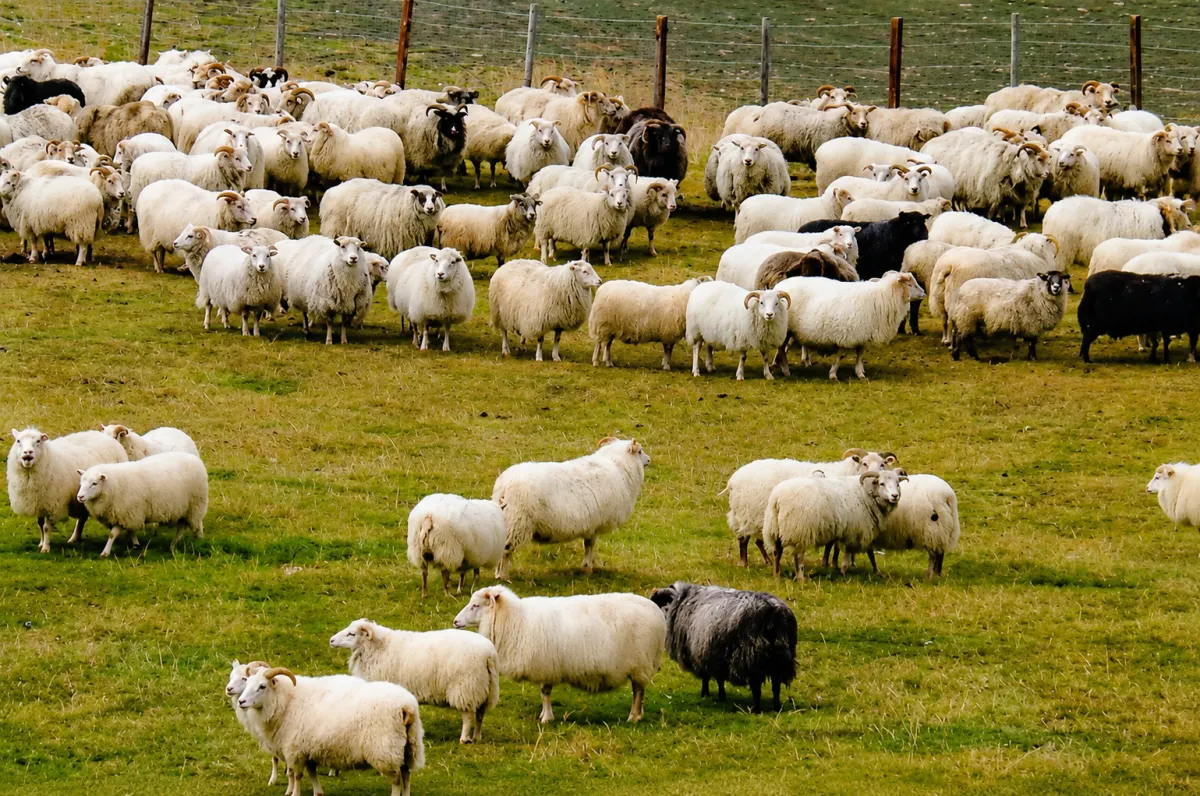
Icelandic sheep
Icelandic sheep produce very lightweight, warm wool. We happened to see a roundup of sheep. Three days are set aside each year for owners to gather their open-range sheep and bring them to a central location where they are sorted. Each sheep has an ID tattooed in its ear, and the owner claims it and takes it home. Meanwhile, there were hundreds of bleating sheep waiting for their owners.
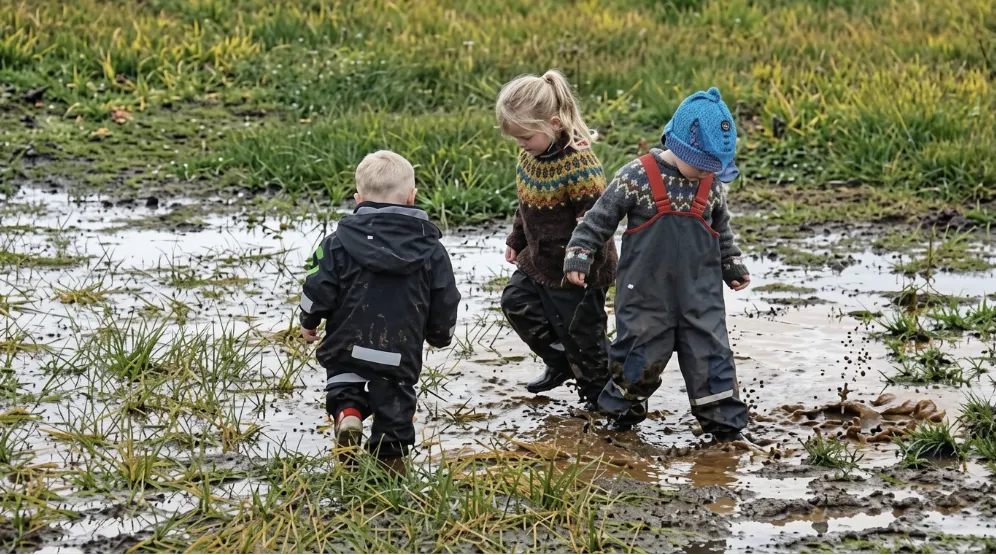
Children in the Puddles
As the parents were sorting out the sheep, we saw their children doing what all children love to do - splashing happily in the water puddles!
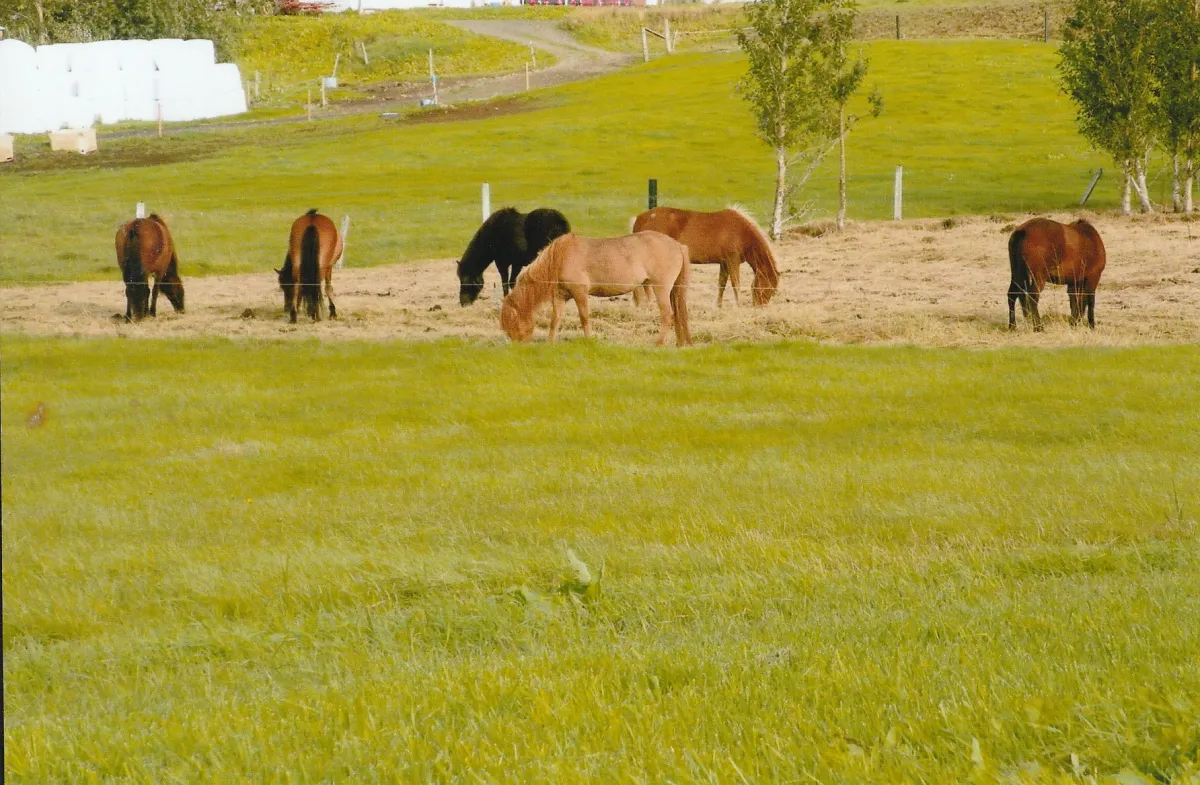
Icelandic horses are a unique breed, and strict measures are taken to prevent other breeds from entering the island.
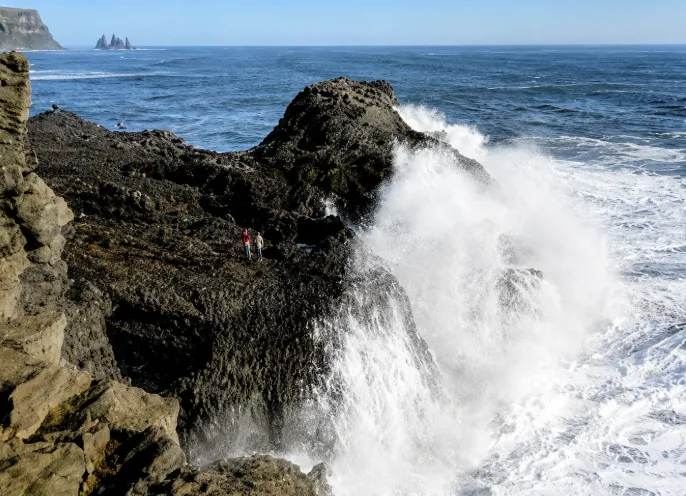
The weather was deteriorating, rainy and very windy! We found our room above a supermarket. We had our misgivings at first, but it turned out to be the nicest room of our trip. And it offered a private bath! Al went out to the car to put away our GPS, and the wind was rocking the car. We set our alarm for 11:30 p.m. to check for clear skies and Northern Lights, but there were only clouds. ☹️
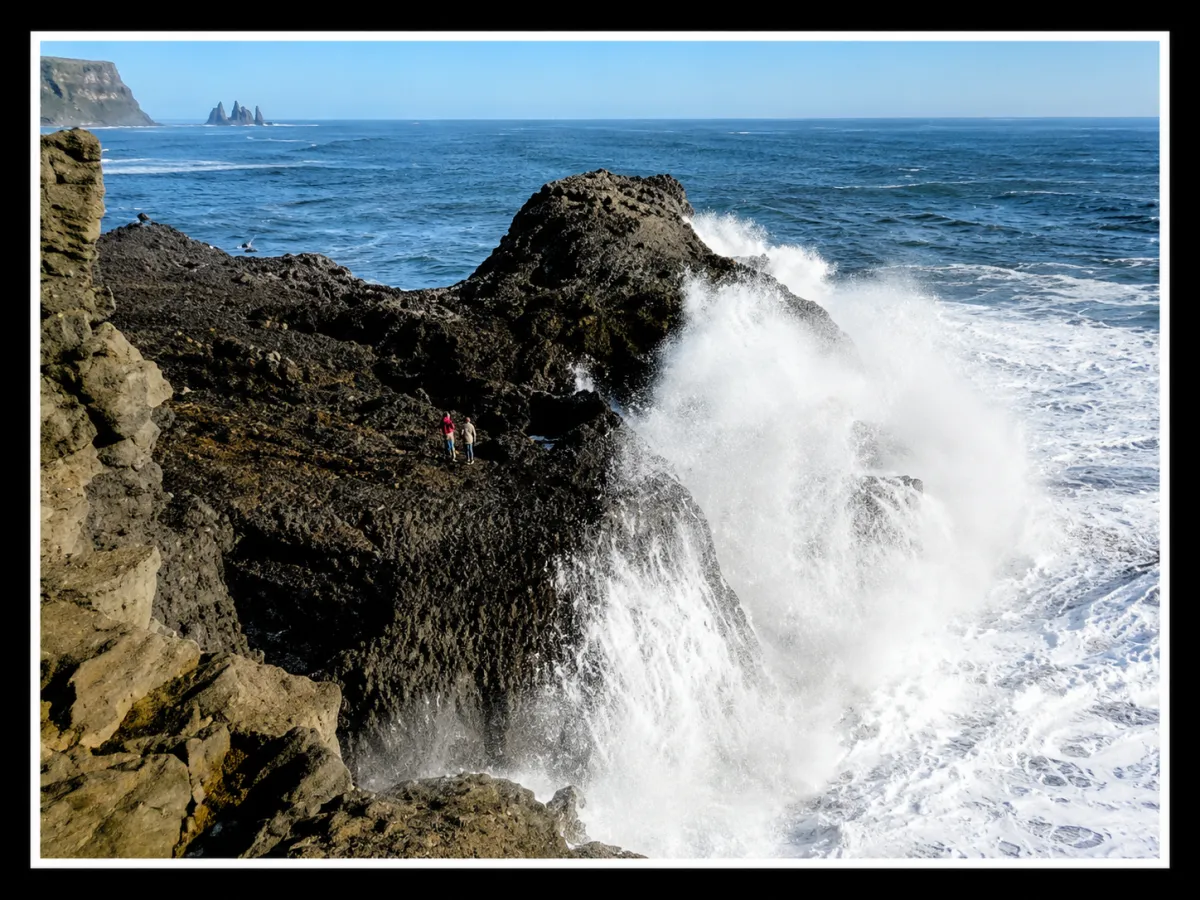
Breakfast was delicious, the best of the trip. It was still very windy. We stopped to take pictures of the crashing surf, dared to get out of the car, and had to brace ourselves against the strong winds (estimated at 50 mph). We heard that a storm was moving across Iceland, bringing snow to the area we had just left. Many roads were closed, and driving was discouraged. We were glad we had made it out safely.
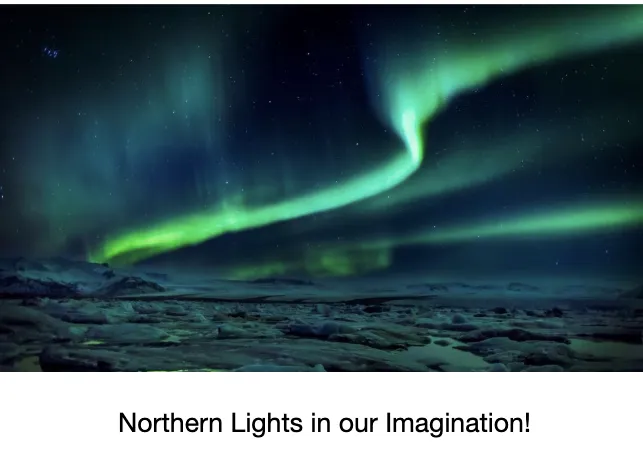
So we checked Iceland off our list of countries visited. It has a lot of raw beauty and is quite challenging. If only we could have seen those Northern Lights!
2013 - BOTSWANA - ULTIMATE SAFARI
For our 60th anniversary we decided to go on the Ultimate Safari with Overseas Adventure Travel. We had traveled with them before and knew it would be a great trip.
CHOBE NATIONAL PARK / BAOBAB SAFARI CAMP
We were escorted to our cabin #2. Crooked, wooden steps up to a rustic cabin; It was very nice and spacious inside with a king size bed draped with netting. A bathroom with a flush toilet and walk in shower. Our cabin had a little porch and we could sit there and enjoy the view. On the plains far below there were hundreds of animals; wildebeest and elephants.
After dinner, we were escorted to our cabin by one of the guards carrying a big stick. The whole area was open to the animals. It was very dark, and we were given big flash lights to light our way to our cabin.
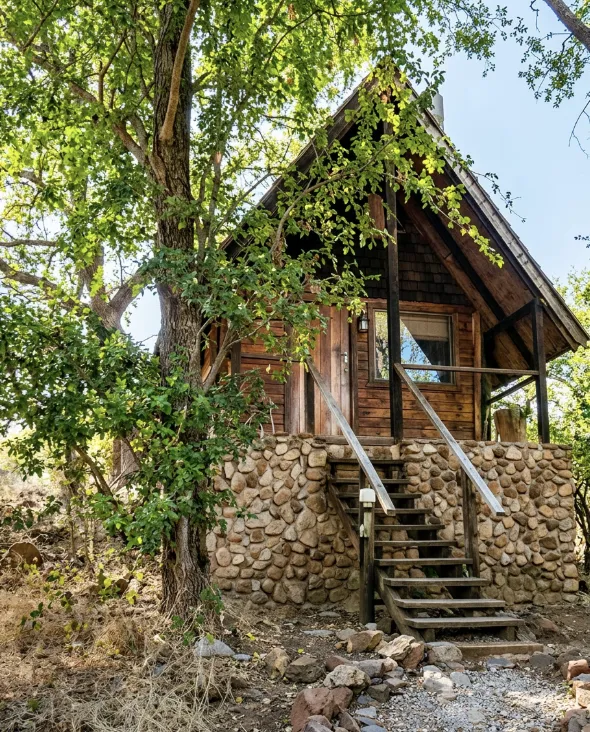
This is what we had been looking forward to for so long. Would we hear hyenas in the night? Or the roar of a lion? There was a big gong in our cabin that we could sound an alarm if we sensed danger.
We were awakened by drums at 5:30 - breakfast at 6:00. Others reported hearing a lion in the night and heavy footsteps of an elephant! Our safari vehicle was open sided with stair step seats. It was great viewing for everyone. The road was deep sand in places and very rough.
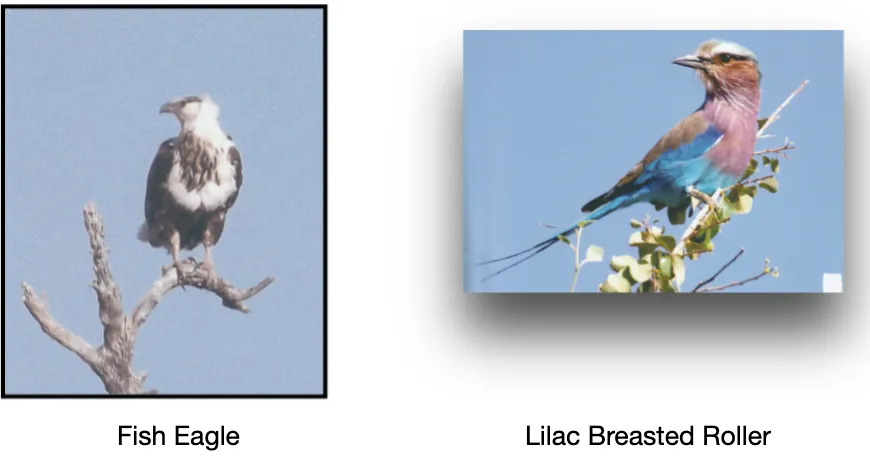
We saw a variety of birds including a fish eagle (they dive from great heights to catch their prey.) And a beautiful lilac breasted roller, the most common bird in Southern Africa. We saw elephants and kudu, impala, giraffe and more elephants..
By now it was time for morning tea and “loo in the bushes.” Men go this way - women that way. Then the driving crew got out big pots of hot water for tea and a little goodie from the kitchen. Stretch your legs and climb back in.
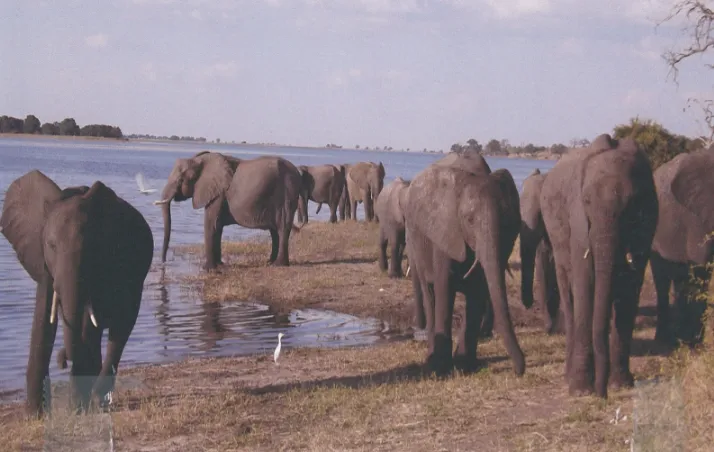
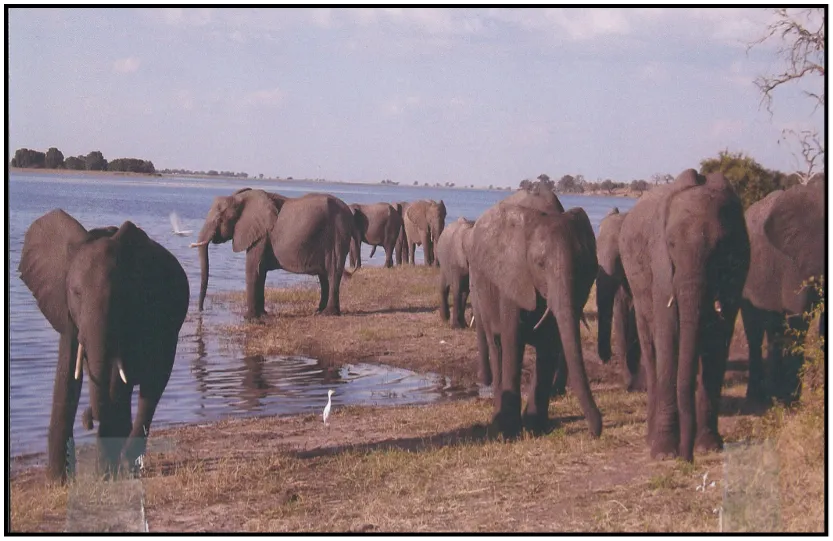
The afternoon drive took us to a favorite watering hole for the animals. The driver positioned our vehicle and here they came - a big herd of elephants! They filled their trunks with water and sprayed it all over. Little baby elephants imitated the older ones.
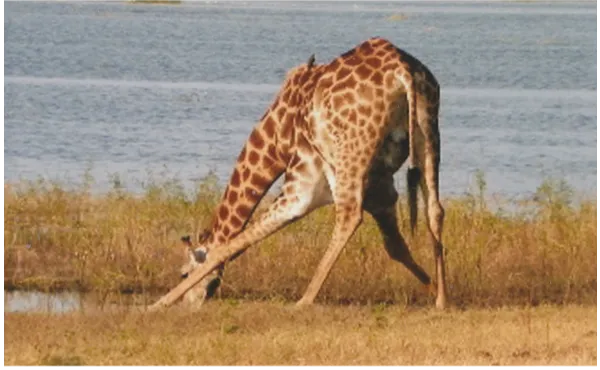
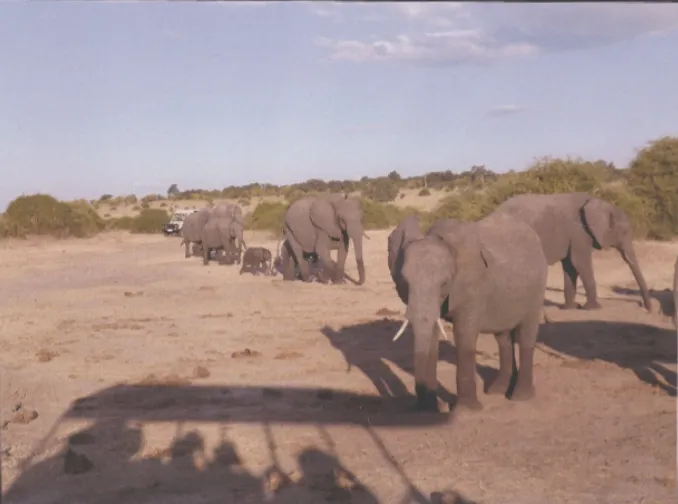
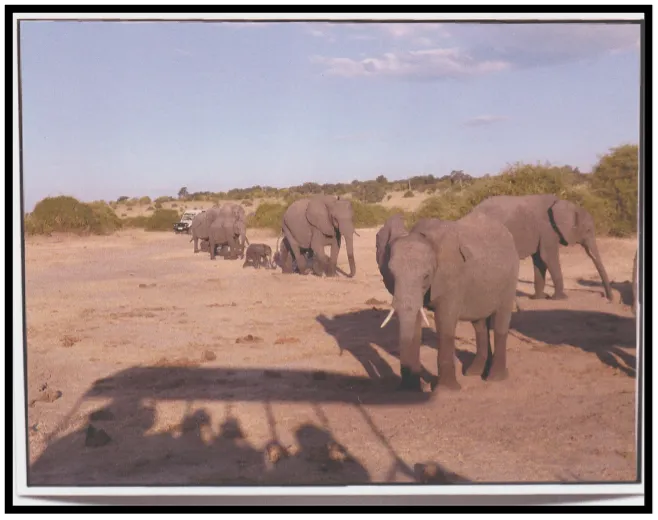
We were very fortunate to get a picture of this giraffe drinking. He is very cautious because in this position he’s very vulnerable. But this is the only way he can reach the water. Then we saw this herd of elephants marching right toward us. When they were 10 ft. away, they veered off. You can see our shadow. It was exciting and a little scary.
That evening we had a traditional African braai (barbecue) inside a boma (round enclosure with open fire in the middle.) Girls came around with a pitcher and bowl and poured warm water over our hands. Then a bowl of soup and a warm roll. There were no utensils - we used the roll to scoop up the soup. We did have utensils for the main meal. Then a surprise birthday cake for Samantha, our guide. She’s 47 years old and this was only the second time in her life that her birthday was celebrated!
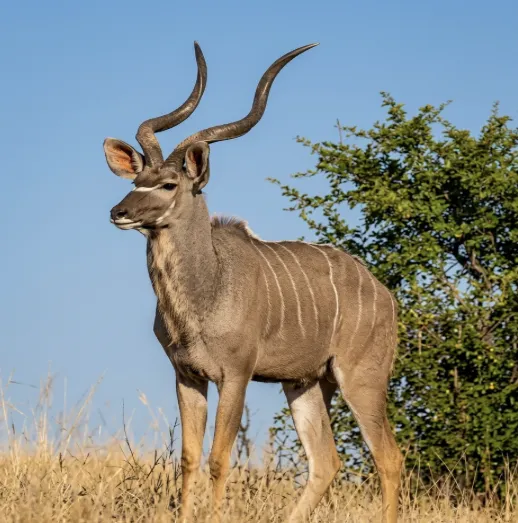
The next morning was another exciting day. We saw a great variety of animals: sable antelope, giraffes, kudu with its beautiful curved horns, and then more elephants. Our guides were great at identifying birds - plover, egret, heron, cormorants and Ibis. Then a lion under a tree, trying to sleep. We had a picnic lunch with a yellow bellied bulbul sitting in the tree above us watching for crumbs, while vervets had to be chased away.
OKAVANGA DELTA (BOTSWANA) / WILDERNESS TENTED CAMP
We flew in a 12-seat Cessna to this new camp. Two jeeps were waiting for us at the airstrip. Our camp featured long, elevated walkways connecting the lodge with the tent cabins. This was to discourage animals from getting too close.
We had the usual briefing and then a chance to use the “loo with a view.” A big open window looking out on the plains (and animals). Our tent/cabin was very private - no other tents in sight, just tall grass, small trees and bushes. A little path was used by people and animals.
As I sat on the small veranda, listening to the birds and writing in my journal, suddenly an elephant walked right past me!
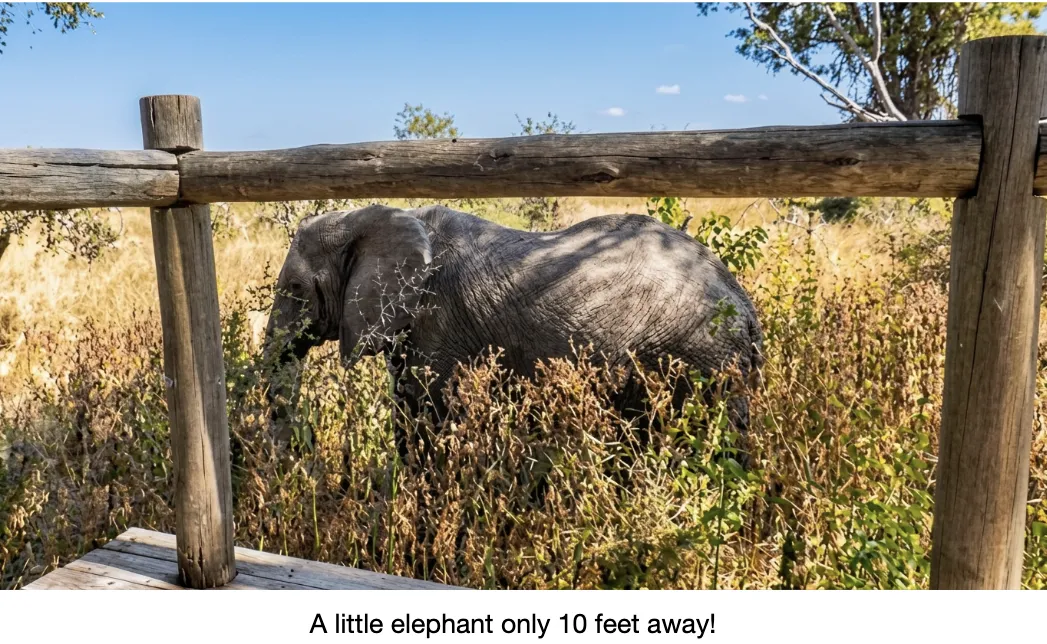
He was silently walking through the tall grass, about 10 feet away! I grabbed my camera and got a quick picture - it was very exciting!
The Okavango Delta forms each year as the rains in Angola to the north send water down the dry creek beds. The delta gradually fills with water, but never very deep. When the rains stop, the water gradually seeps back into the soil.
We were there when the delta was just right. The water was only 3 feet deep.
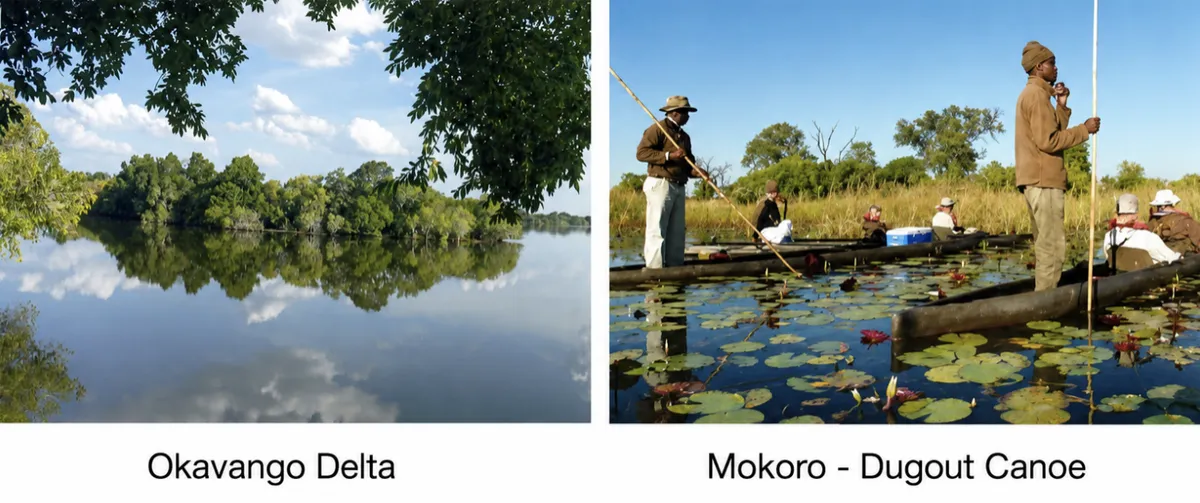
We were looking forward to a mokoro ride and it proved to be one of the highlights of our safari. After a bumpy ride through the deep sand, we arrived at the water where the mokoros and polers awaited us.
A mokoro is like a dugout canoe. We sat on 2 seats on the bottom of the mokoro with the poler standing behind us. The poler was very competent as he poled us through the shallow water. We relaxed and enjoyed the incredible experience. We glided through the reeds and water lilies almost silently.
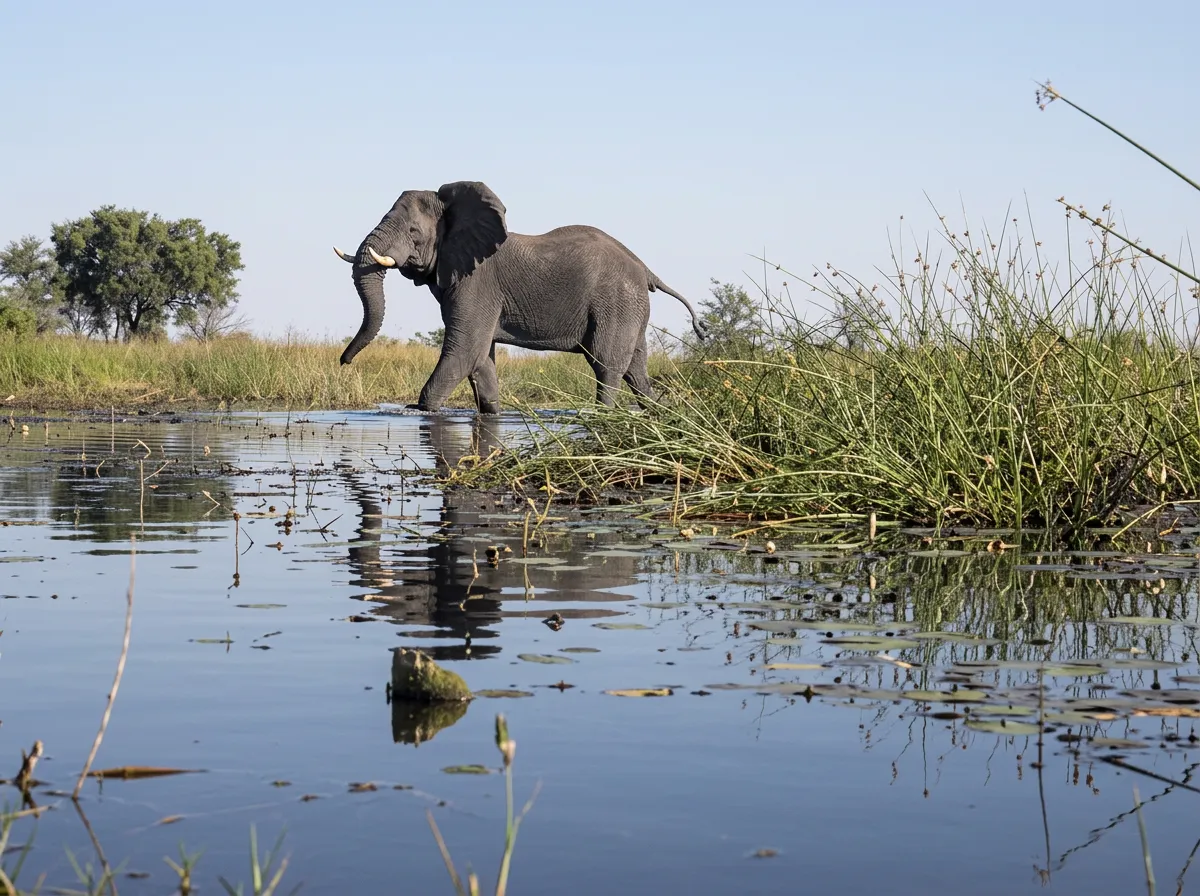
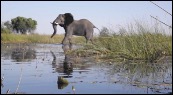
Then elephants were spotted approaching the water. We stopped and waited and watched and took pictures! It was a memorable experience to see them splashing through the water to get to some trees on the other side. Then our mokoro docked on a little island and of course it was teatime.
Morning game drive - We saw this LEOPARD, and her cubs were in the bushes eating an impala. Then the mother got up, sauntered slowly past our Jeep and quickly climbed a tree.
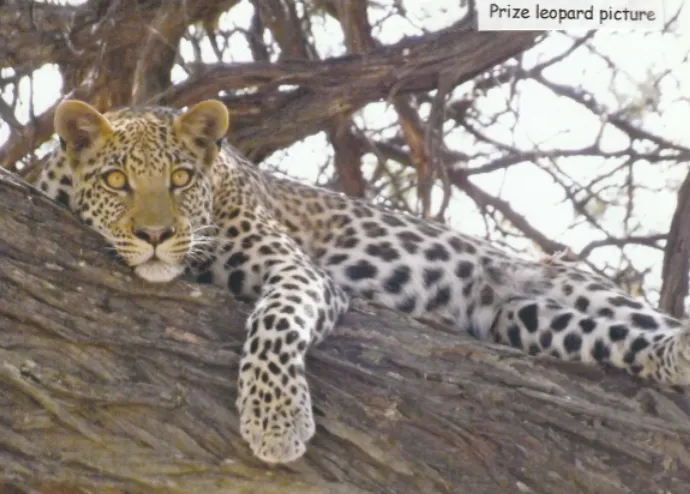
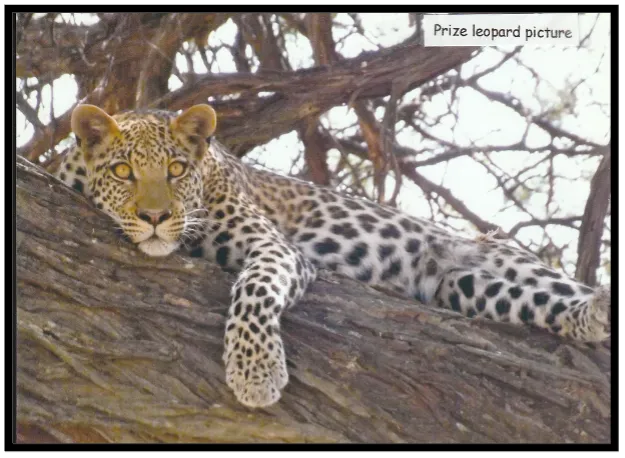
She laid there on a branch in the classic pose while we took many pictures. It turned out to be one of our prize pictures.
That evening the workers entertained us with singing and dancing. Then we were supposed to do something for them. Fortunately, a young man in our group volunteered his services. None of us had any idea what he would do.
It turned out, he was a professional magician!! I wish I could describe the magic trick he did - it was impossible, but he did it.
It went something like this: he got all the workers involved. He tore a corner off a playing card, then had a young man hold the card. The workers were holding a long string that went from the card holder to the last man.
Then the last man was given an apple and a knife and asked to cut the apple open. Inside was the corner piece that matched the card.
The young men howled with laughter, rolling on the floor!! They were wowed and so were we!
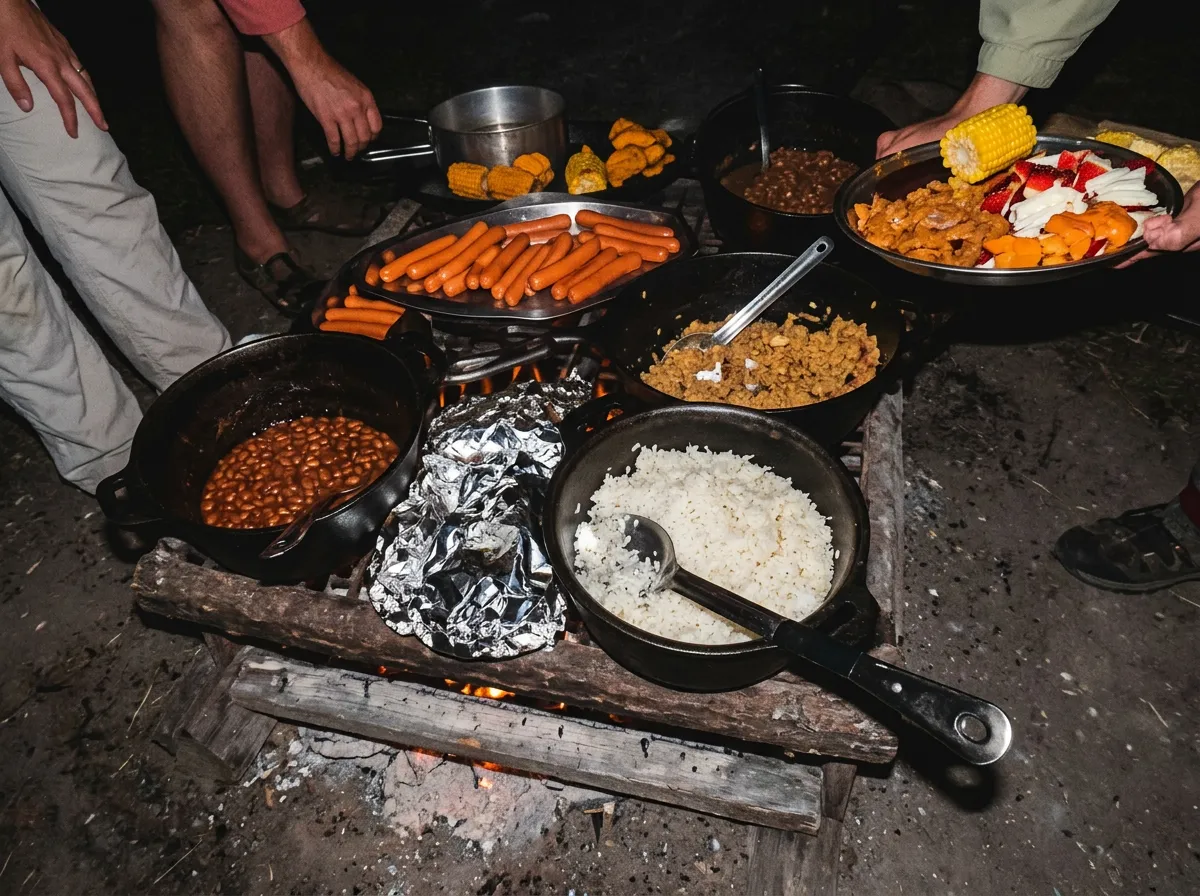
That was followed by a braai. Al was called up to explain the dish in English after they gave long, animated explanations in their native languages. He said it was “greeits” with an exaggerated southern accent and stole the show!
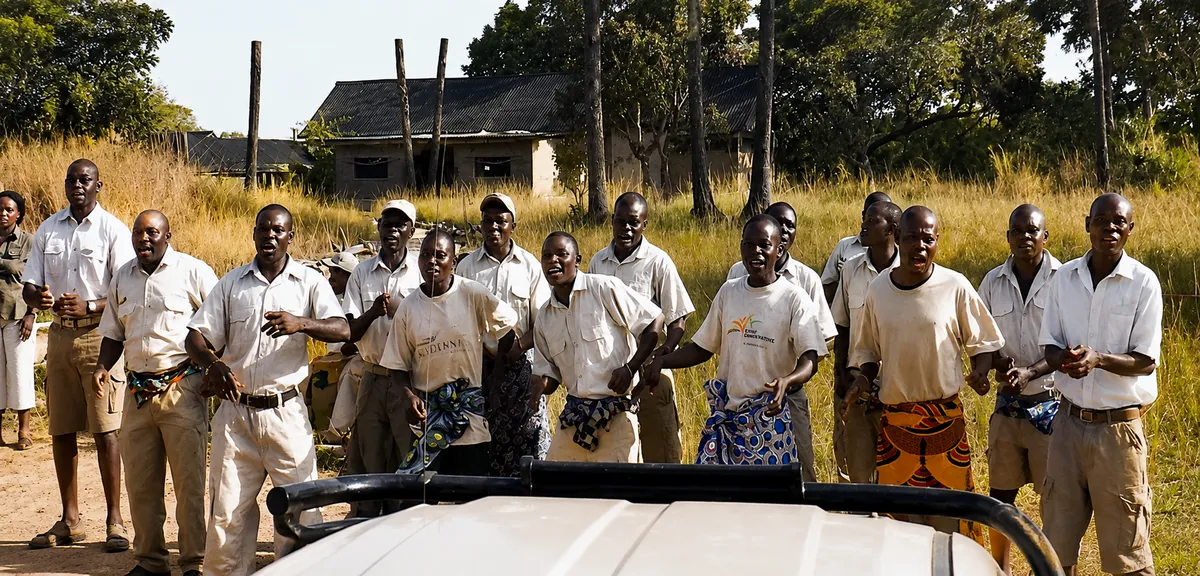
KAFUE, ZAMBIA & LUFUPA CAMP
We were greeted by a robust men’s choir - 18 men singing and harmonizing. It was a beautiful location right on the river, and blue sky, clouds and trees were reflecting in the river. It was a moment to remember!
Our driver guides were also trained and skilled at spotting and identifying birds of many species, and there were so many to observe!
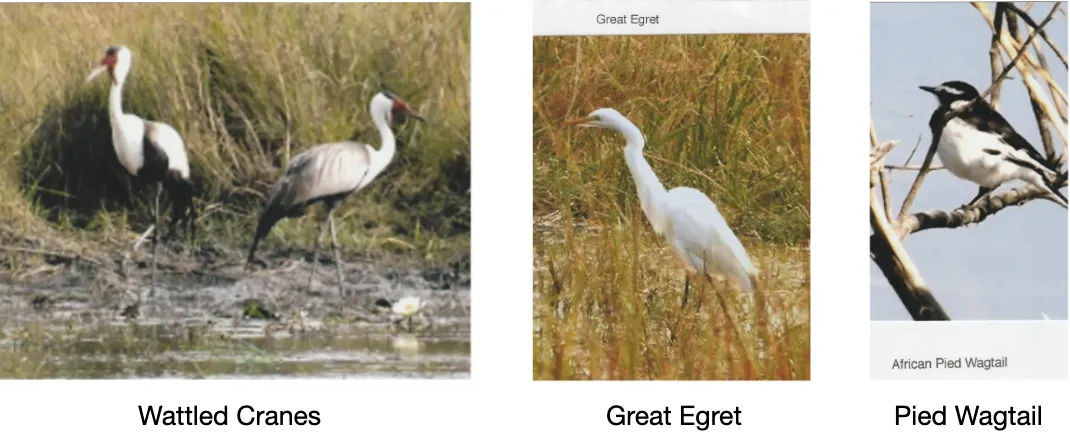
We saw Wattled Cranes, Spur Winged Geese, Gray Laurie, Cape Turtle Dove, Long Crested Eagle, Hamerkop, Great Egret, Cormorant, Red Billed Francolin, African Pied Wagtail, Goliath Heron, Fish Eagle, Pied Kingfisher, Great White Egret, African Darter, Bee Eater, and others.
We have pictures of each of them, of course. Here were some of our favorites: Wattled cranes, Great Egrets, and African Pied Wagtails.
Tsetse flies were a big problem in some areas of Kafue. They were as big as horse flies and the bites really hurt!
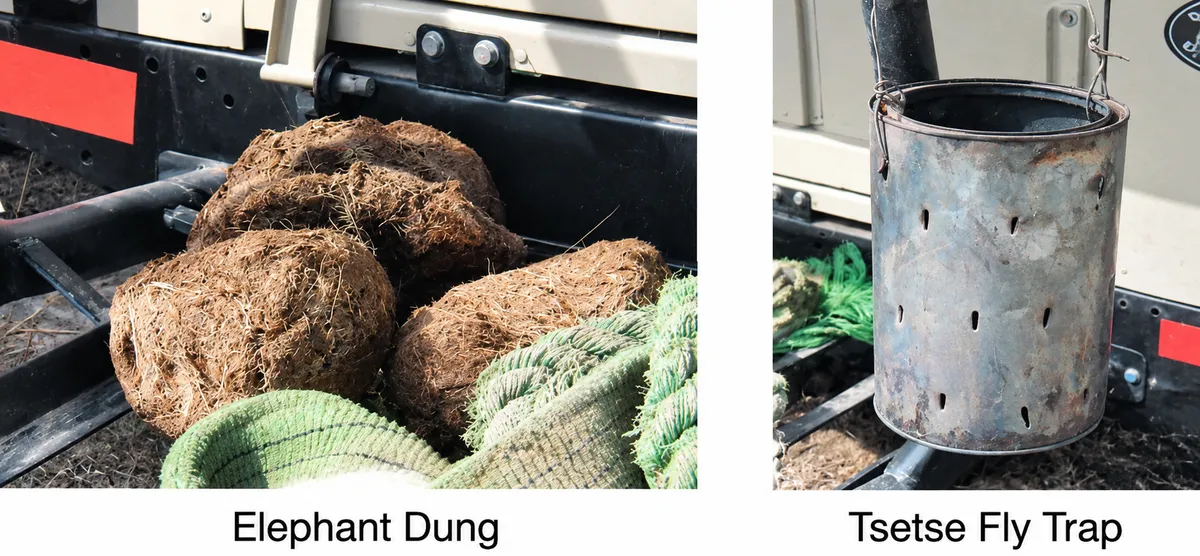
Here is the solution. Collect clumps of dry elephant dung, put them in a tin can with holes, hang the can on the front or back of the jeep, light the fire and the smoke keeps the flies away. Ingenious, right? You want to find some tsetse flies and try it out?
Here is the solution. Collect clumps of dry elephant dung, put them in a tin can with holes, hang the can on the front or back of the jeep, light the fire and the smoke keeps the flies away. Ingenious, right? You want to find some tsetse flies and try it out?
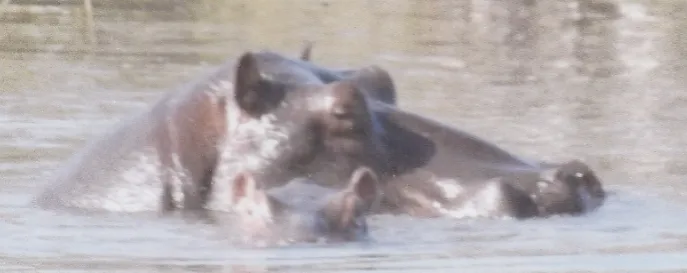
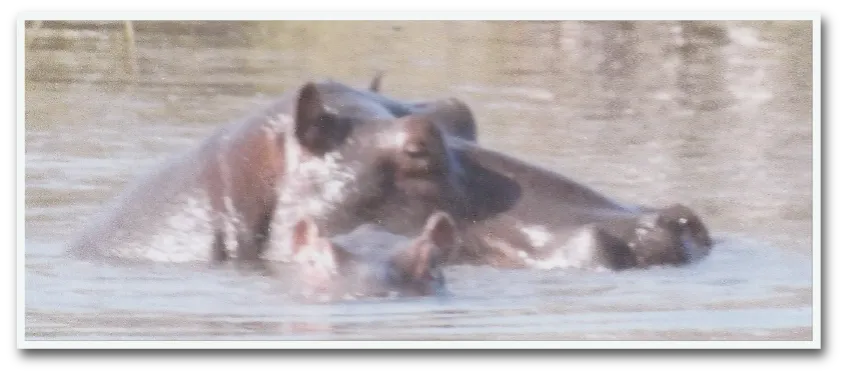
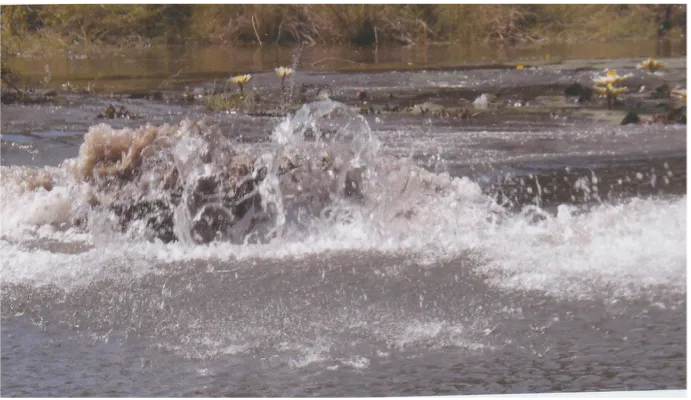
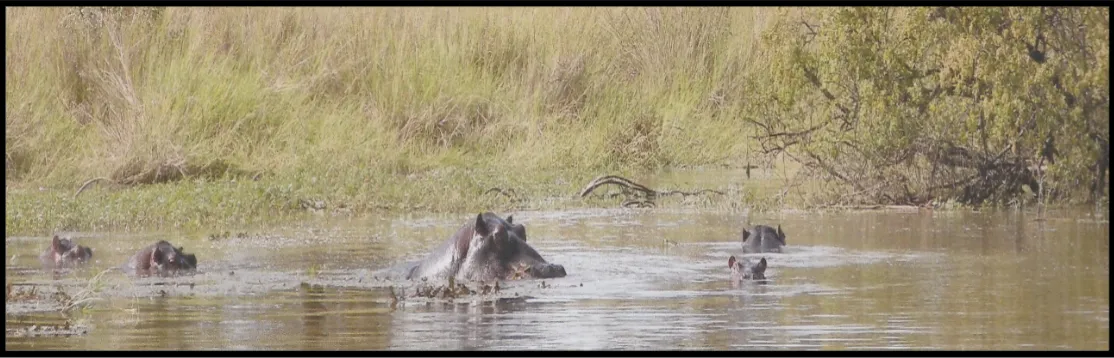
Suddenly, with a mighty splash one of them charged into the water and chased us. The boat went into full power and outran him. It was quite a scare!
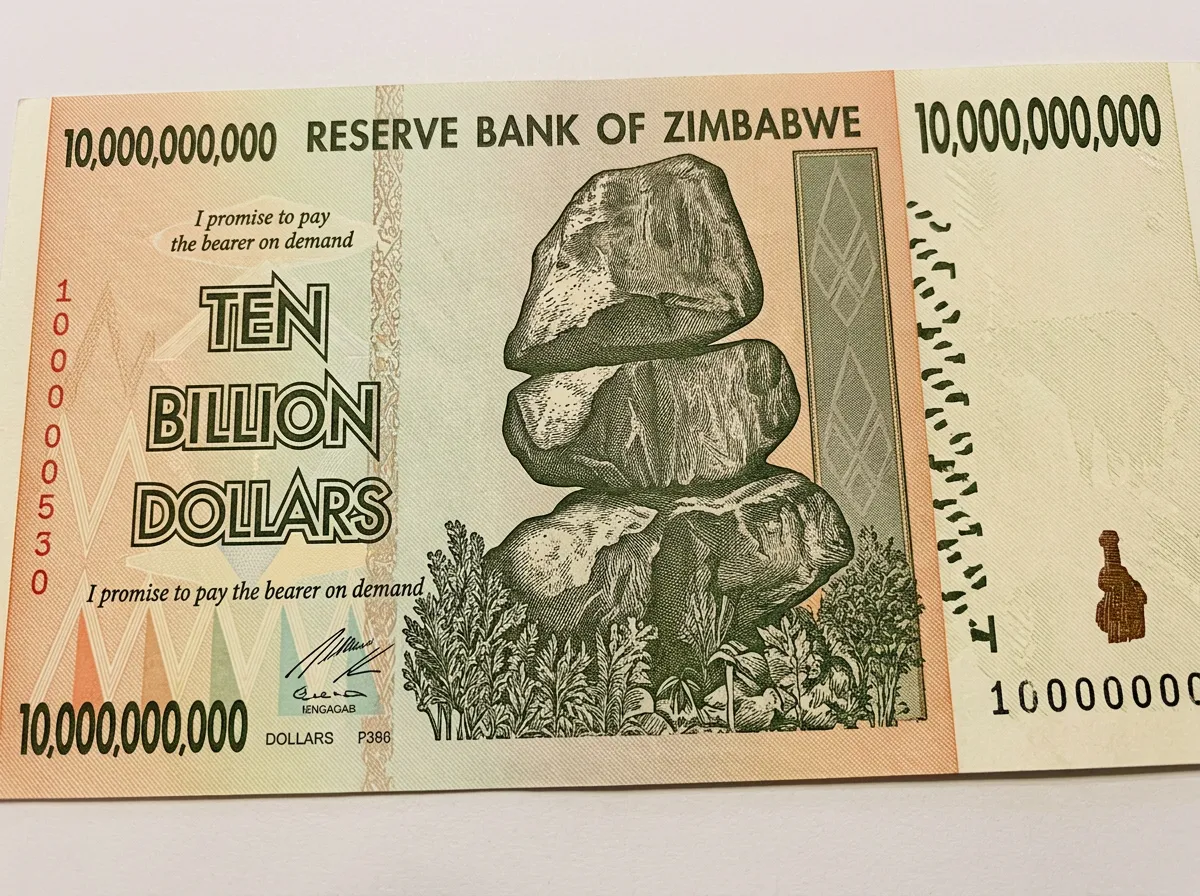
It was time to move on again. We crossed the border from Zambia to Zimbabwe on the Victoria Falls Bridge and went in a grocery store to buy a candy bar. They had no coins to make change.
They use U.S. currency now because their money is worthless.
Boys were selling these paper currency bills on the street as souvenirs. This Twenty Billion Dollar bill was worth virtually nothing.
LINKWASHA
We landed at the airstrip for Linkwasha camp. A “Bush Terminal” offered shade and cold drinks from a cooler. Then we rode in a jeep, for an hour over the deep Kalahari sand to the camp. Our rondavel was very nice featuring a 4-poster bed with netting, towels on the bed were made to look like elephants, a bathroom with a big walk-in shower, and an outdoor shower. It was enclosed in a way that gives privacy but was still open to the savannah and animals. We had tea time on the veranda with samples of typical African food including mopane worms, deep fried, crispy and quite good (so they say.).
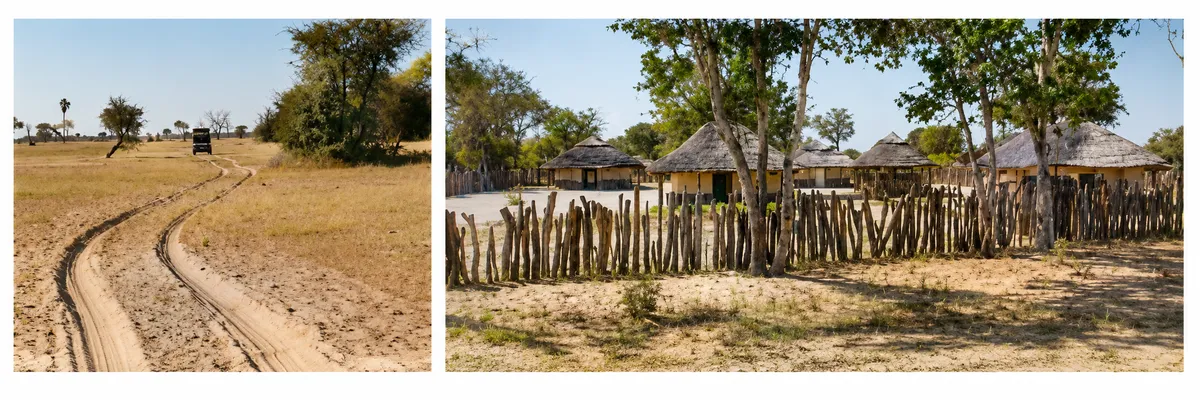
We drove on this public road to visit a nearby village. The village was typical, with a fence made of long poles to keep the wild animals out.
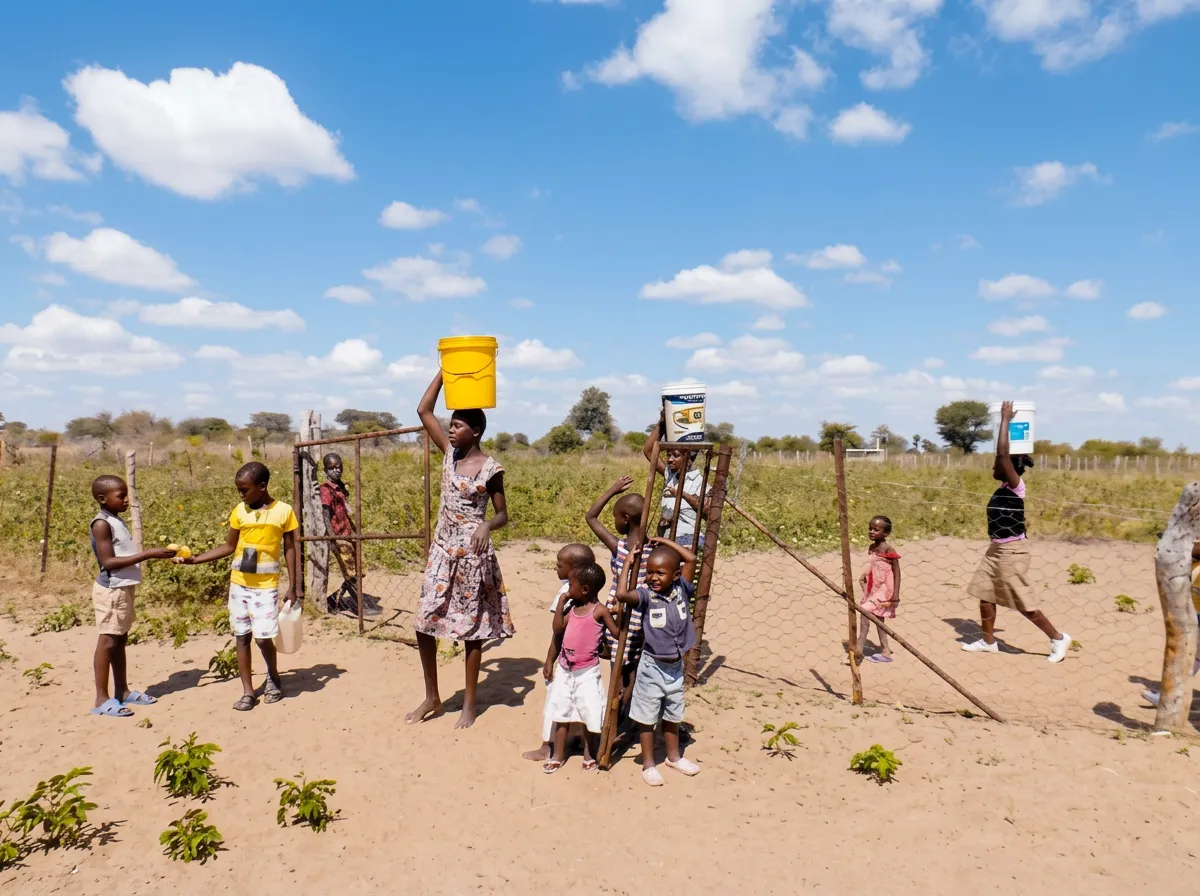
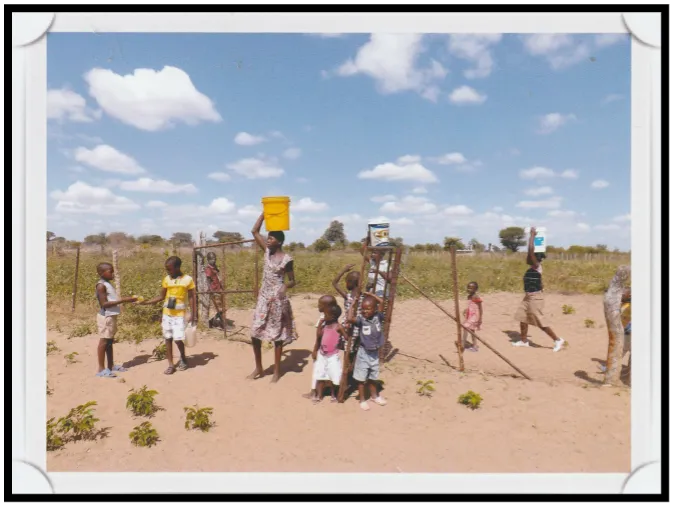
The community well was a gathering place for women and children.
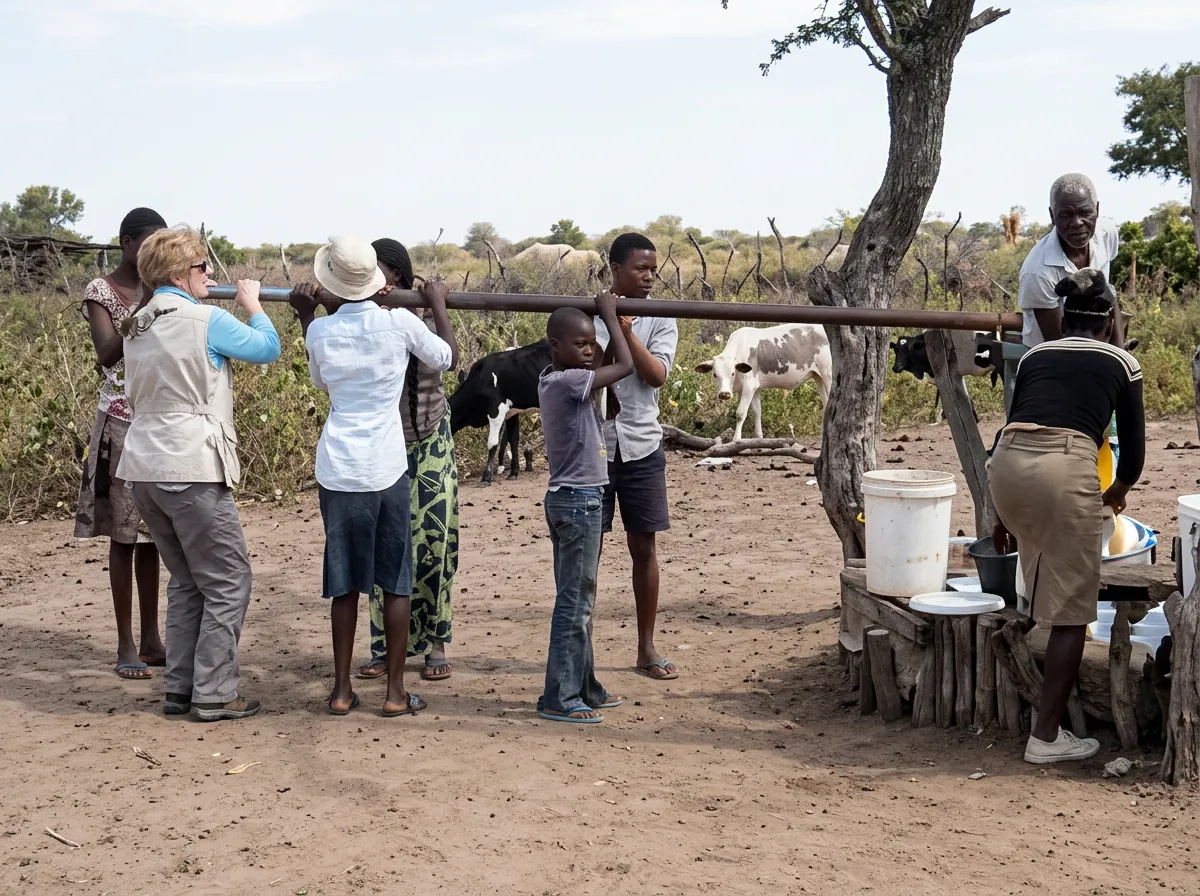
The community well was a gathering place for women and children.
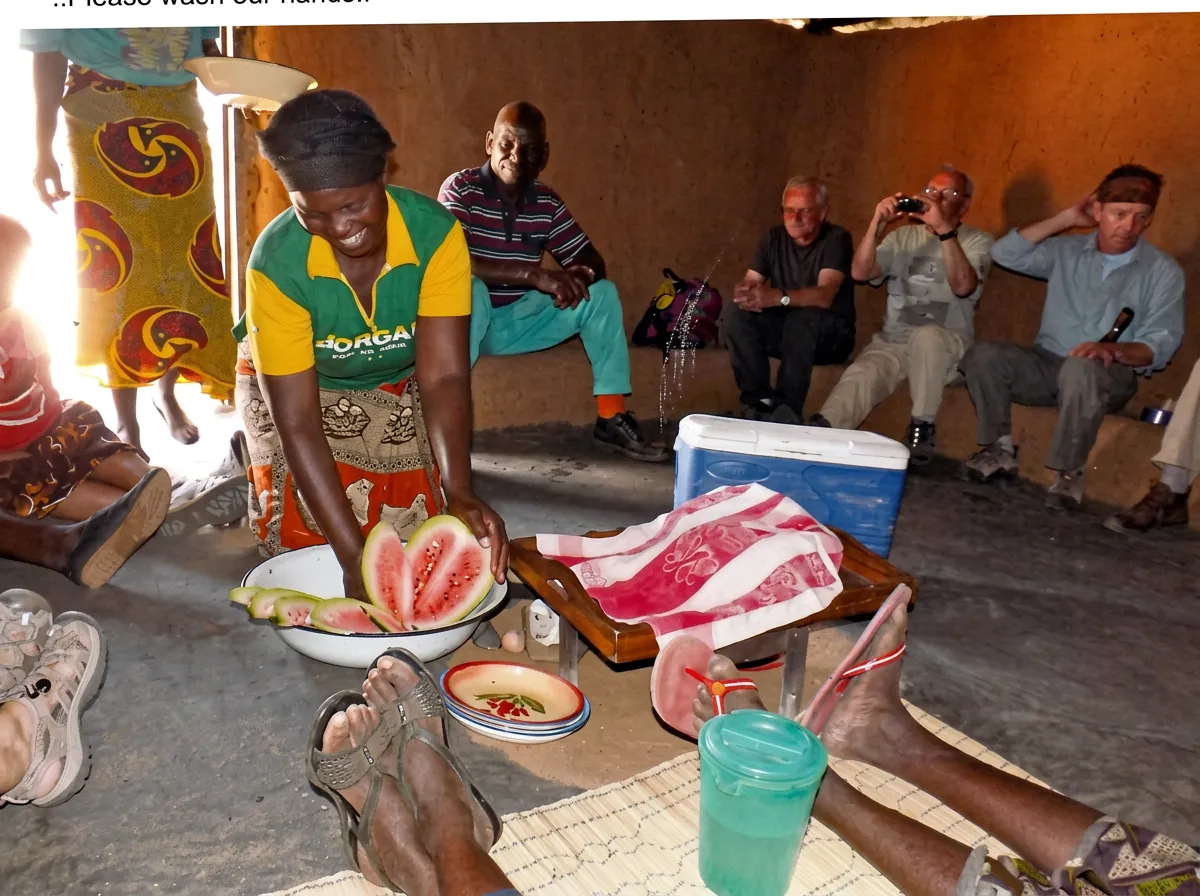
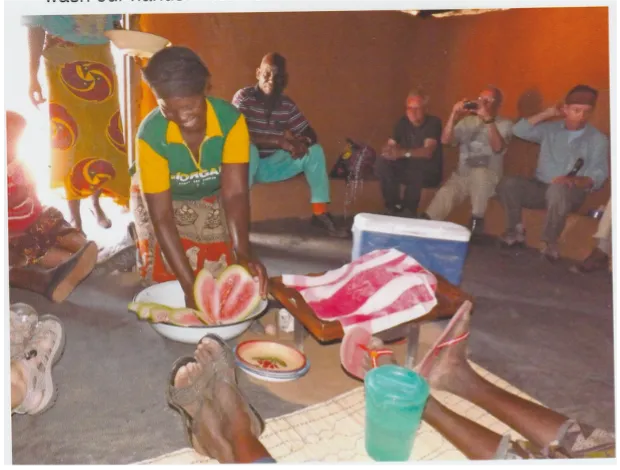
We were invited into the home of the village chief. The men sat on one side of the room, the women on the other side. He told about life in the village, the set of rules they have, the food they eat. Their diets are very limited, but they seem healthy. We asked him how far he had been away from home and he said the next village. That’s about 10 km.
One of the wives brought a basin of warm water and a dry cloth to each of us. Then another lady served watermelon.
Quite an interesting glimpse into life in another world.
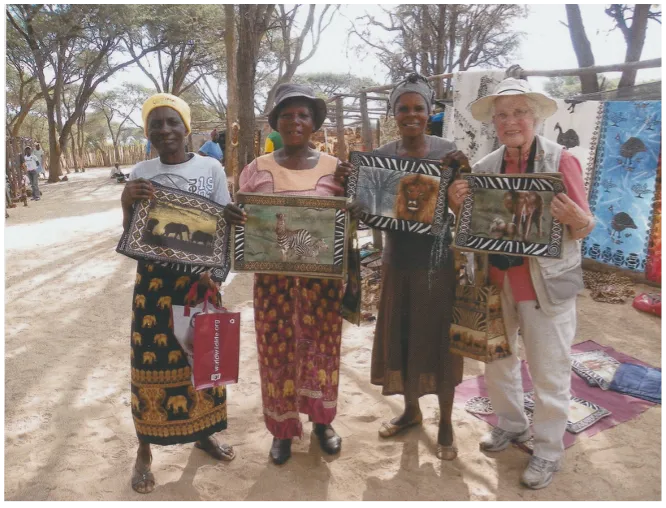
These ladies had placemats for sale, just what I was looking for!
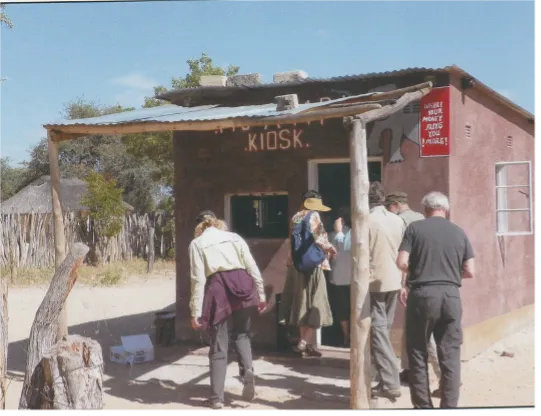
This kiosk sells just the basics like flour, oil, bread. They drink milk from the cows they raise and that is also their source of meat.
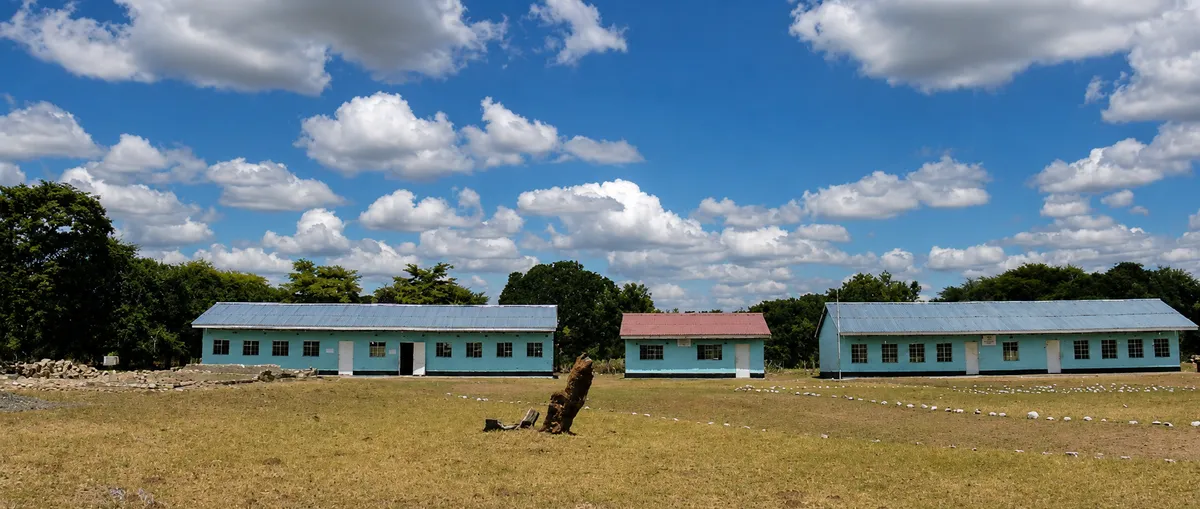
Grand Circle built a very nice school for this village. The children were eager to show us their songs and dances.
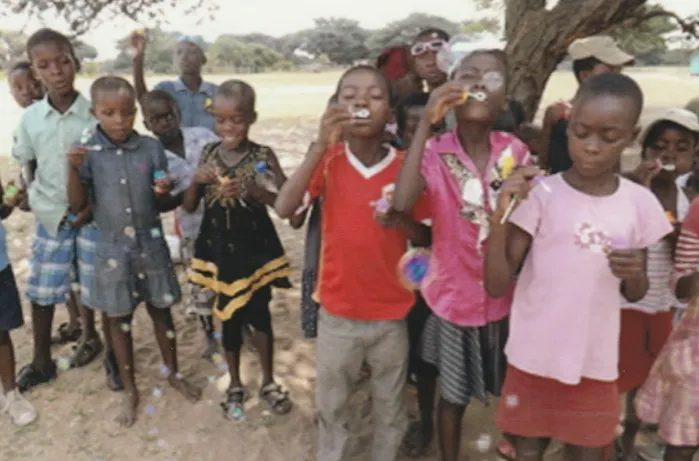
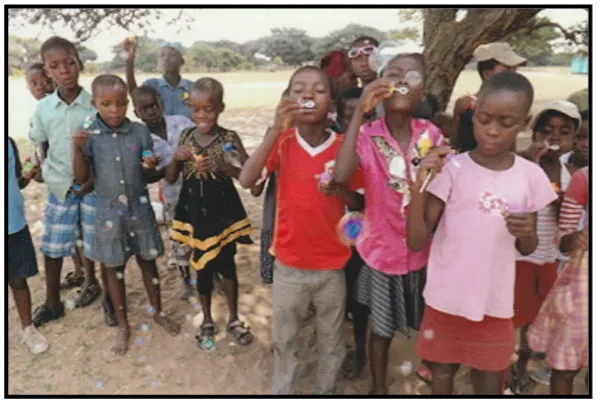
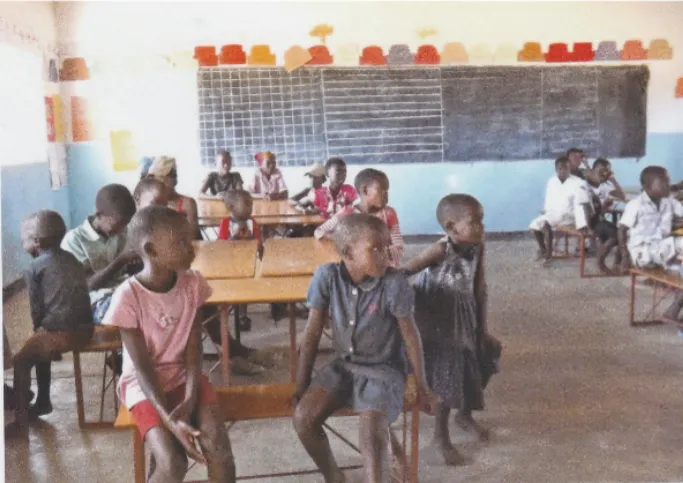
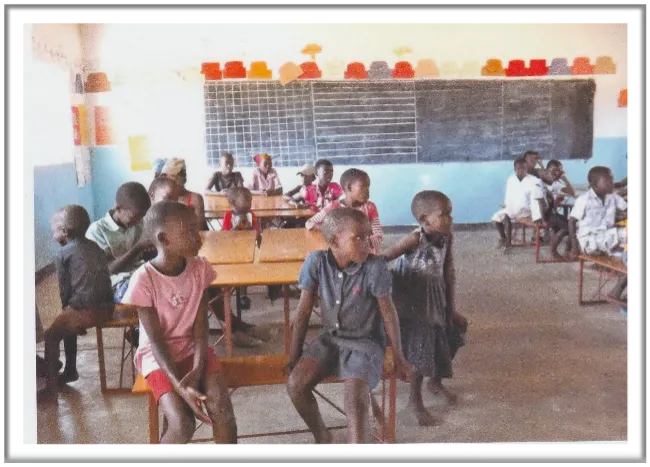
They also tried to teach us some of their letter sounds. We did not do very well. We brought bubbles for all the children. At first, they didn’t know what to do with them, but they soon caught on.
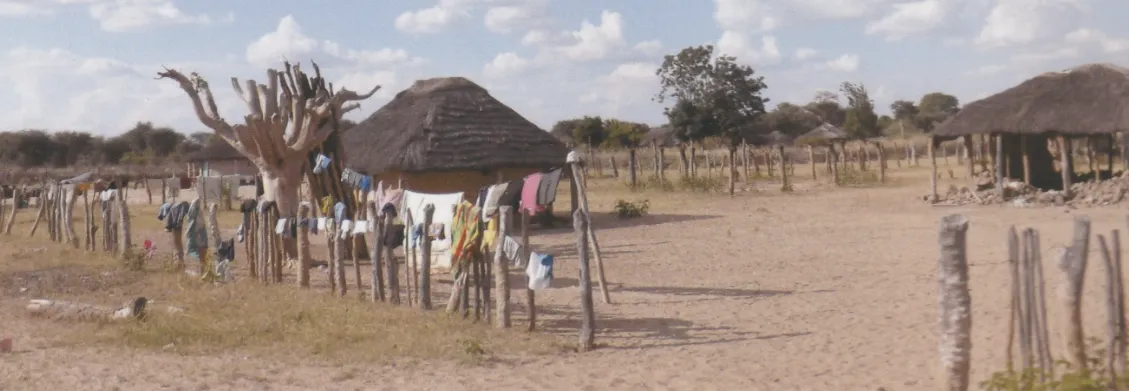
Another world with happy peaceful people.
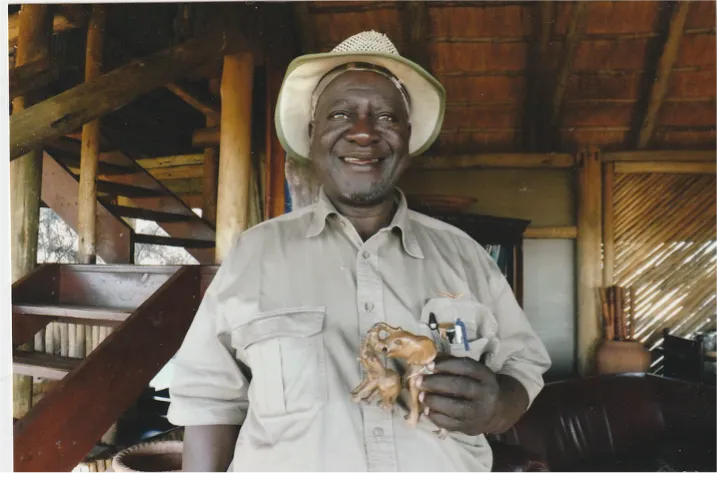
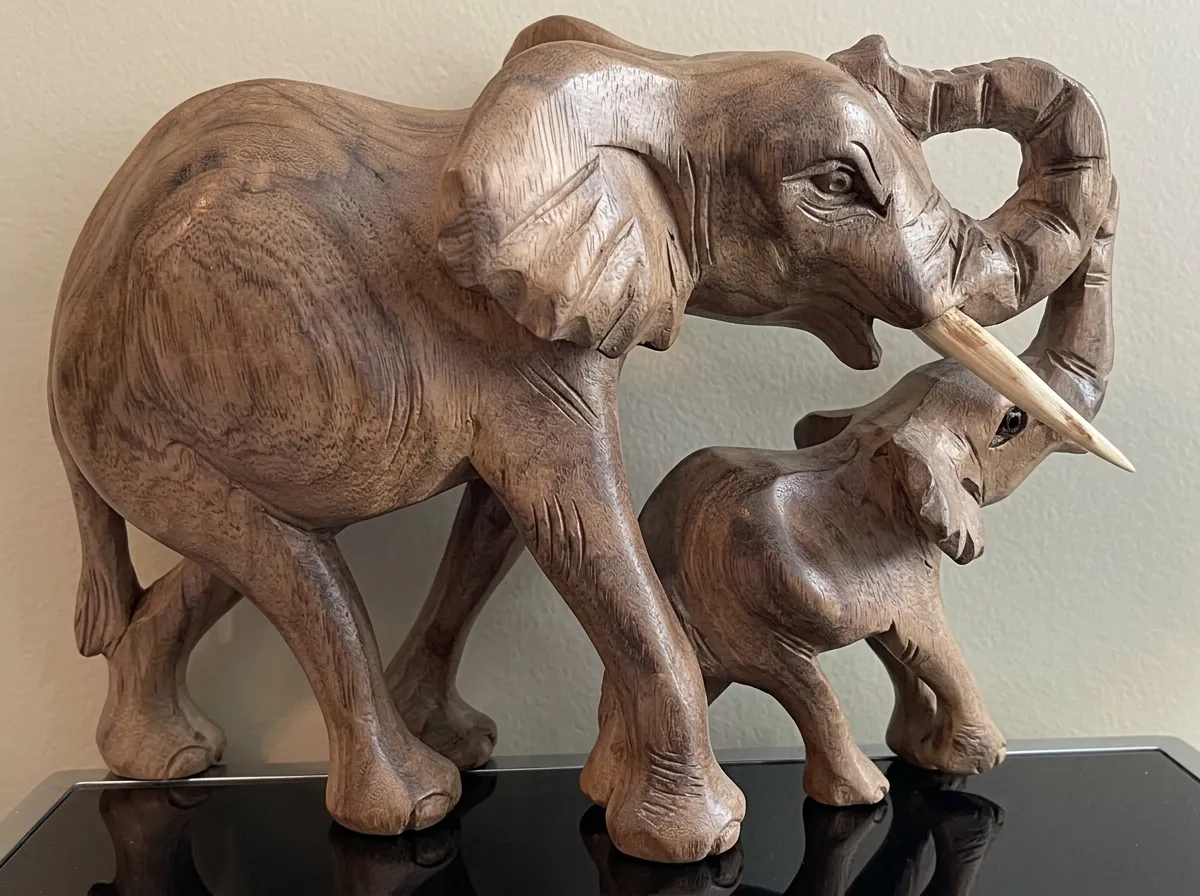
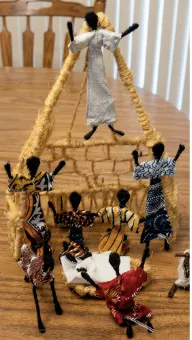
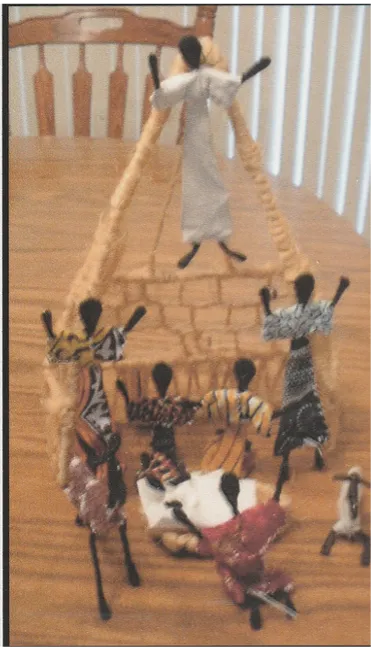
Mafuka, our driver guide, was also an expert wood carver. He carved this elephant and baby out of “white syringa wood” and autographed it for us. Another work of art is this manger scene, crafted by someone in the village near our safari camp. It is made from scraps of cloth, wire, sticks, thread and bits of twine.
It was time for our last morning game drive, and our driver knew just where to find a pride of lions!!!
He parked the land rover in a good photo position, and we took nonstop pictures and video for 30 minutes.
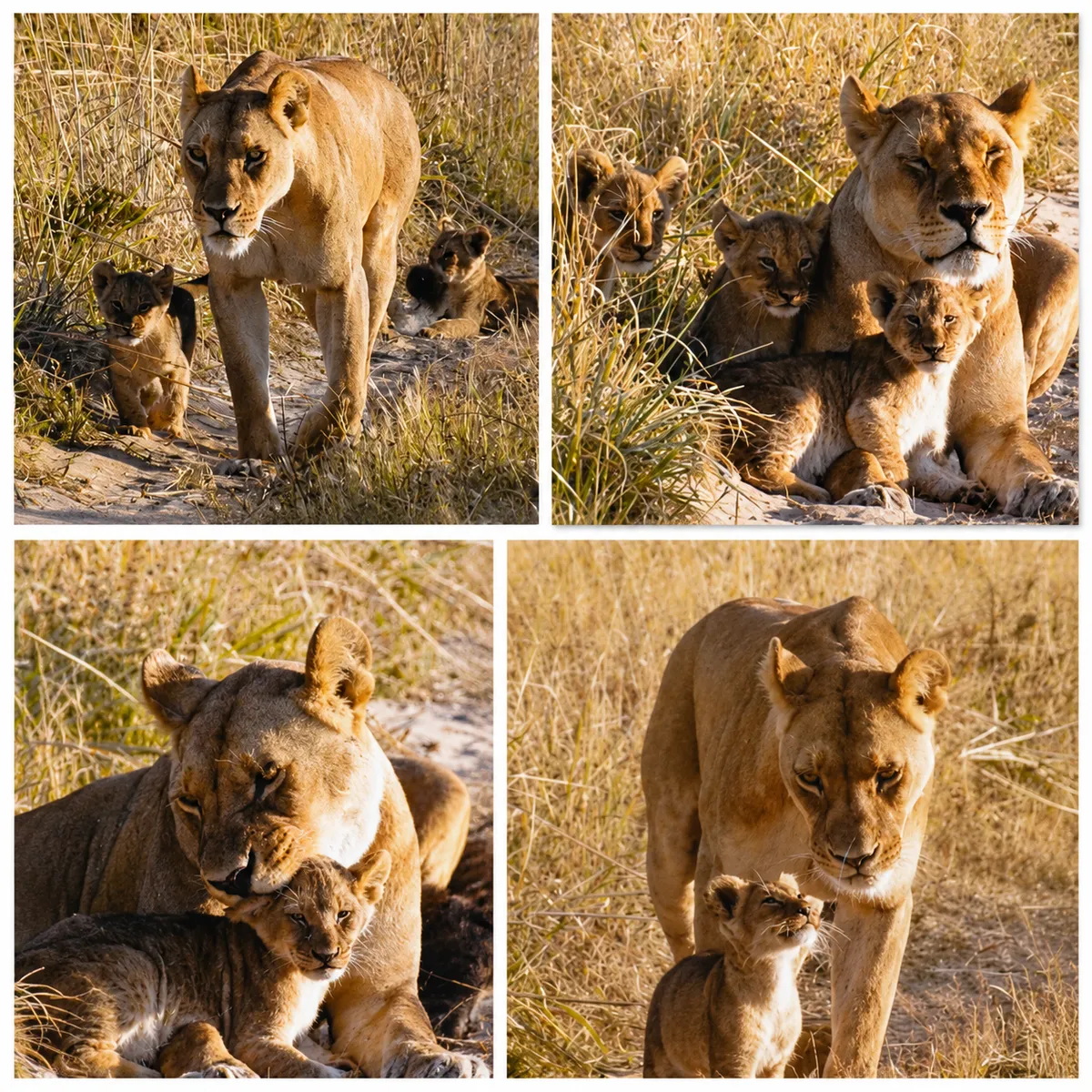
It was almost too good to be true, and it was certainly a grand and glorious ending for our safari!
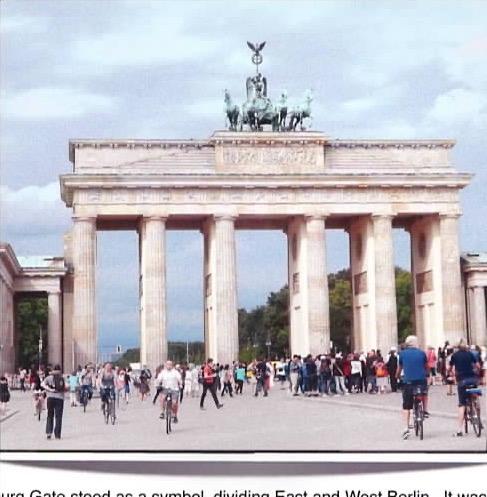
BERLIN
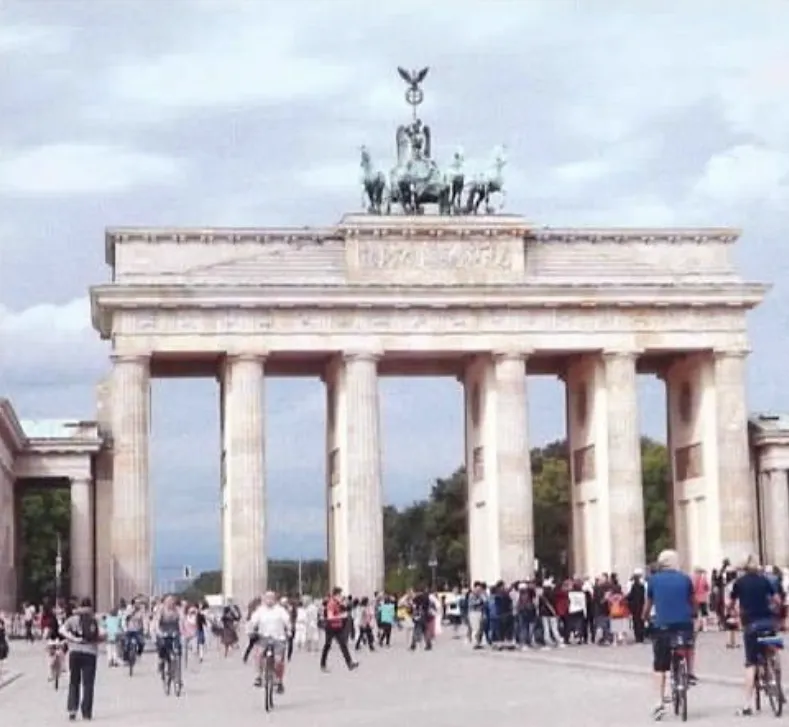
This beautiful city had once been laid in ruins and has now been restored to its former beauty. There were still a few remnants of the war left as reminders. A city bus tour took us to all the major points of interest, with our guide filling in many details. We saw Checkpoint Charlie, crowded with tourists trying to get pictures, the Holocaust Museum, and Unter den Linden Boulevard lined with beautiful, full-grown linden trees. They had all been destroyed during the war.
Most impressive was the Brandenburg Gate, which, fortunately, was not damaged. The gate was built in 1791 as a Peace Gate. In the years leading up to World War II, it became a party symbol. Following the war, it symbolized the Great Divide. Later, it became part of the Berlin Wall during the Cold War. West Berlin was isolated by the wall, and those who tried to escape were often shot. It became the site of many rallies and speeches.
On June 12, 1987, President Ronald Reagan gave his famous speech: “Mr. Gorbachev, tear down this wall. ”Five months later, the wall was torn down by jubilant Berliners. The speech was written by Peter Robinson, who grew up in Vestal, New York, where we lived. He attended school with our boys, and we remember him well.
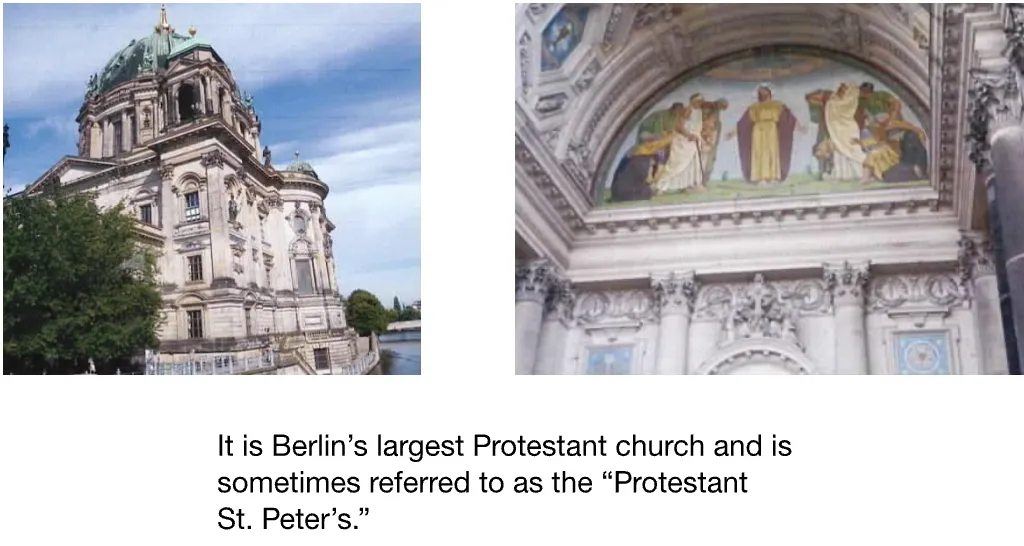
BERLINER DOM
This cathedral was destroyed during the war and then completely reconstructed to match the original.
We enjoyed walking through this vibrant city: trolleys painted with animals, people sitting around fountains, calliopes playing in the bright sunshine, a parade with flags and horns, and lots of local food. We smelled something delicious and saw a man shaving strips of meat from a rotating vertical skewer over a charcoal fire. We quickly ordered one, and it was absolutely delicious. Whenever we saw a Döner during our travels, we ordered one.
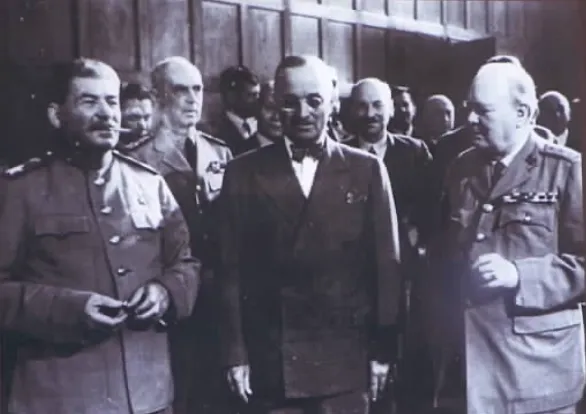
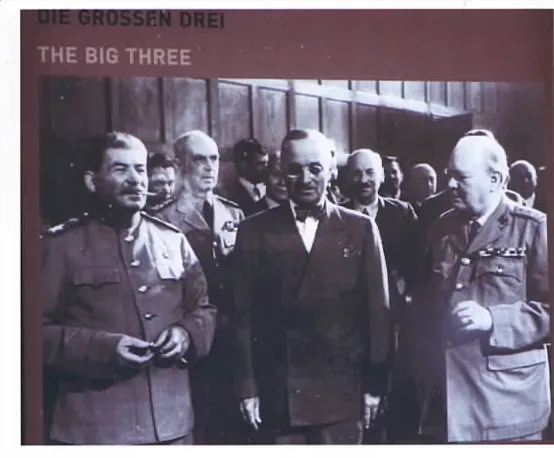
POTSDAM
This is the place where the “Big Three” met to decide the new boundaries of Europe. Roosevelt attended the first two meetings but died before the third one. Attending this meeting in Potsdam were Stalin, Truman, and Churchill. It was here that we began our boat cruise.
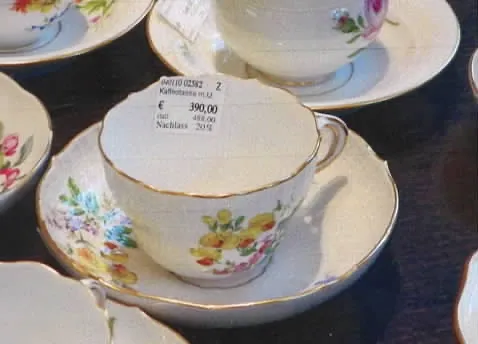
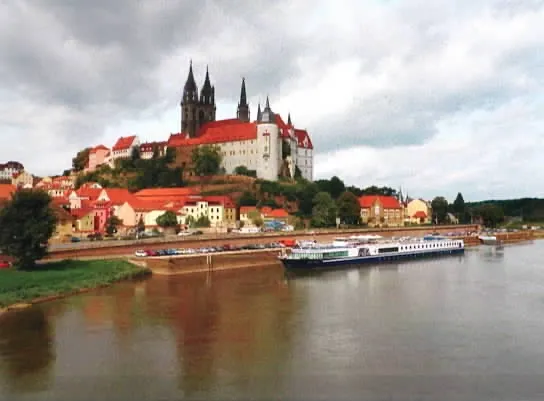
MEISSEN
We had heard about this porcelain factory and how expensive its pieces were. The displays of delicate porcelain with exquisite hand-painted flowers and designs were fascinating, but oh, the prices! One teacup and saucer set was marked at 390 euros, or about $468. The smallest item we could find was a tiny thimble for $100. We settled for postcards instead.
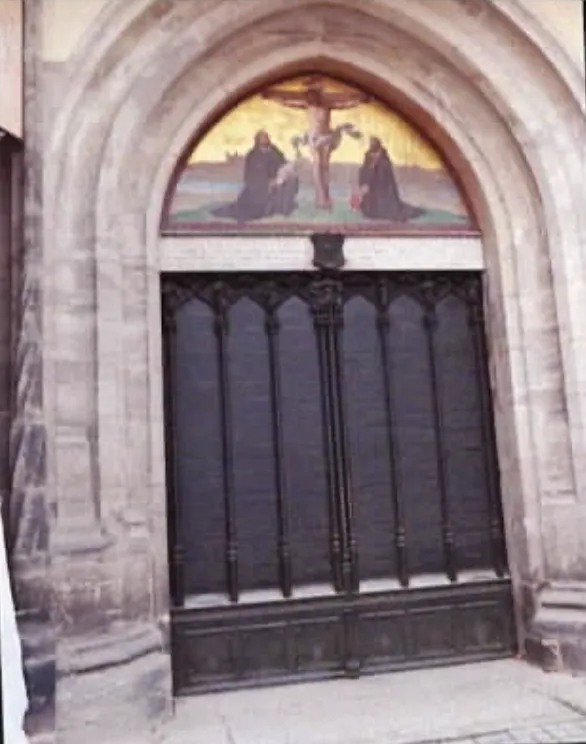
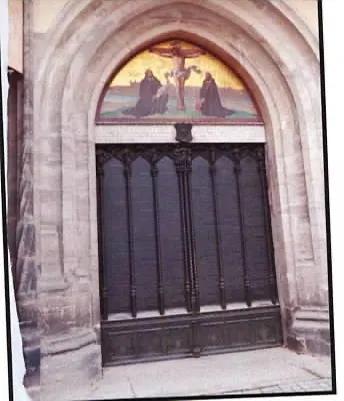
WITTENBERG
We learned that Luther, a monk, married Katharina, a nun, and they lived together in a former monastery with their four children. (I took a close-up picture of a portrait of Luther, and my new smart camera said, “Blink detected.”) The famous door where Luther nailed his paper was destroyed in a fire. The new metal door has his theses engraved on it. Written in 1517, they marked the beginning of the Protestant Reformation.
The main points of his 95 Theses were:
•Sola Scriptura (“Scripture alone”): The Bible alone is our highest authority.
•Sola Fide (“faith alone”): We are justified through faith alone in Jesus Christ.
•Sola Gratia (“grace alone”): We are saved by the grace of God alone.
DRESDEN
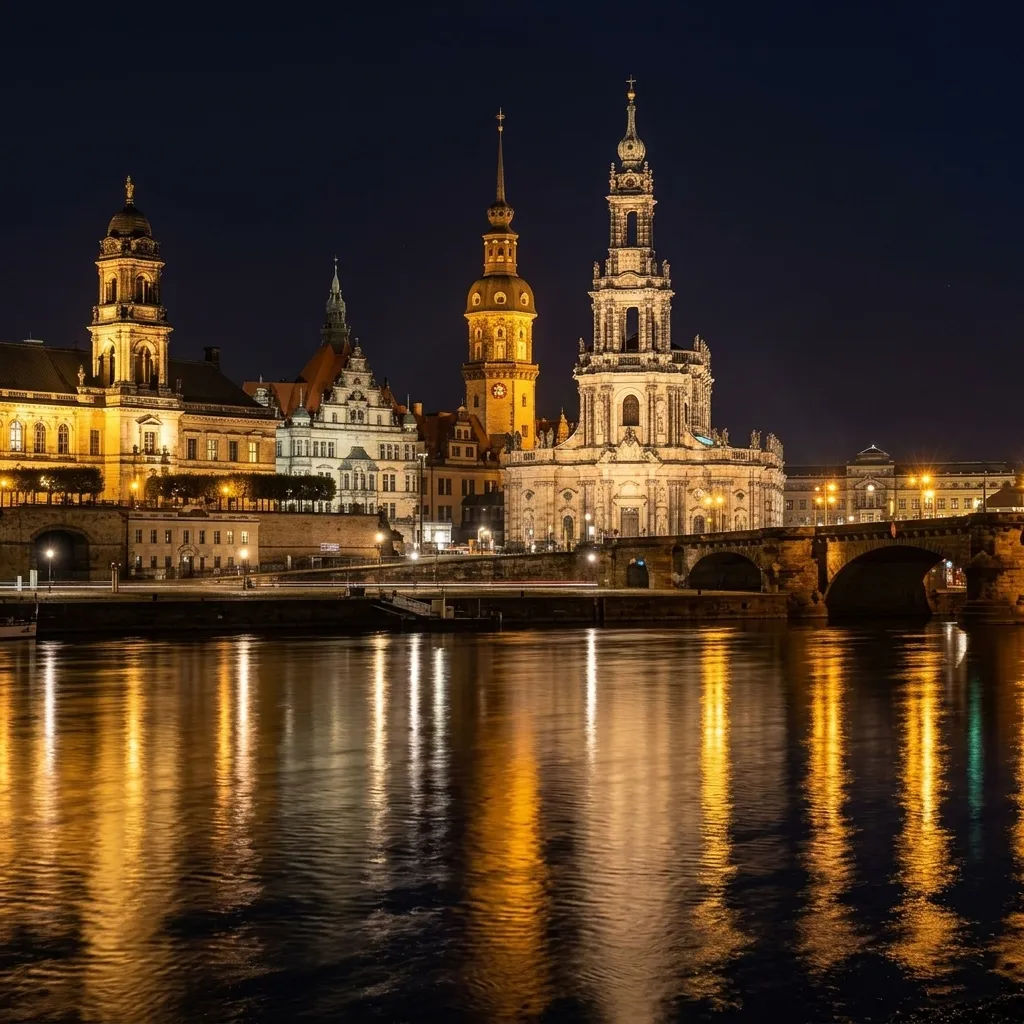
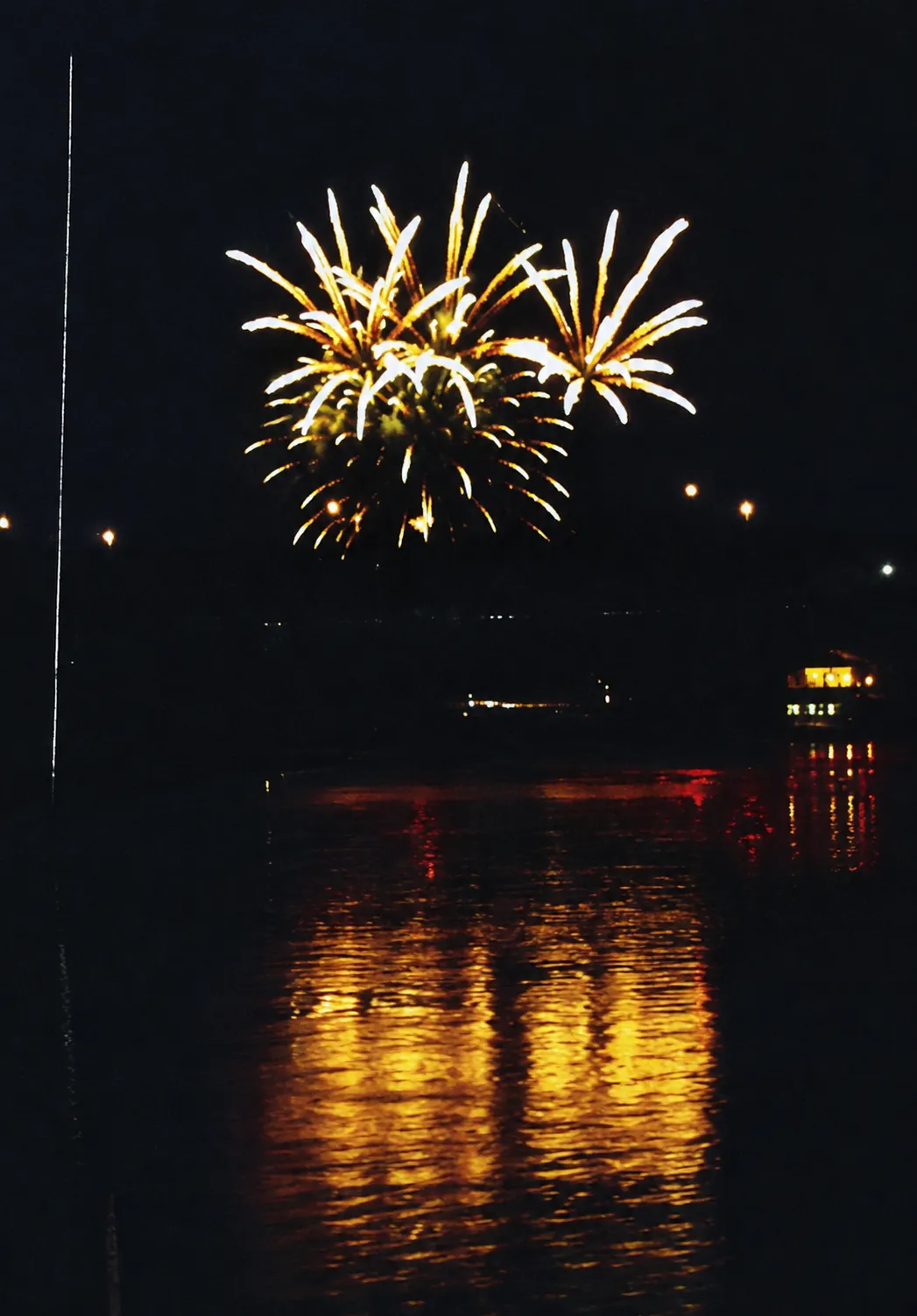
We sailed on to Dresden, arriving at sundown. But the crew, led by the captain, was putting on a show, and we had to attend. The skits and slapstick humor became sillier and sillier. Meanwhile, we were arriving in beautiful Dresden, all lit up at night. The rebuilt city was truly a sight to behold, and we were stuck inside listening to nonsense music. There were spectacular fireworks for the grand finale, and they finally let us go outside to watch them (probably to avoid a mutiny).
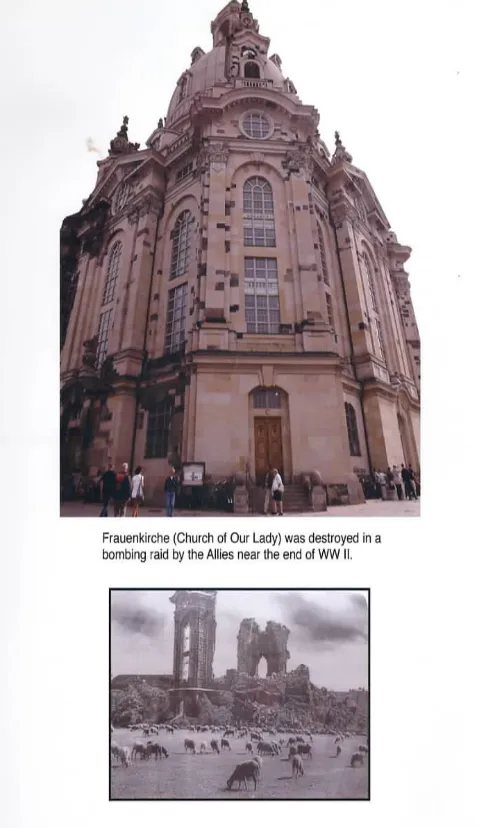
The many spectacular buildings that had been destroyed in the last days of the war have been meticulously rebuilt to their former glory. But the cathedral, the Frauenkirche, lay in broken pieces on the ground as a symbol of the futility of war. The ruins were left untouched for 50 years. Finally, the church was restored with funds from all over the world, especially from England. Some of the original blackened stones were reused, and you can still see them in the façade.
In England, the son of the bombardier who had bombed the church created a gold cross and donated it to Dresden, where it was installed on top of the dome. This photo was taken on the day the new dome was put in place with great ceremony.
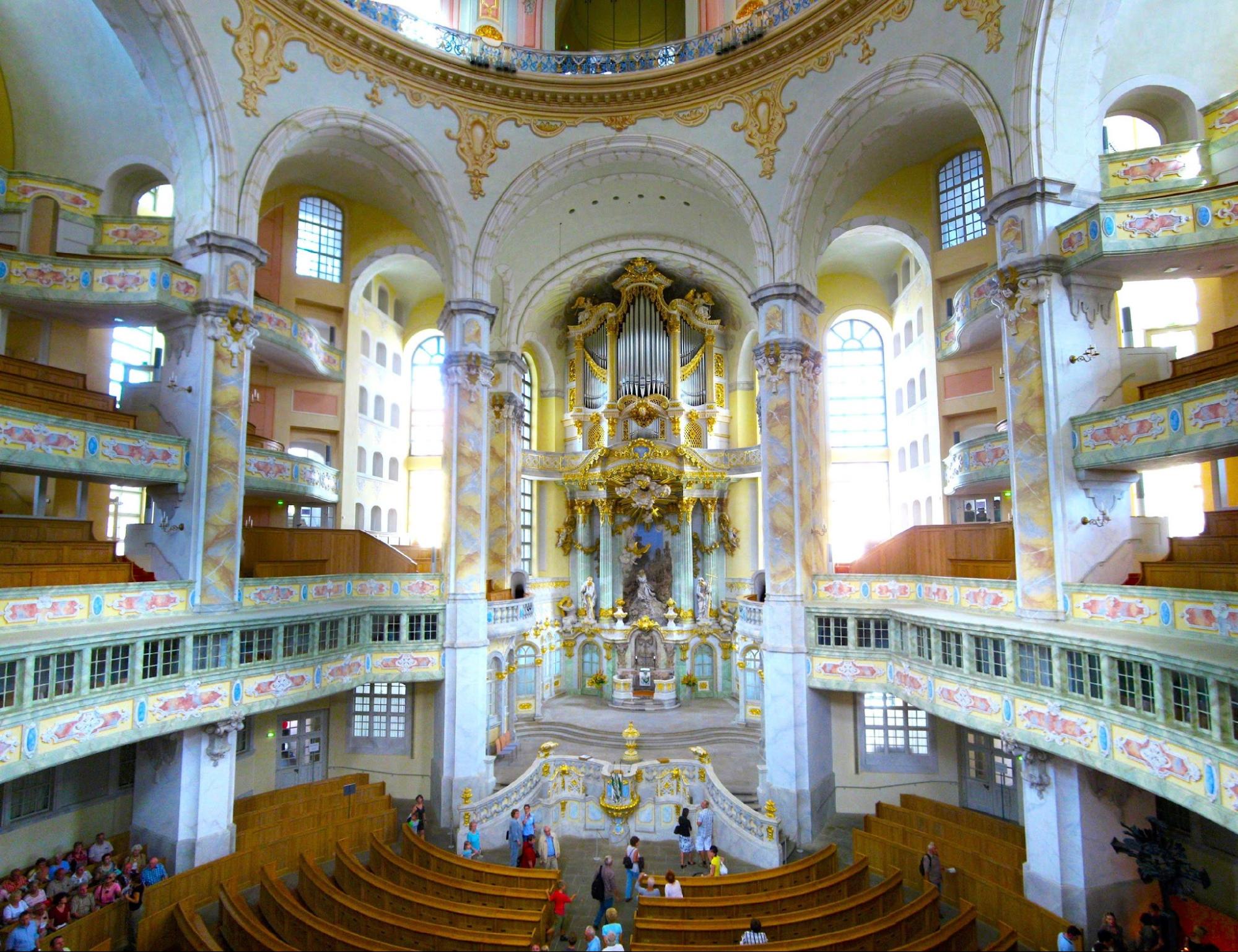
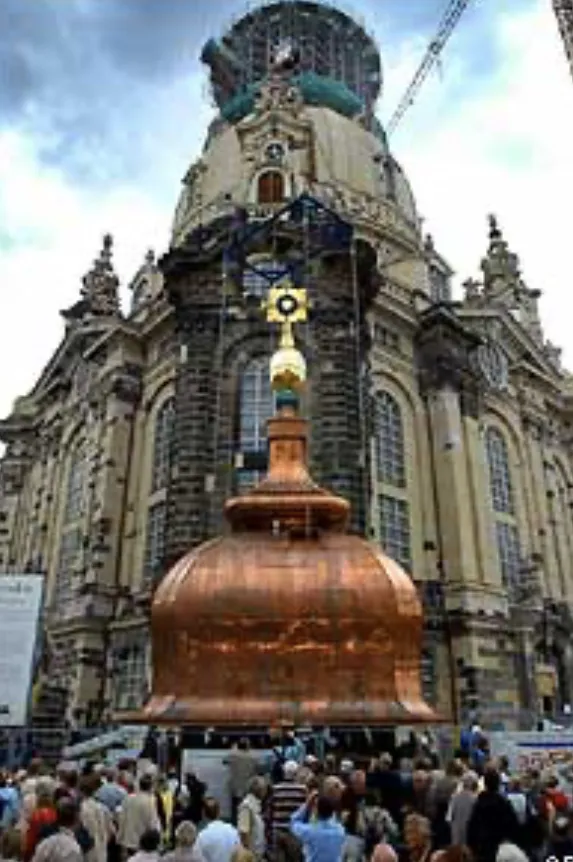
We had been here in Dresden in 2003 and witnessed the cathedral being rebuilt. Now, in 2014, it was completed, and we were so anxious to see it, hear more about it, and go inside to view the rebuilt marble walls and statuary, the altar, and the paintings. We had read articles about how they used copious quantities of eggs to create the color that gives the interior its almost luminescent glow. To reproduce the massive carved doors, they asked families to loan their wedding pictures that had been taken in the church or beside the carved doors.
So, we joined the traditional walking tour of the city. The main square was still full of tents and temporary structures being taken down after a festival that had ended the day before. We walked right past the church with no chance even to glimpse inside. The guide kept us moving to stay on schedule. I wish we had simply left the group and gone inside this world-famous church. This is the magnificent interior of the Frauenkirche that we didn’t get to see.
PRAGUE
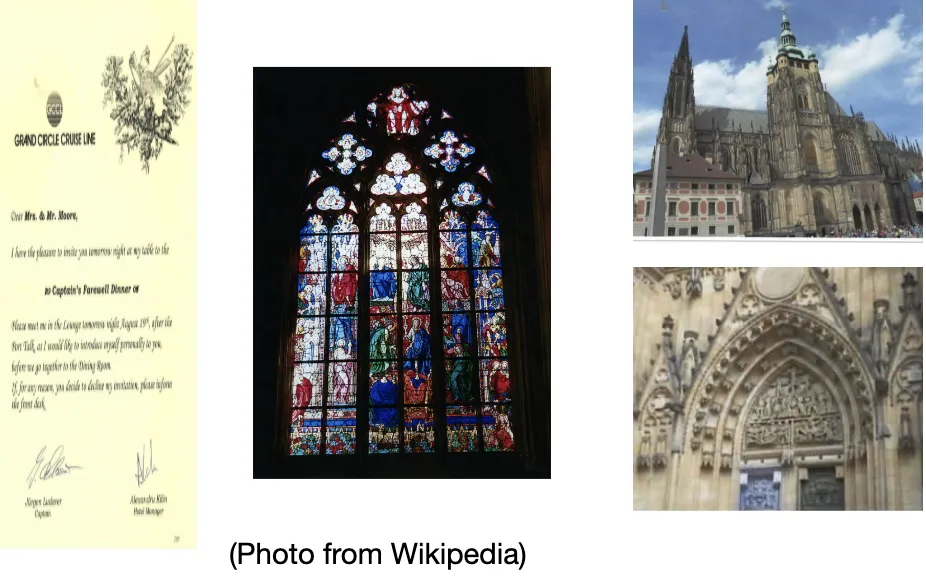
Our cruise was over, and our bus ride took us to Prague. We caught a glimpse of the “100 Spires” for which the city is famous. We spent time at St. Vitus Cathedral, towering high above the city. Construction began in 1344, but progress was slow because the architects were also involved in building Charles Bridge. The cathedral was finally completed in 1929, nearly 600 years after it was begun.

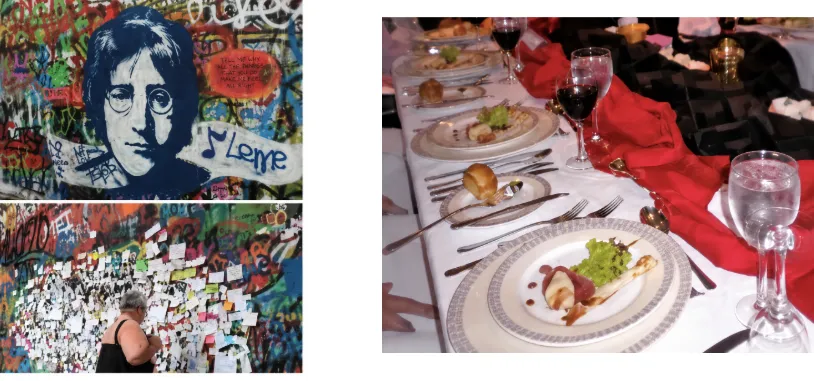
We had the usual walking tour of Prague. We saw a river gnome, dancing houses, a colorful car, and a padlock fence where lovers attach their locks and throw away the key. Then we spent a long time at the John Lennon Graffiti Wall, where thousands of notes had been attached.
There was no mention or explanation of the famous Charles Bridge, even though it was within sight. Finally, the guide ended her talk and said we had 20 minutes to see Charles Bridge on our own. There were no handouts with information about the statues on the bridge, and nothing was said about the equally famous Astronomical Clock. We were thankful that we had visited Prague before and had plenty of time then. Even so, on this trip, we made a brief visit across the bridge and stopped to see “The Clock.”
(In the “Eastern Europe” story, you’ll find information and pictures of both.)
2014 – Panama Canal - More of the Country
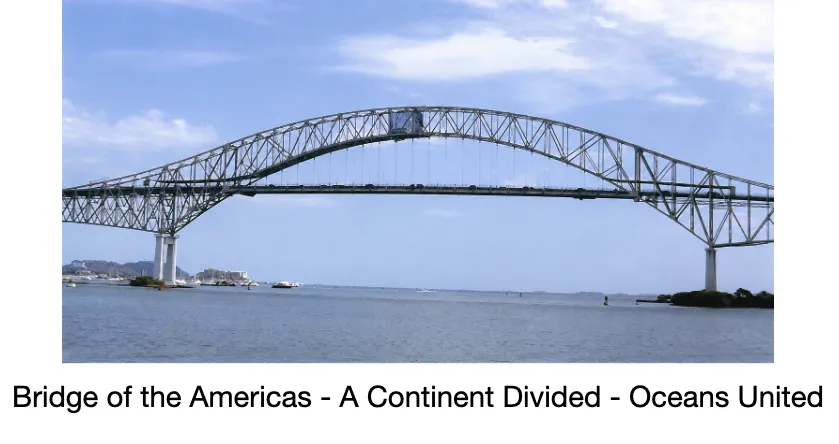
This trip was to include more of the countryside and local living.
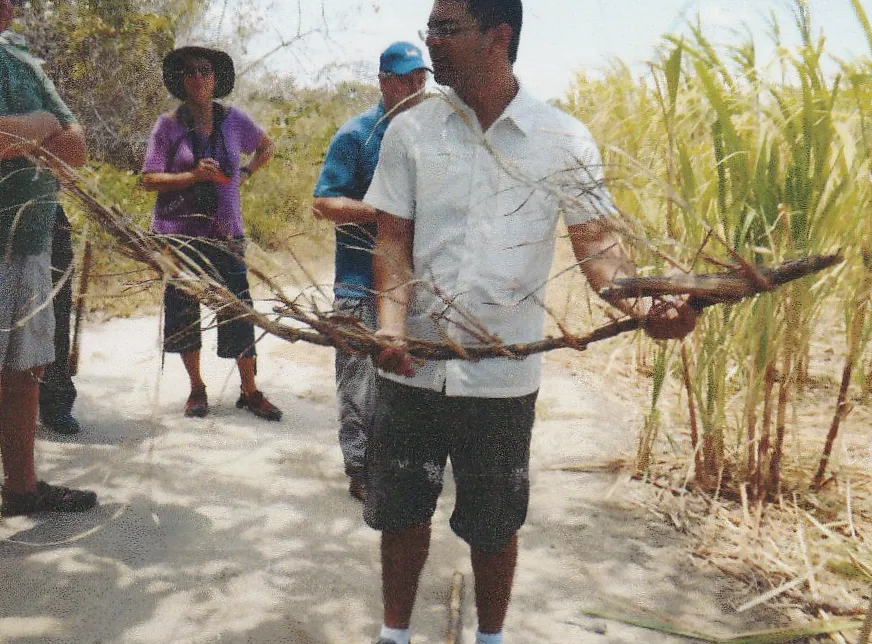
SUGAR CANE
First, we went to a sugar cane field where a man demonstrated how to cut the cane with a machete, strip it, and plant it. The canes are planted horizontally.
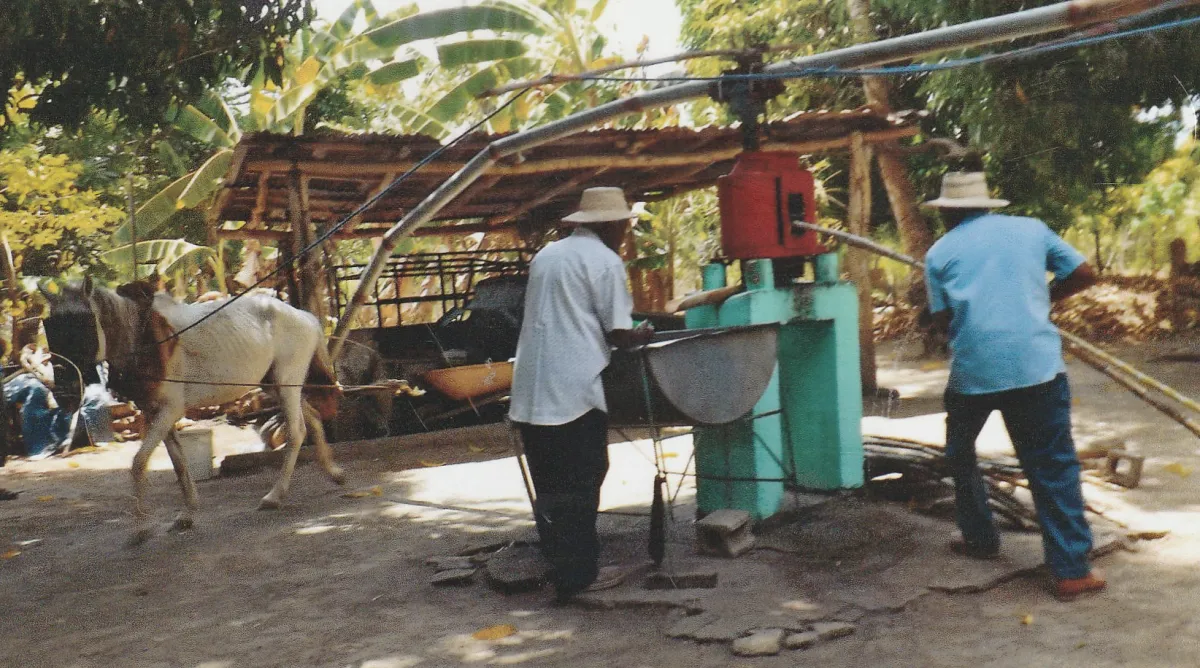
Then we watched a demonstration of feeding the cane into a press operated by a horse walking in a big circle. The juice flowed out through a funnel. We were offered a taste with a little lemon juice added, and it was very tasty.
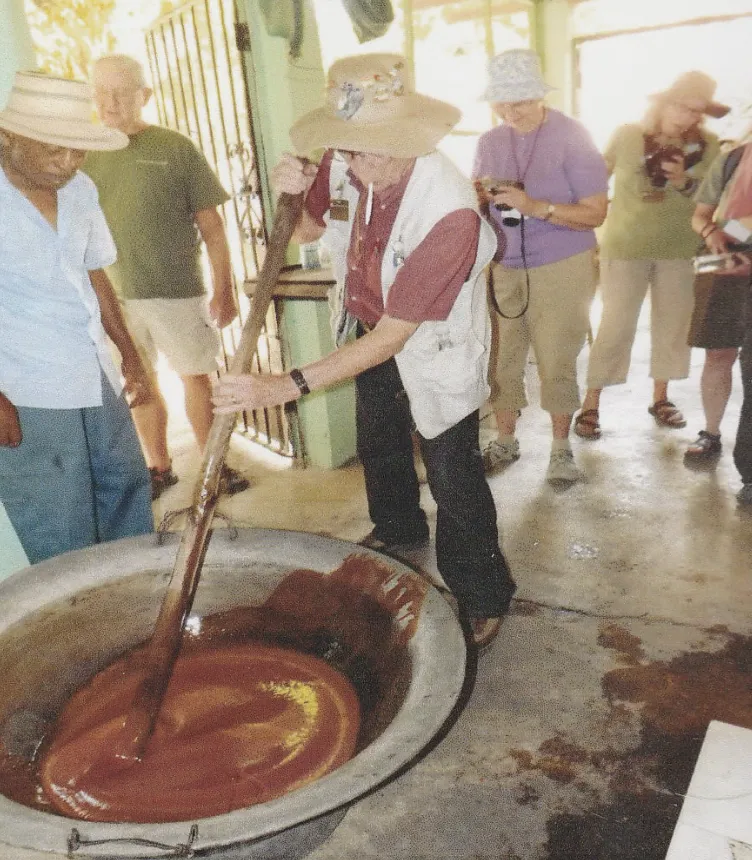
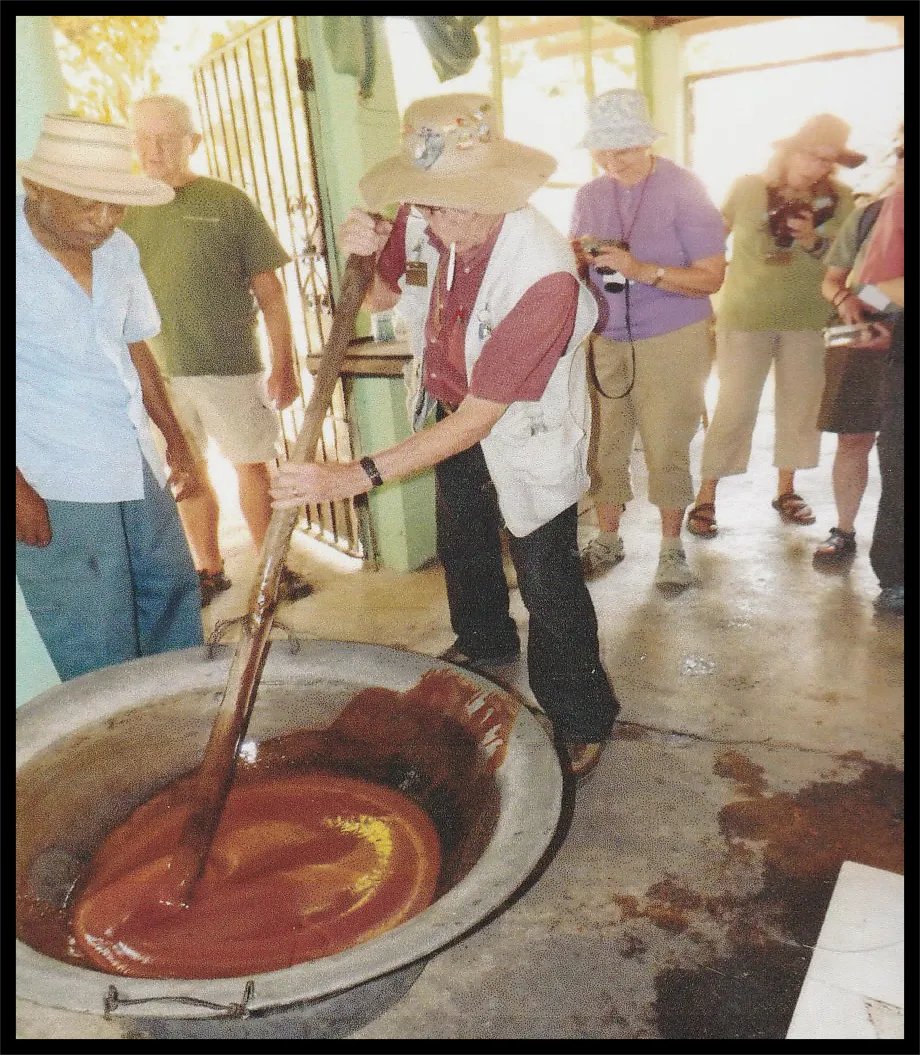
A huge vat containing 20 gallons of sugar cane syrup was boiling and bubbling over a wood fire. The thick syrup needed constant stirring, so Al had a turn. He kept a plastic spoon in his mouth, ready for a sample. The syrup was boiled down and then ladled into wooden molds to make candy. We bought some, and it was very good.
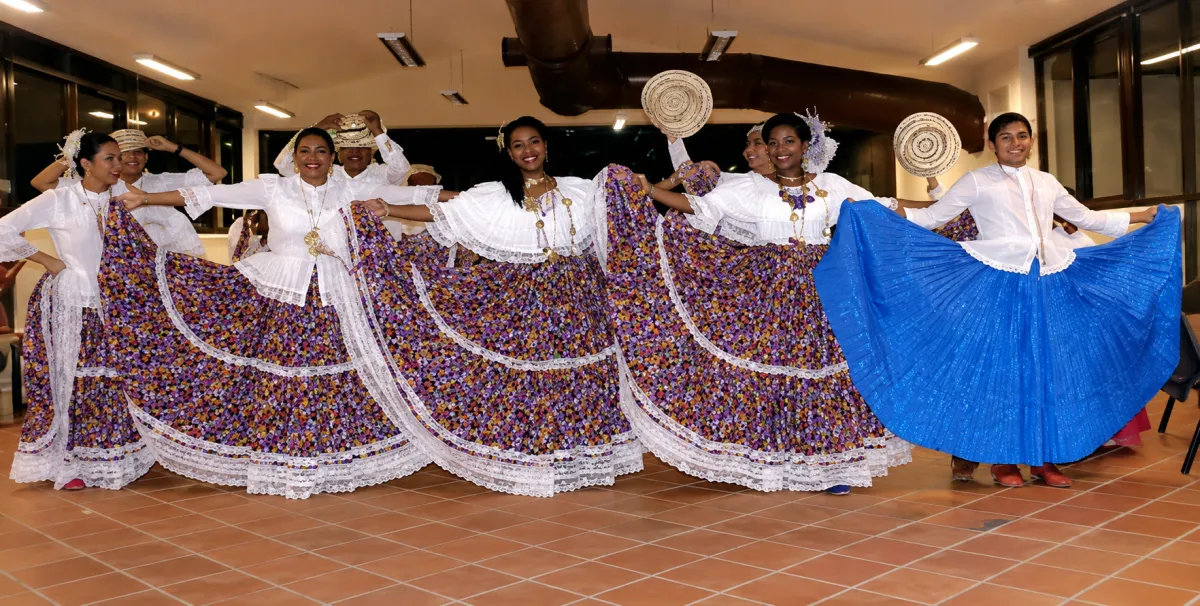
The evening folklore show featured local teens dressed in elaborate and colorful costumes.
EMBERRA VILLAGE
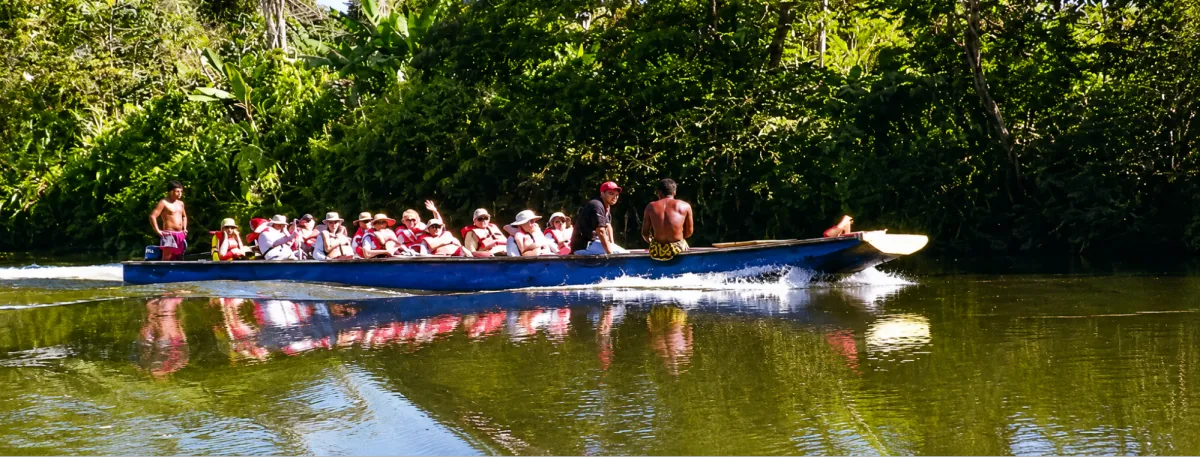
A bus took us to the Gatun River, where dugout canoes were waiting for us. The “polers” wore brightly colored beaded loincloths.
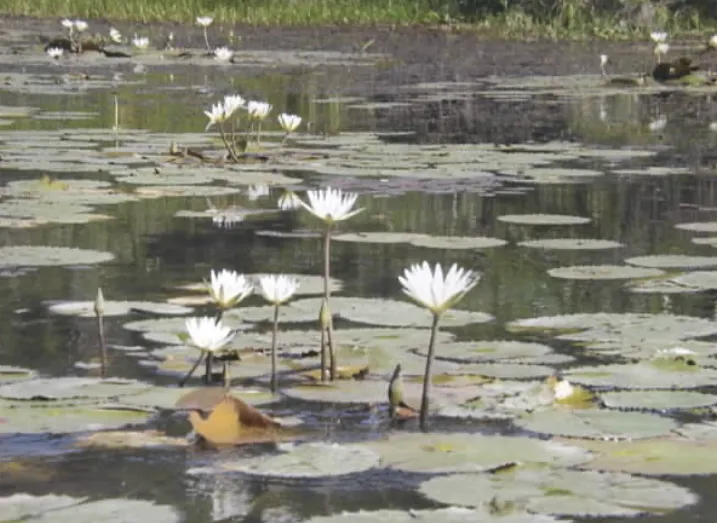
It was a 40-minute ride on the river, with dense jungle on each side and monkeys jumping in the trees. Then we turned into a narrow tributary marked by a wooden sign reading “Emberra Village.” After a few more miles, we arrived at a very primitive village on the banks of the river.
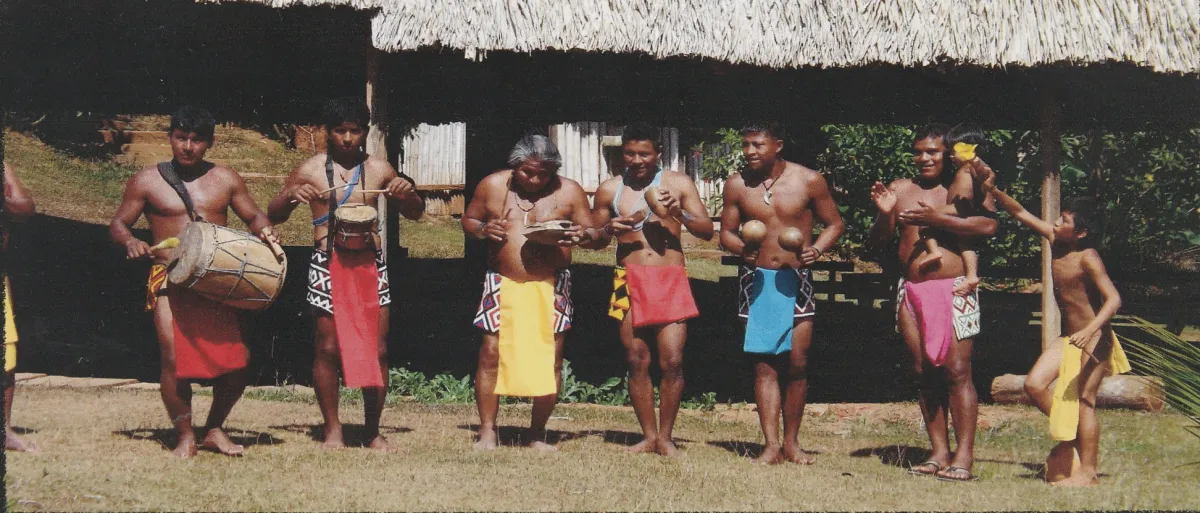

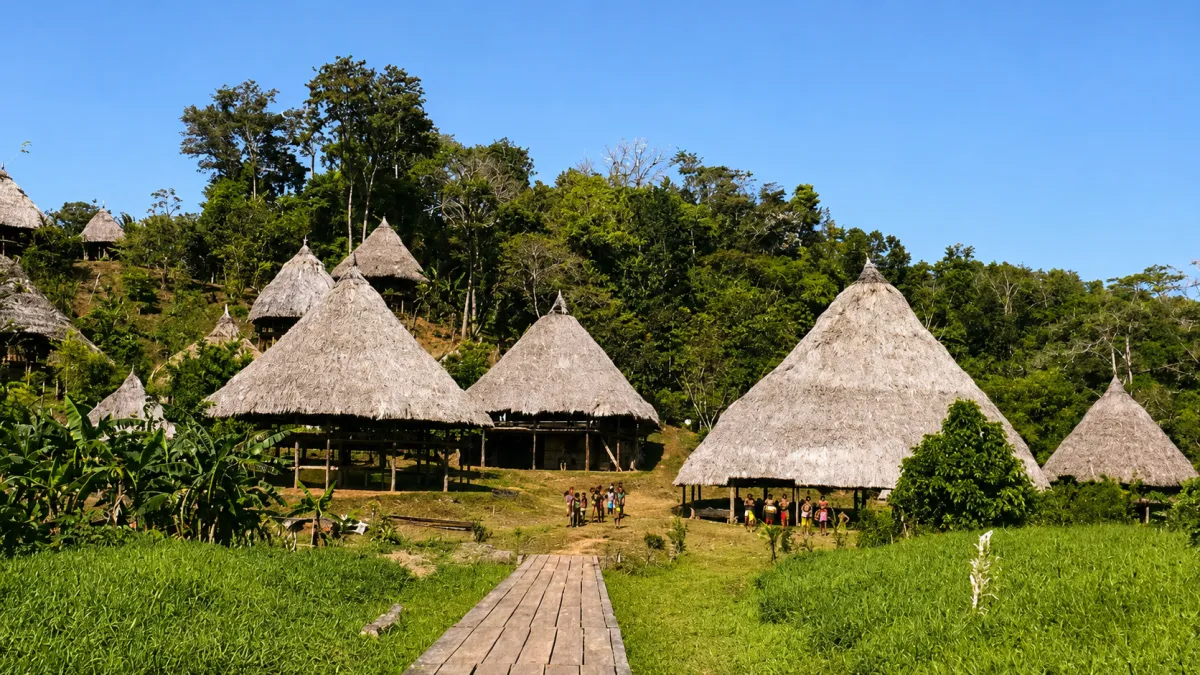
There were about a dozen neatly made thatched-roof huts. We were greeted by singing and dancing from girls wearing brightly colored outfits. Several little girls, about 4 or 5 years old, were running around and having fun. They wore beaded skirts and tops like the older girls. Meanwhile, toddler boys were happily playing with a soccer ball.
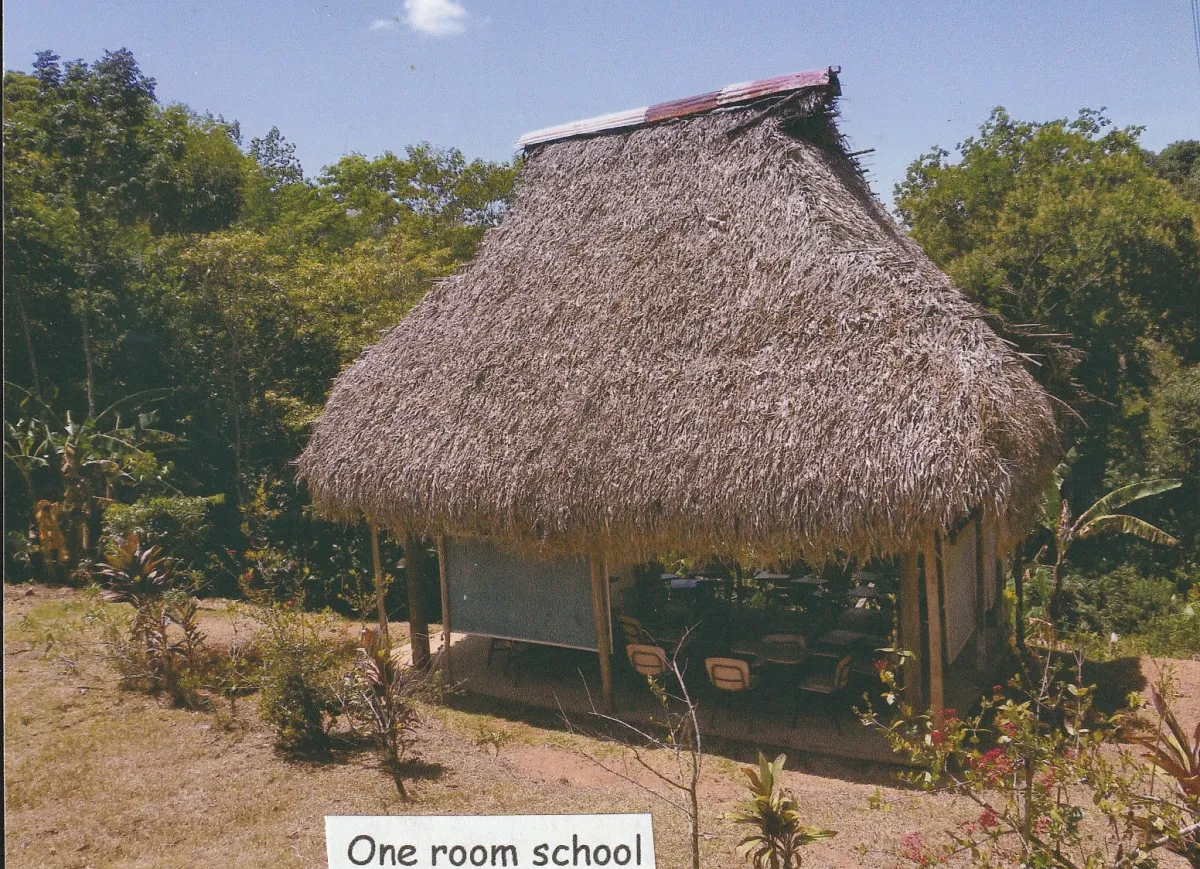
We visited their school, which was simply an open-sided concrete slab. It was not in session because the teachers had a meeting. There were 23 students in grades 1–6, but only 16 chairs, so the rest of the children sat on the floor. We looked at their textbooks, which were beautiful books filled with colorful pictures. After 6th grade, the students travel by boat to a junior high school three hours away, and later to a senior high school in Panama City.
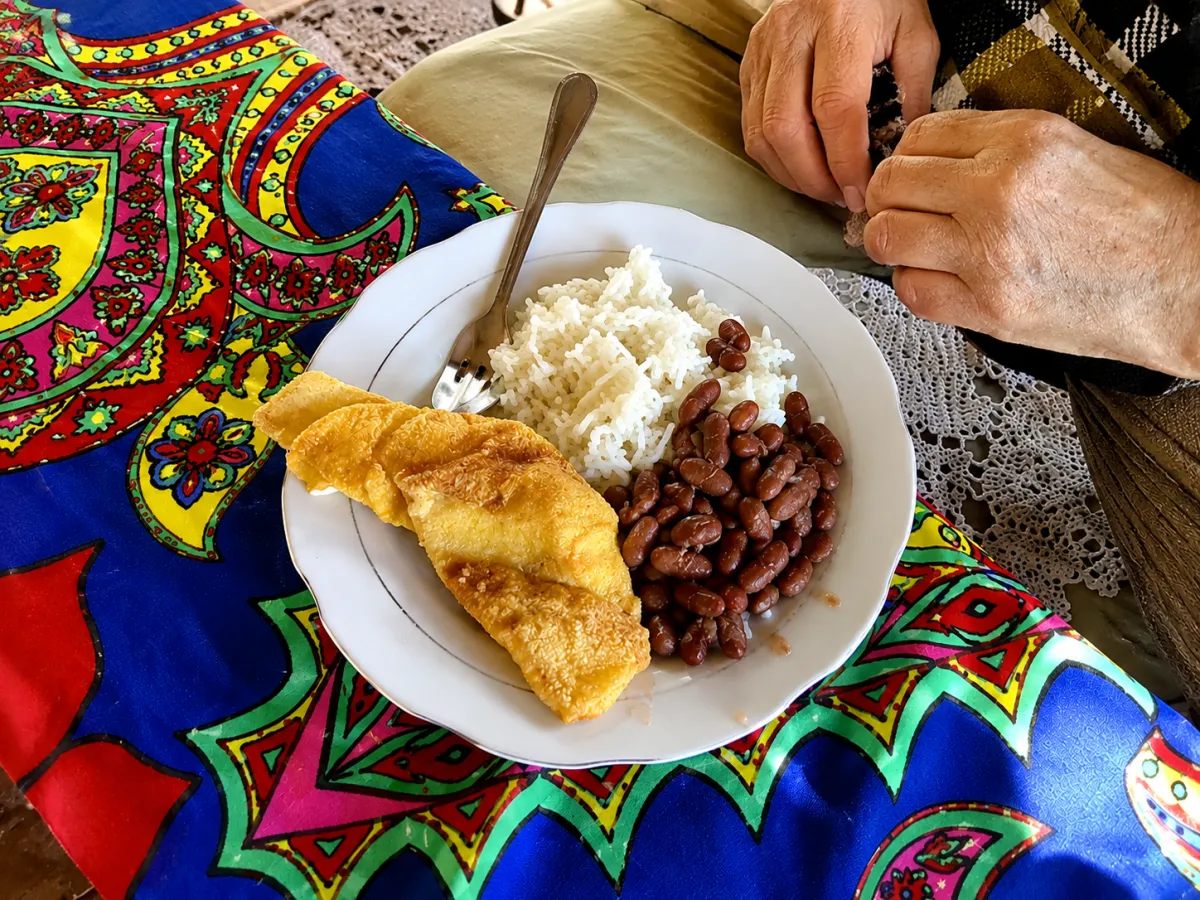
We were divided into groups of four or five and sent to different huts for lunch. We were given a basin of warm water and a colorful cloth to wash and dry our hands. The hostess served each of us a plate of rice and beans along with a piece of crusty, deep-fried tilapia fish that had been freshly caught. We ate the fish with our fingers. There were no napkins and nothing to drink, but the food was delicious. It was an interesting experience.
Then it was back to the boats for the long but enjoyable canoe ride on the river. Later, we relaxed in our room and enjoyed some hammock time.
PASSAGE THROUGH THE CANAL
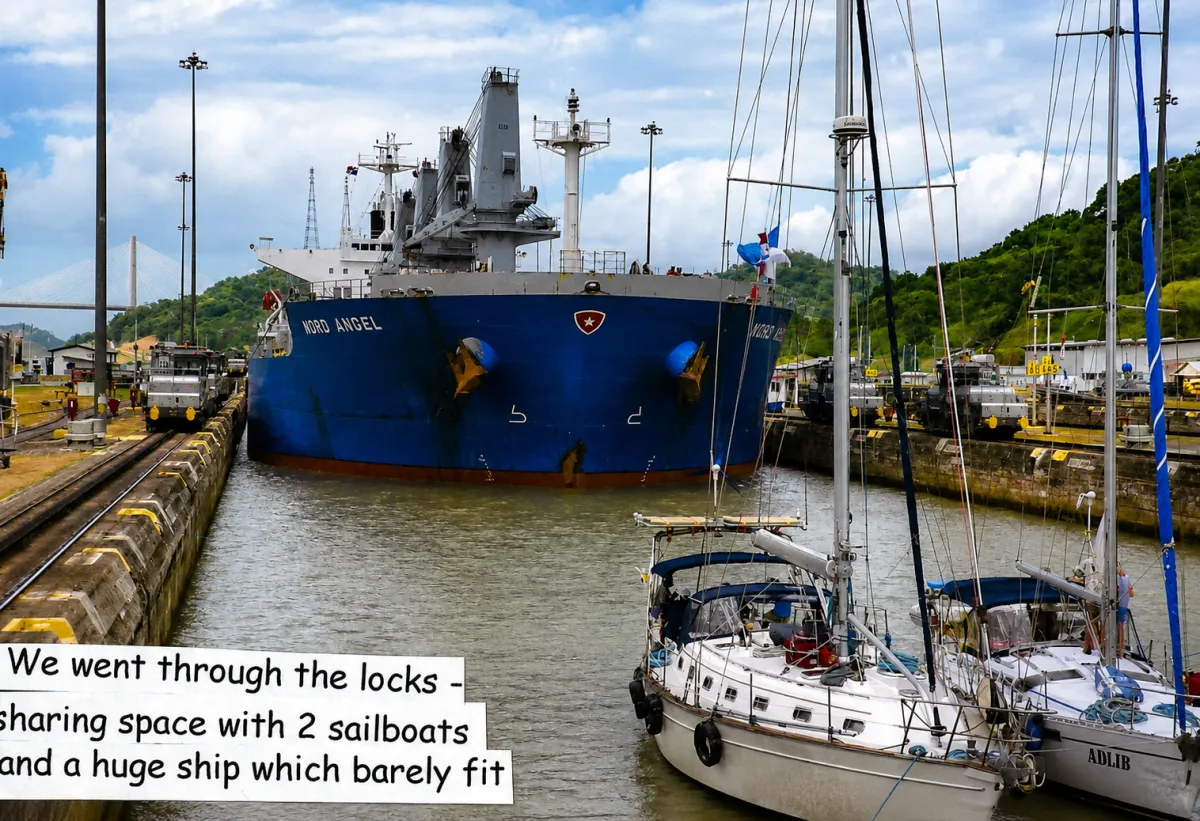
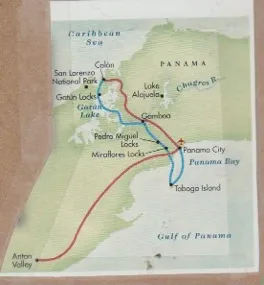
Our ship had to wait its turn to go through the Gatun Locks, and we finally entered the first lock. Our boat looked like a rowboat beside the enormous ship sharing the lock with us. Each of the three locks lowered us farther until we reached the level of Gatun Lake. There we anchored overnight, the boat gently rocking.
We cruised across Gatun Lake and entered the first lock, Pedro Miguel, along with two small cabin cruisers and one enormous ship, the Nordangel. We all barely fit. The “mules” pulled the large ship very, very slowly.
Next, we entered the Miraflores Lock and saw hundreds of spectators in the building where we had eaten dinner almost a week earlier. The third lock lowered us to the level of the Pacific Ocean. And so, our Panama trip came to an end. However, we still had to get home.
Then we happened to spot our friends already standing in a line closer to the gate. They lifted the rope and encouraged us to slip in with them, so we did. We finally boarded three hours after we had landed. I was tired, hungry, and thirsty, with no opportunity to get anything to eat or drink.
This was the worst airport experience we had ever had, so I wrote a letter to the Miami airport. To my surprise, they actually replied and thanked me for the letter. They explained that they had been trying to get Washington to send more agents to handle the growing number of travelers. They said they planned to take my letter to Washington to help support their case. I wonder if it ever helped. We’ll never know.
2015 - SWITZERLAND - ONE MORE TIME
We wanted to return to Switzerland one more time. We had visited many times before and had fallen in love with the towering mountains, icy glaciers, green meadows, hiking trails, brown cows, and red trains. But my husband had just recovered from a near-fatal illness. Would he be strong enough for the trip? He really wanted us to go, so we made plans for a much slower-paced journey. We figured the Swiss air would do him good.
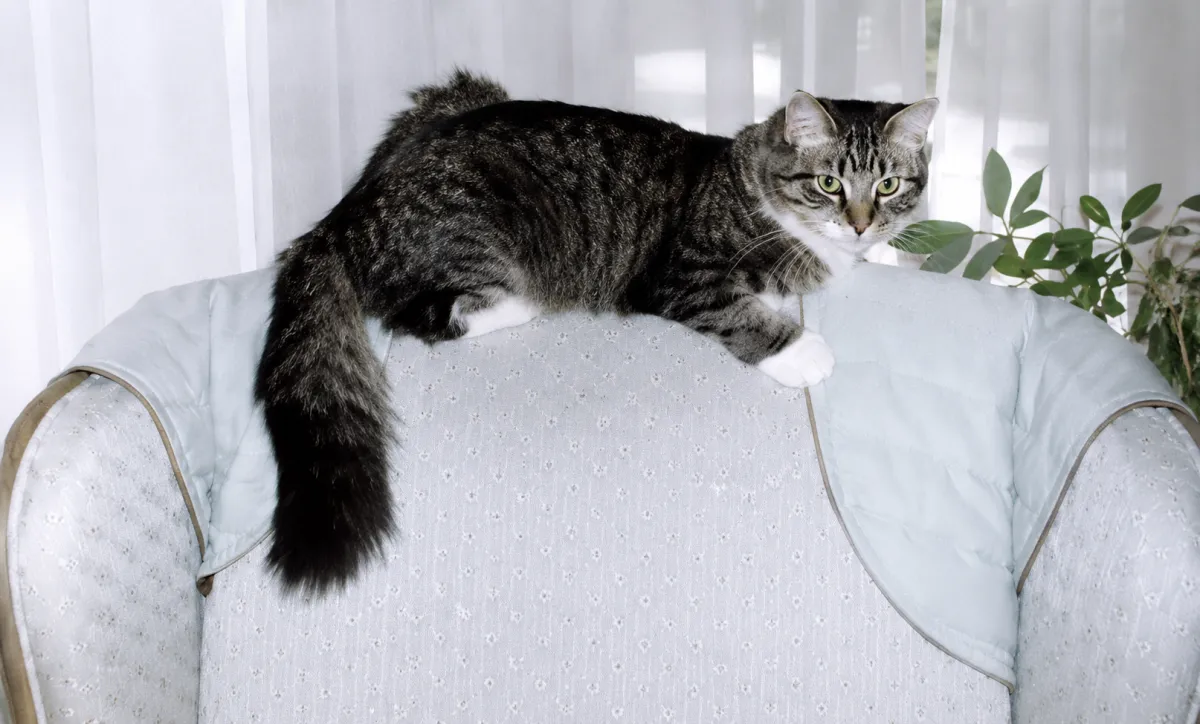
However, our trip got off to a rough and very sad start. On the day of our departure, we had to say goodbye to our 16-year-old cat, Alexander. We buried him in our backyard and left only a few hours later to begin our journey to Switzerland. Because we were traveling using frequent-flier miles, our itinerary was far from ideal. We had a seven-hour layover in Chicago, then flew to Berlin, and finally to Zurich.
We were physically and emotionally exhausted.
Still, we were now in familiar Zurich and made our way to the train station to validate our train passes. Suddenly, I realized I no longer had my jacket, my favorite L.L. Bean jacket. I had left it on the plane! We are usually very careful and always double-check to make sure we have everything. But the jacket was gone, and we had to move on. We reported it to Lost and Found.
We needed to change trains in Bern, a station we knew well from many previous trips. It is a large station on two levels, but normally not a problem for us. We each had a 22-inch carry-on suitcase and a rolling backpack, and we needed to go up to the next level. Use the elevator? No, no, we could handle the escalator. We had done it many times before. As we started up, somehow my husband lost his balance and fell backward onto the moving escalator. Thankfully, the backpack cushioned his fall, but his bare arm scraped against the moving escalator steps, which kept grinding against his skin. A man quickly jumped onto the escalator to help him up, and together they managed to reach the top. His arm was badly cut and was dripping blood. Our train was nearby, and we made our way there. The conductor took one look at us and immediately escorted us to his “office.” There, he pulled out a first aid kit and carefully I bandaged my husband’s bleeding arm. We thanked him profusely and returned to our seats, feeling shaken and stressed.
Soon we arrived at Interlaken Ost - we got off the train, and as we boarded the train to Lauterbrunnen, we realized I didn’t have my ever-present tote bag!! Nothing of real value in it, but it had my journal, books, maps, and misc. Travel aids. I had probably left it in the conductor’s office. Train personnel told us to report the loss at the Lauterbrunnen station, which we did. They said they would search the train we had been on. (And we did get it back a few days later.)
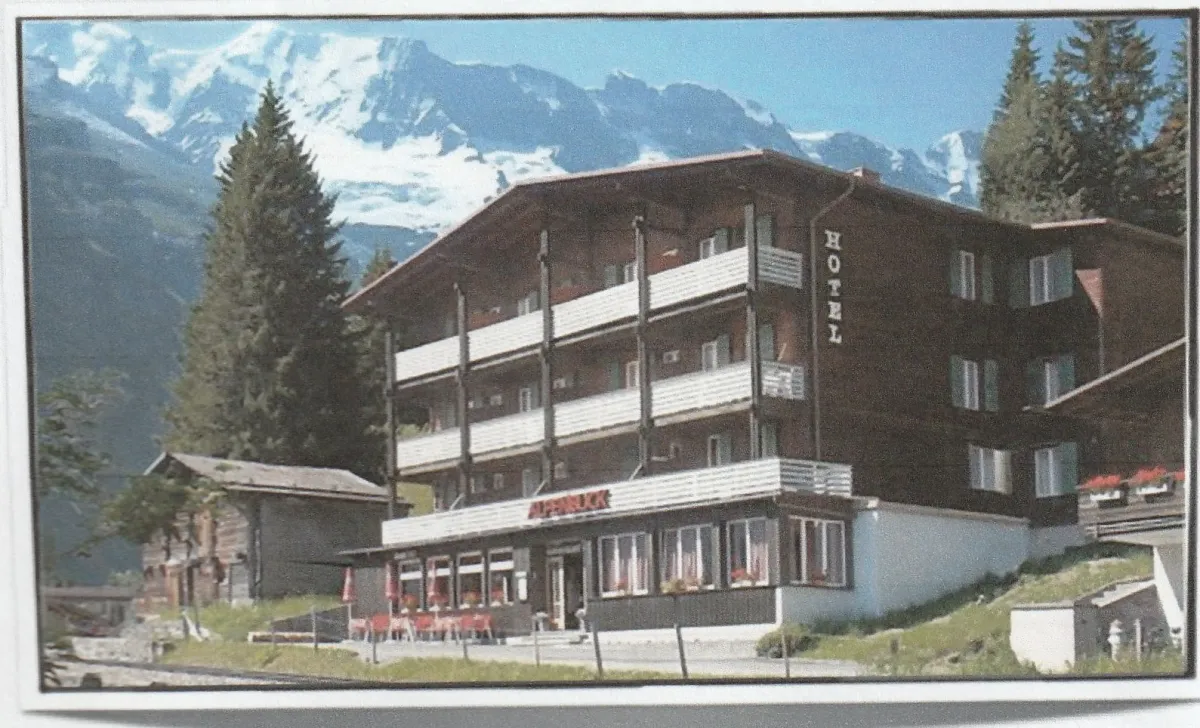
So, we arrived at our destination, “Hotel Alpen Blick” in Murren. Jane (owner) assessed our situation, she re-bandaged Al’s still bleeding arm, and helped us to our room. We were exhausted. But straight across from our balcony were the glistening peaks of the Eiger, Mönch, and Jungfrau! What a glorious sight! All our troubles faded away as we immersed ourselves in the beauty of the Swiss Alps. We plugged in our little travel pot, made a cup of coffee, and sat on the balcony drinking in the fresh mountain air and the sight of the snowy peaks against the blue sky. All’s well that ends well.
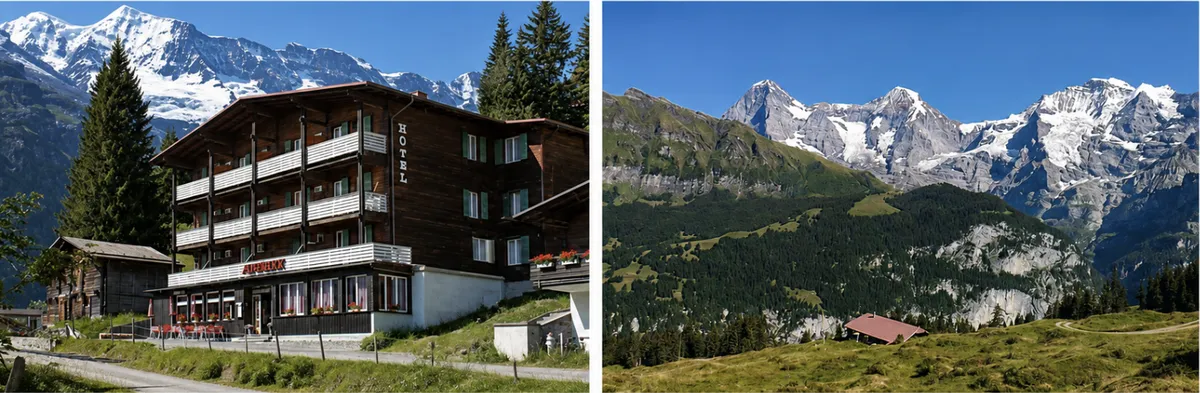
After a good night’s sleep and a delicious breakfast of hard rolls, croissants, jam, cold cuts, juice, and café au lait, we were ready for the day. Murren is located on a ledge of the mountain, accessible only by cable car. No cars - just pedestrians - utterly quiet and peaceful. We sauntered into the village, past the familiar hotels and chalets. There are a few shops with beautiful gifts, souvenirs, and hiking needs. Some cows were grazing on the steep bank. And always the view looking straight across the valley to the towering mountains or looking straight down into the Lauterbrunnen Valley. We used our hiking sticks everywhere we went. They gave us better balance and confidence in walking. Many people, young and old, use them as a very common sight.
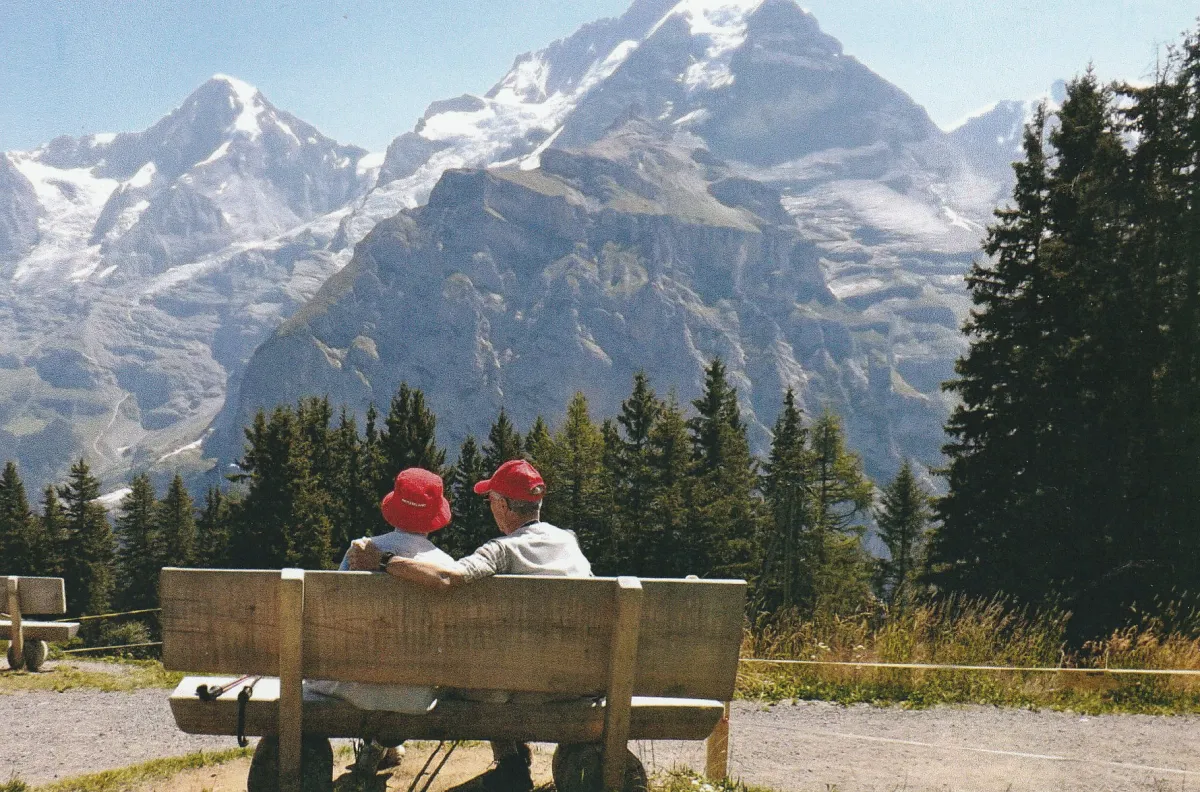
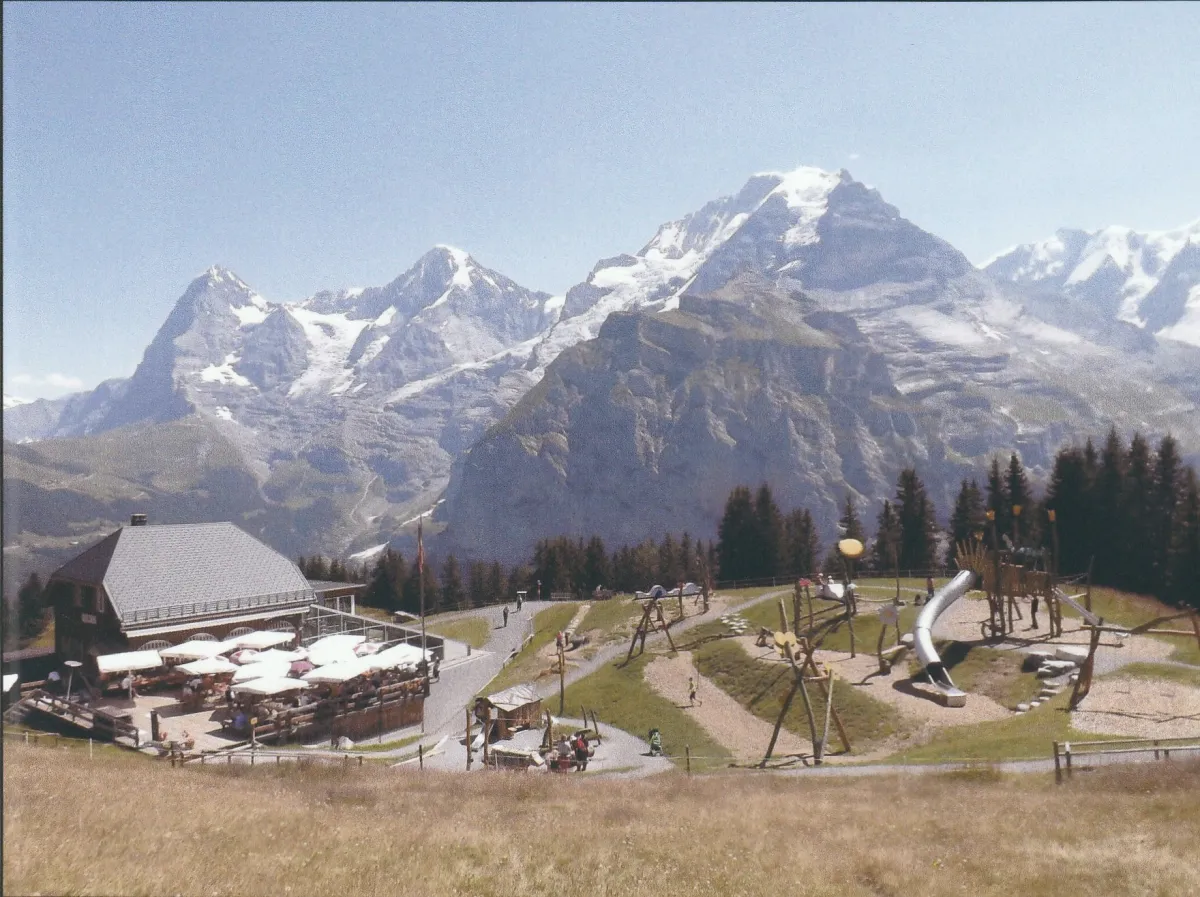
We took it easy on our first day and just rested and relaxed after we walked into the village. We unpacked and organized our room because we planned to stay there for several days. The next day dawned clear with only a few clouds, and we decided it was a good day to take the funicular from Murren up about 1,000 ft. to Allmendhubel.
We never dreamed we would someday bring our great-grandchildren to this wonderful playground. And we had our picture taken at our favorite “bench with a view.”
There are many trails leading from Allmendhubel - some marked red (difficult), not for us! Another, marked “yellow” or easy, wound down to Murren through cow pastures, past some chalets, and through woods.
It was one of our favorite hikes, and we remembered a spot on that trail where we had had our Christmas card picture taken.
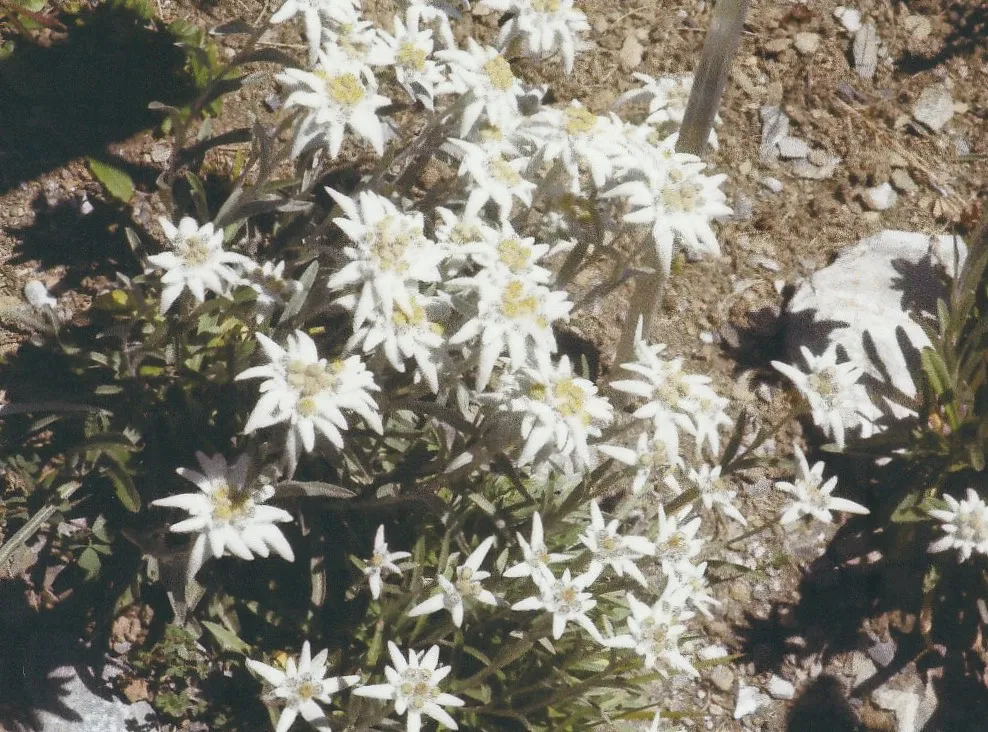
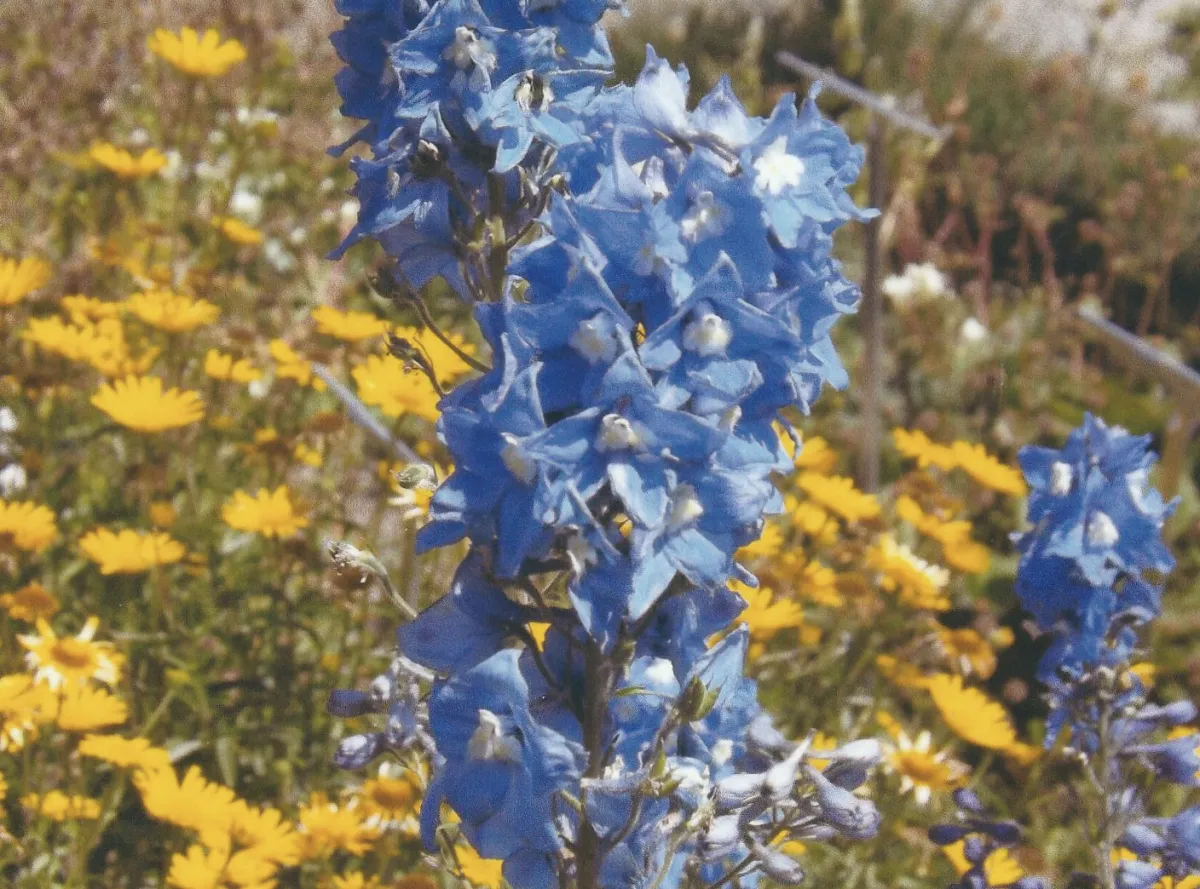
Today we concentrated on the “Flower Trail” and took pictures ofEdelweiss edelweiss and Alpine Delphinium.
Visit to Lisa’s
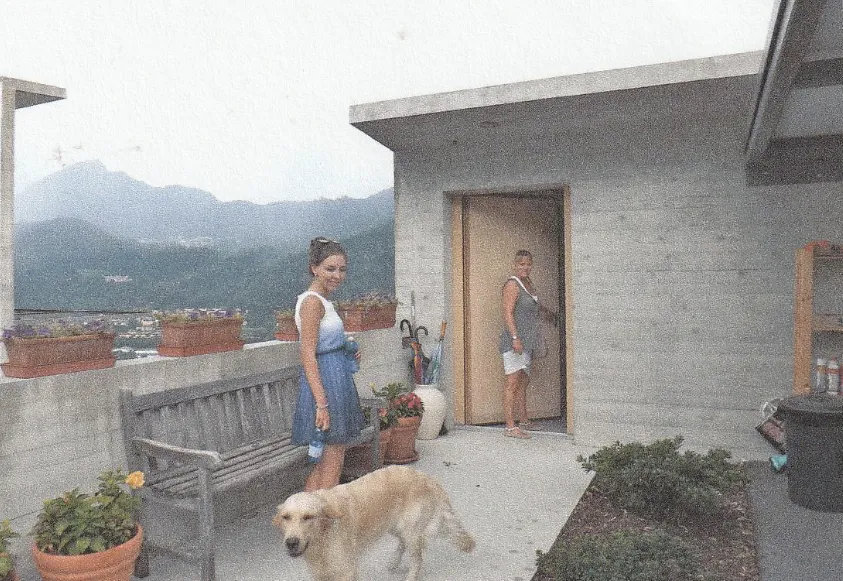
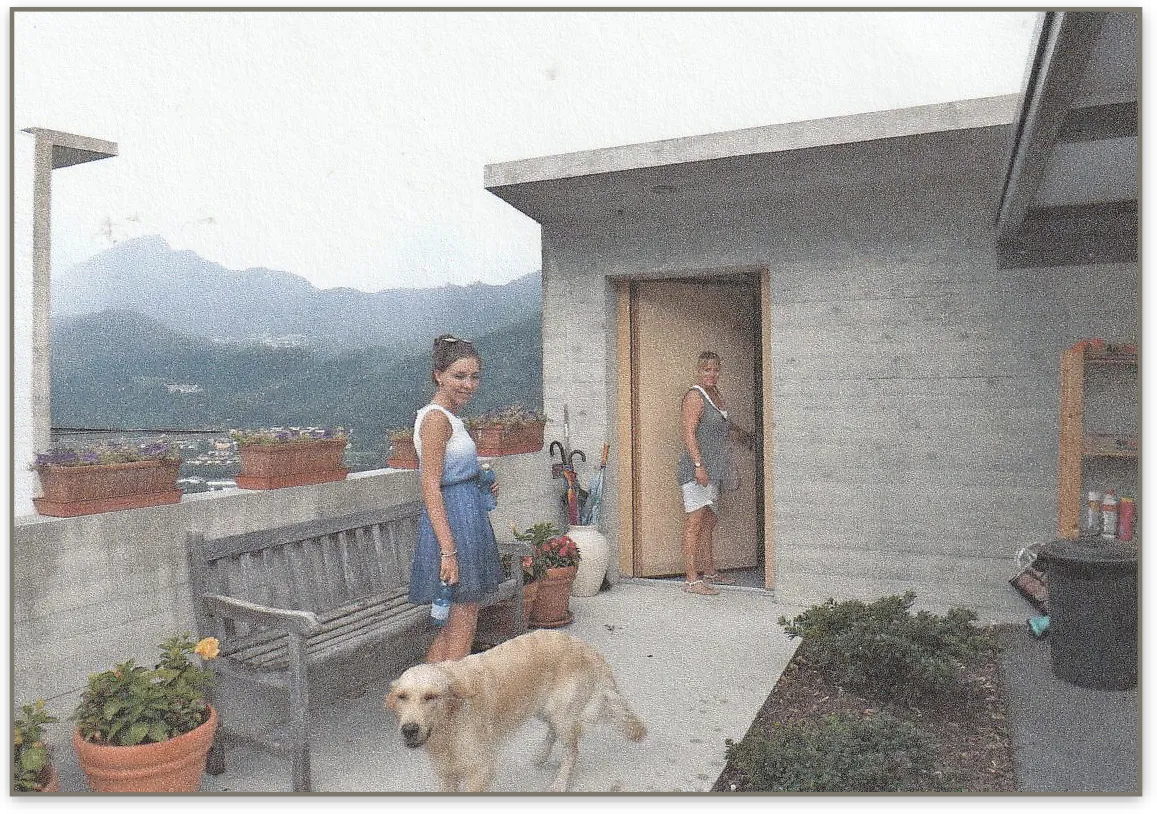
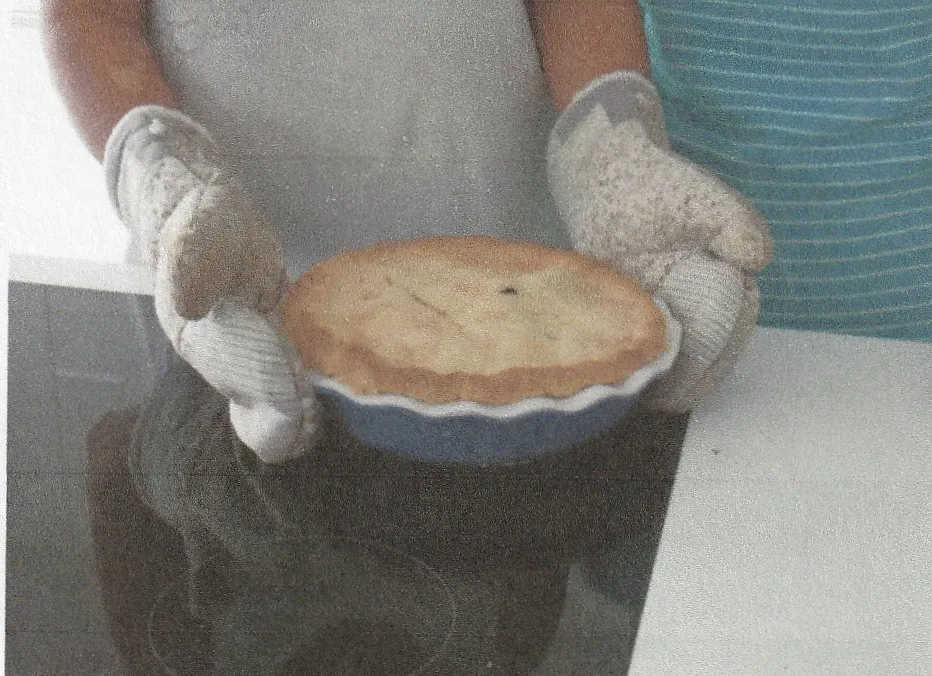
Our niece Lisa lives in southern Switzerland, and we had made plans to visit her. It was a very enjoyable 5-hour train ride with sunny skies, mountains, and lakes. Lisa, her daughter Eliana, and their dog and cat live high above Lugano with a view of the city and the lake. We went on a boat ride on Lake Lugano to Lisa’s favorite restaurant. She herself is a gourmet cook. For dinner one night, we had a quinoa salad with chopped pepper, fresh garlic and onion, roasted potatoes with fresh rosemary and olive oil, carrots sautéed with fresh ginger, curry, and garlic, salmon baked with special seasonings, and a perfect blueberry pie.a
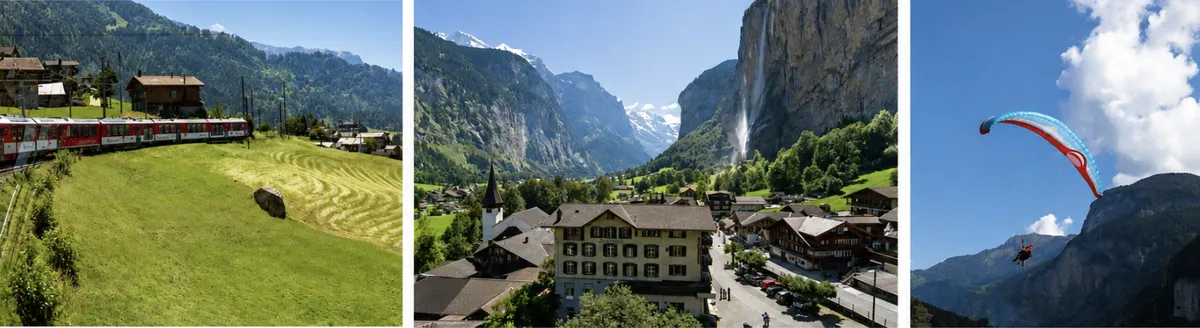
We took the train back to Lauterbrunnen and this time to a hotel in the valley. Staubach Falls was very close, and at the end of the valley, the Jungfrau. The valley is a favorite with hang gliders because of consistent updrafts.
Cable Car to Birg
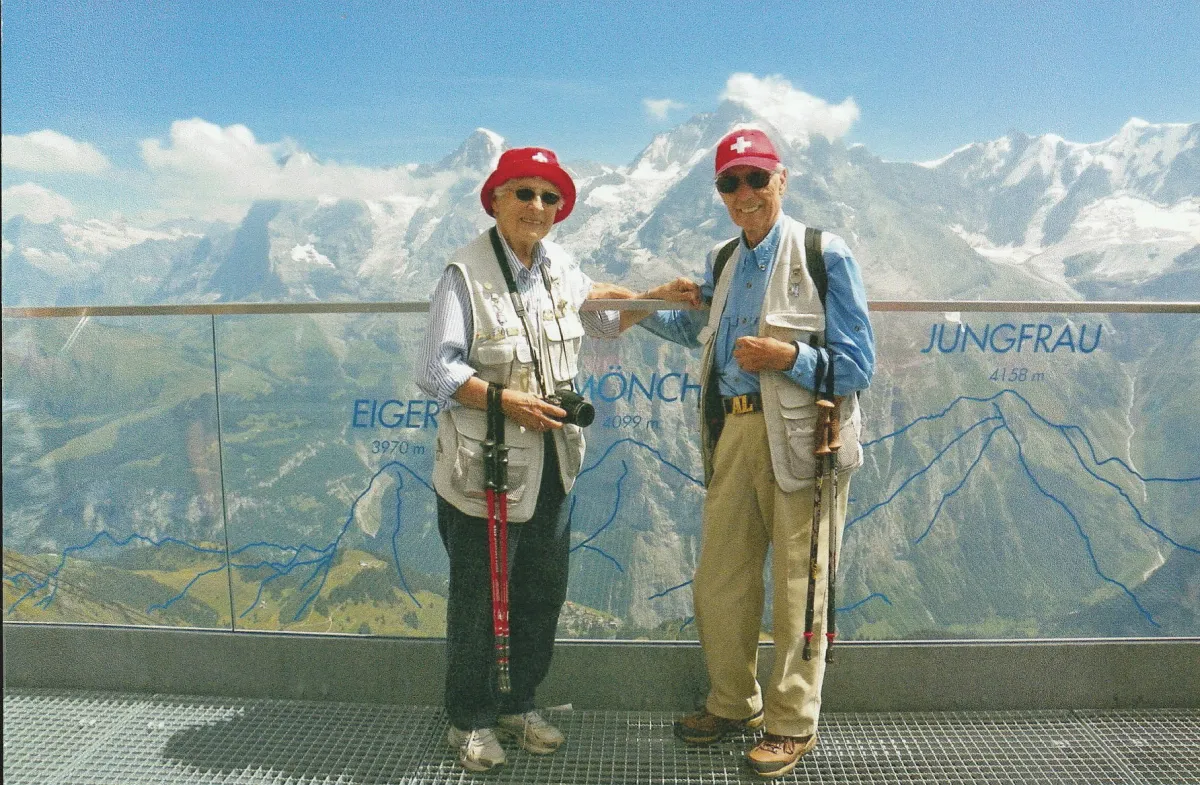
The Schilthorn mountain rises high above Murren, and we have taken the cable car to the revolving restaurant up there several times. But this time we were going to stay at a lower elevation (Dr.’s recommendation) and go only as far as Birg. The cable car took us higher and higher, and we could see Murren, way down there, on the edge of the mountain, and then we got off at Birg. From Birg, the Big Three (E, M, and J) are center stage, and a panorama of mountains surrounds us. There is a great viewing platform and one place where the floor is clear glass. Brave souls like to stand on this and look straight down to the valley floor! (1800 meters)
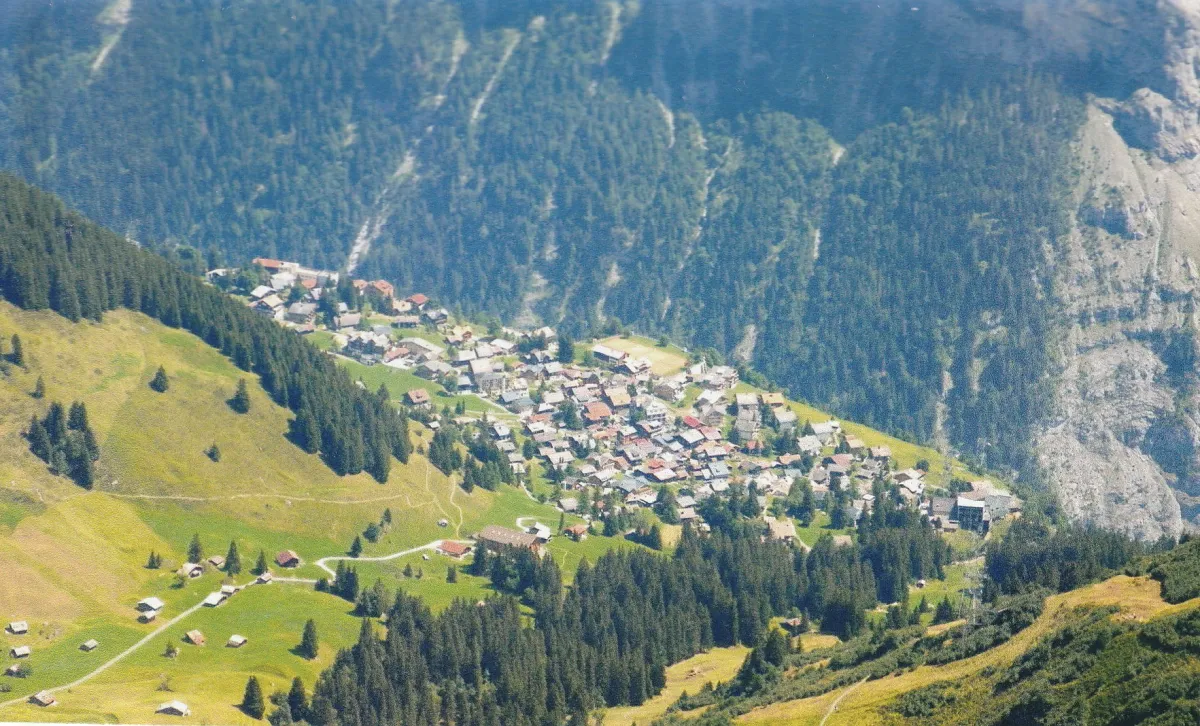
On our way back to Murren, we got off at the cable car stop in Gimmelwald. This is the classic mountain village: cowbells hanging on old wooden barns, chalets with colorful window boxes, a small school, and, for backpackers, a place to “Sleep in the Straw.” The farmer sends his cows up to the summer pasture, cleans out the cow stalls, puts down fresh straw for beds, and has a real rustic B&B. We actually peeked in the barn and saw a young man sleeping in one of the stalls. Rick Steves loves this place and promotes it in his travel books.
We ate our lunch there in Gimmelwald at a small outdoor restaurant. In this delightful setting, a couple was playing American songs on guitar and violin to a handful of people. They played “The Happy Wanderer” for us. Very fitting! Another “Top of the Mountain Day”
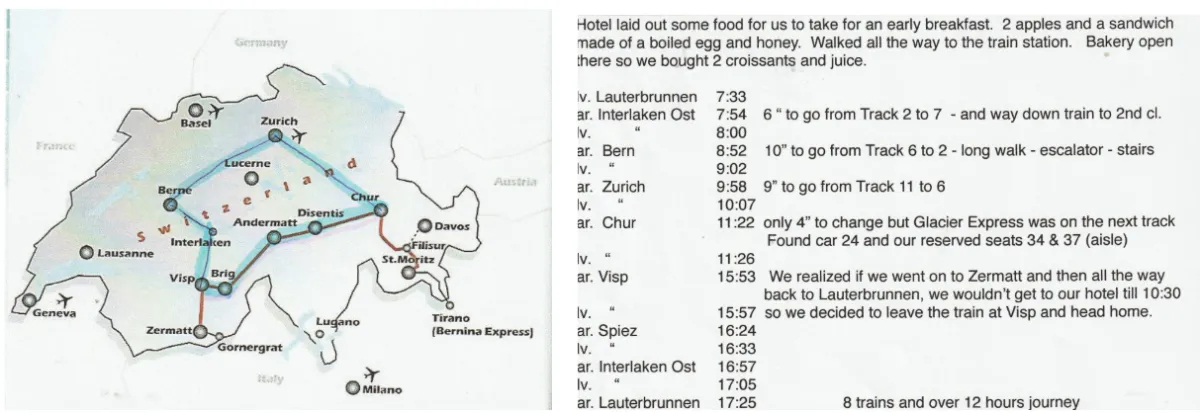
We decided to take the Glacier Express, a luxury train with domed windows that goes from St. Moritz to Zermatt. On the way, it goes over 291 bridges and through 91 tunnels. We rode it from Chur to Visp.
This is a very famous train, and we wanted to ride it mostly for the experience. We had ridden trains over the same tracks many times. We had to get up early to get the 7:33 train in Lauterbrunnen. Then we followed a very close schedule to connect with the Glacier Express in Chur. We found our reserved seats, but they were aisle seats with 2 seats on either side of us and then the windows. Yes, there were domed windows, but the glare made it hard to take pictures. We had ridden in lesser trains where you could just lower the window, stick your head out, and take pictures. Everyone was eating dinner as part of their package tour. Most of them would probably ride the whole distance.
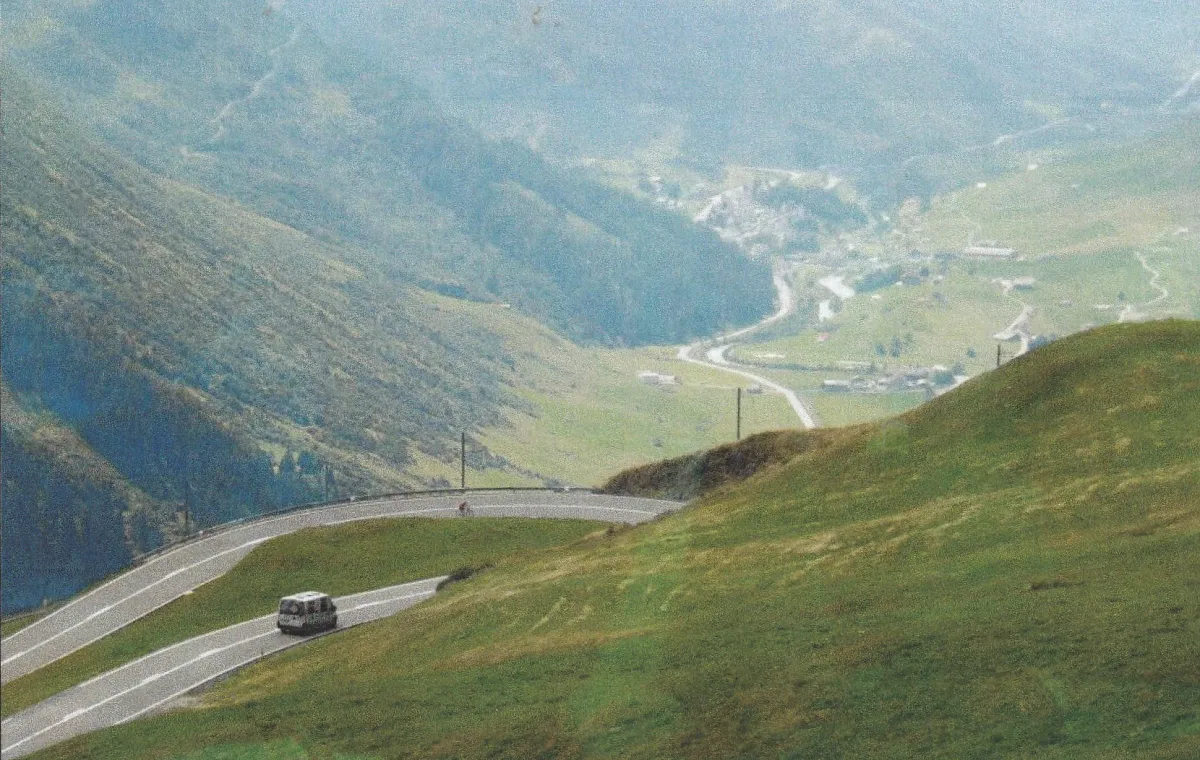
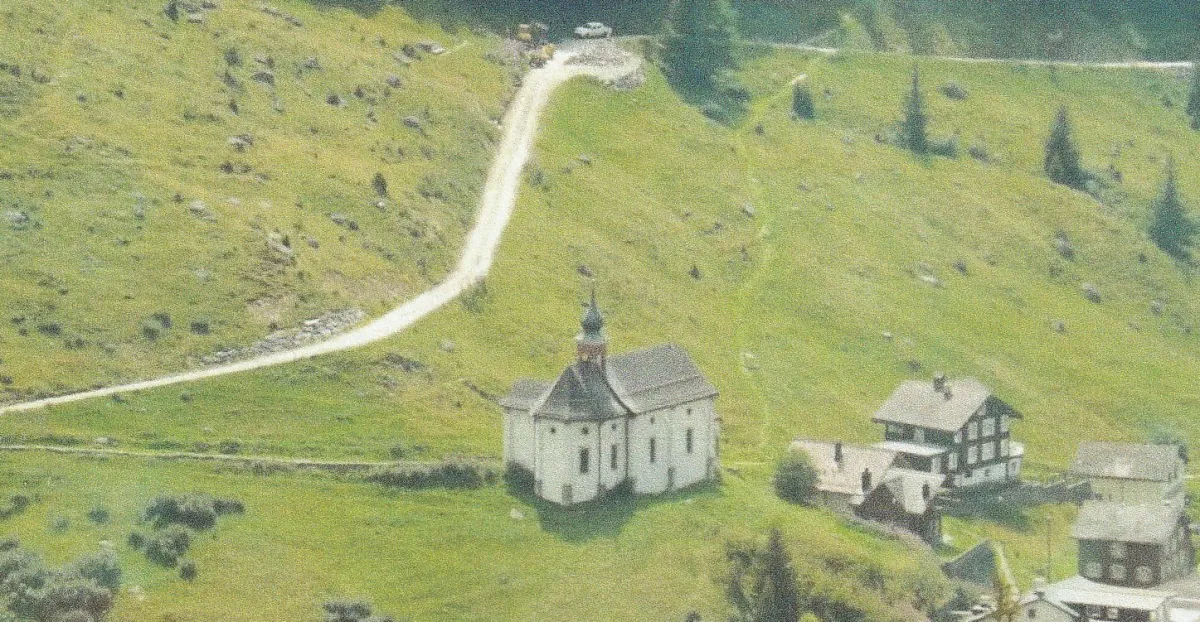
This 4-hour ride from Chur to Visp was over the spine of the Alps with dramatic scenery. When we reached the Overlap Pass, the highest point at 6,670 ft., we switchbacked down the mountain to Andermatt.
We have stayed here several times and recognized the little church. When we got to Visp, we decided to skip Zermatt and just “head for home.” It had been a long day, and we were “tired but happy.” It was our last day in this beautiful place - and it was raining. But the rain increased the flow of the many waterfalls.
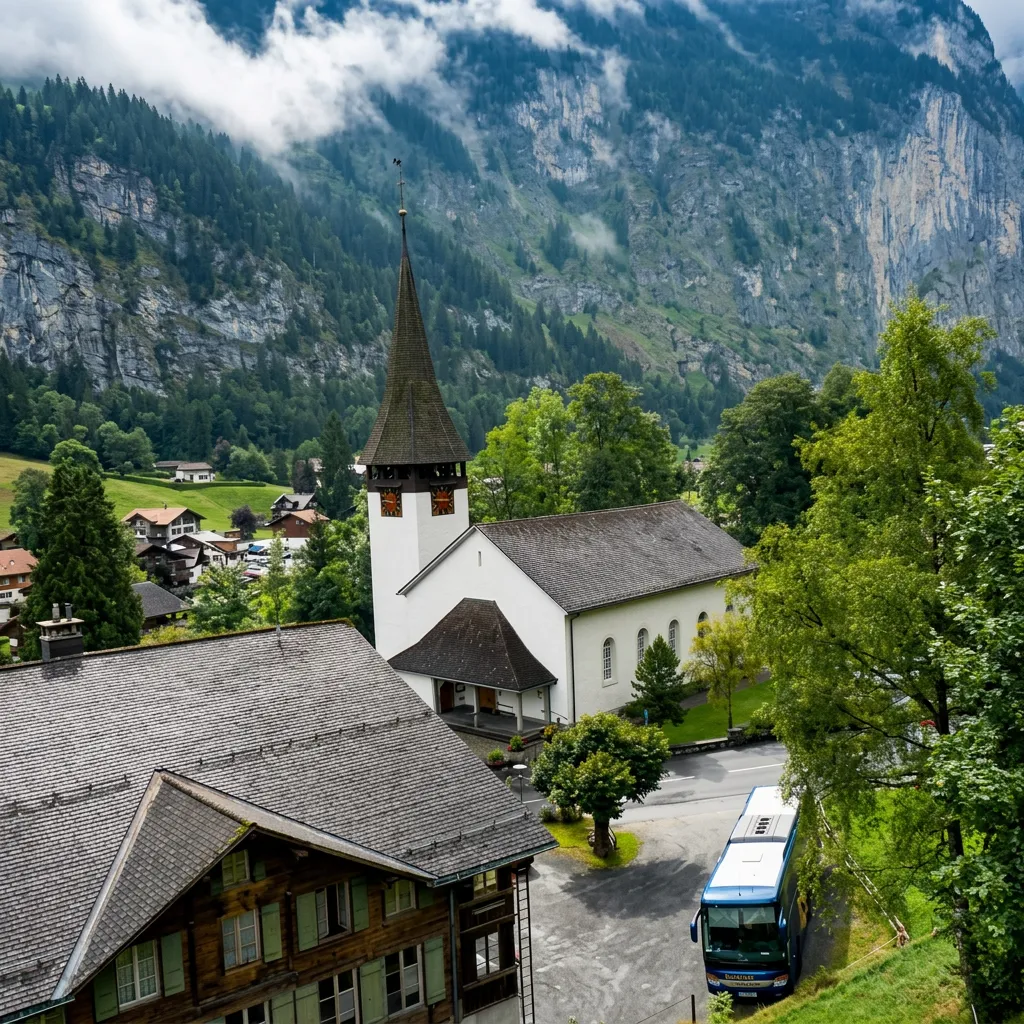
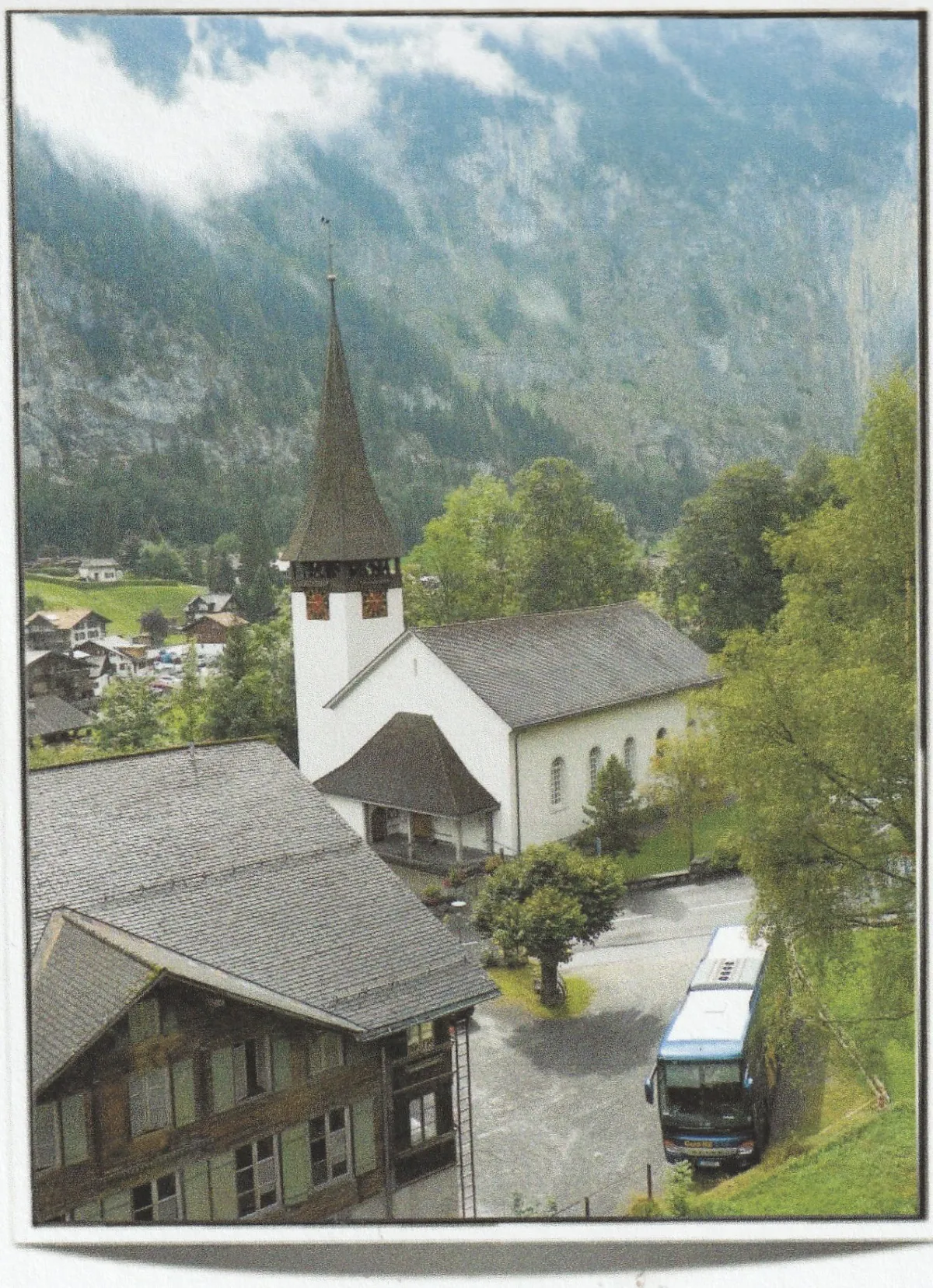
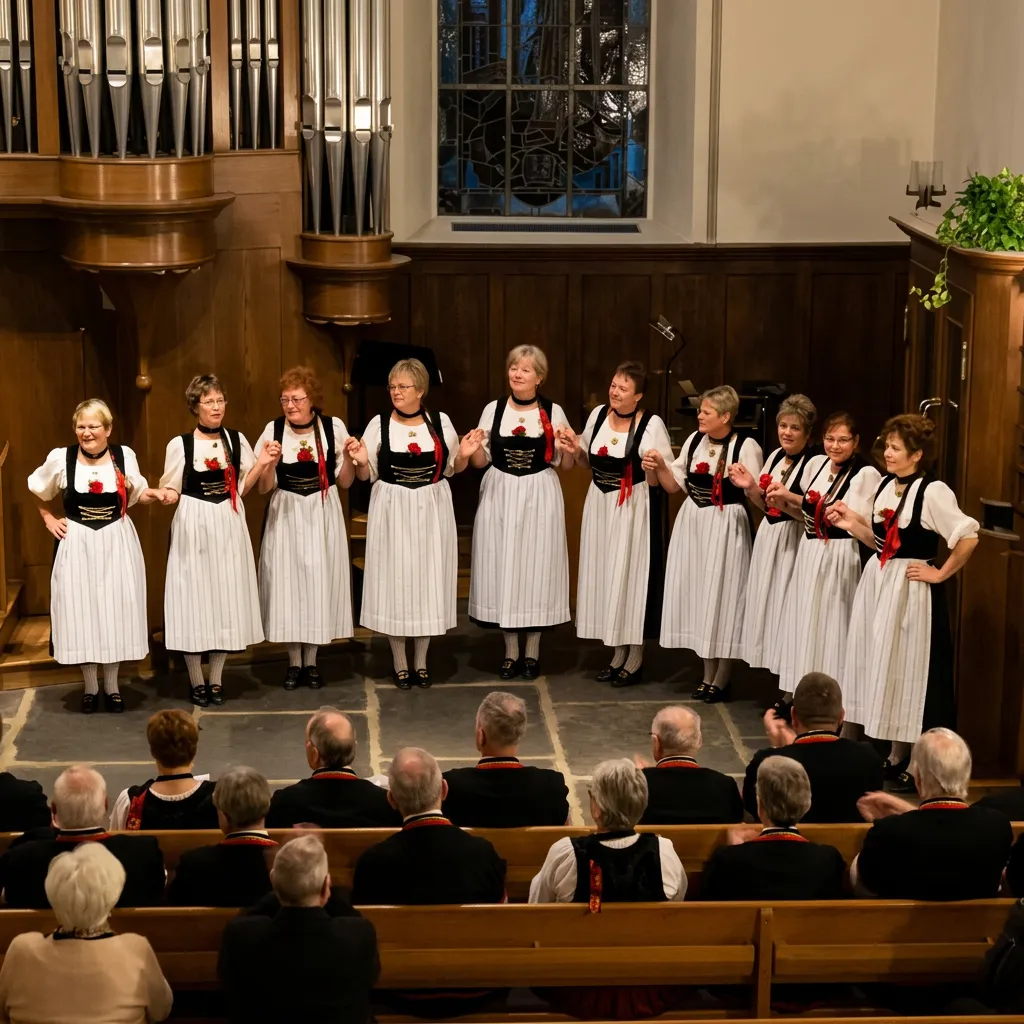
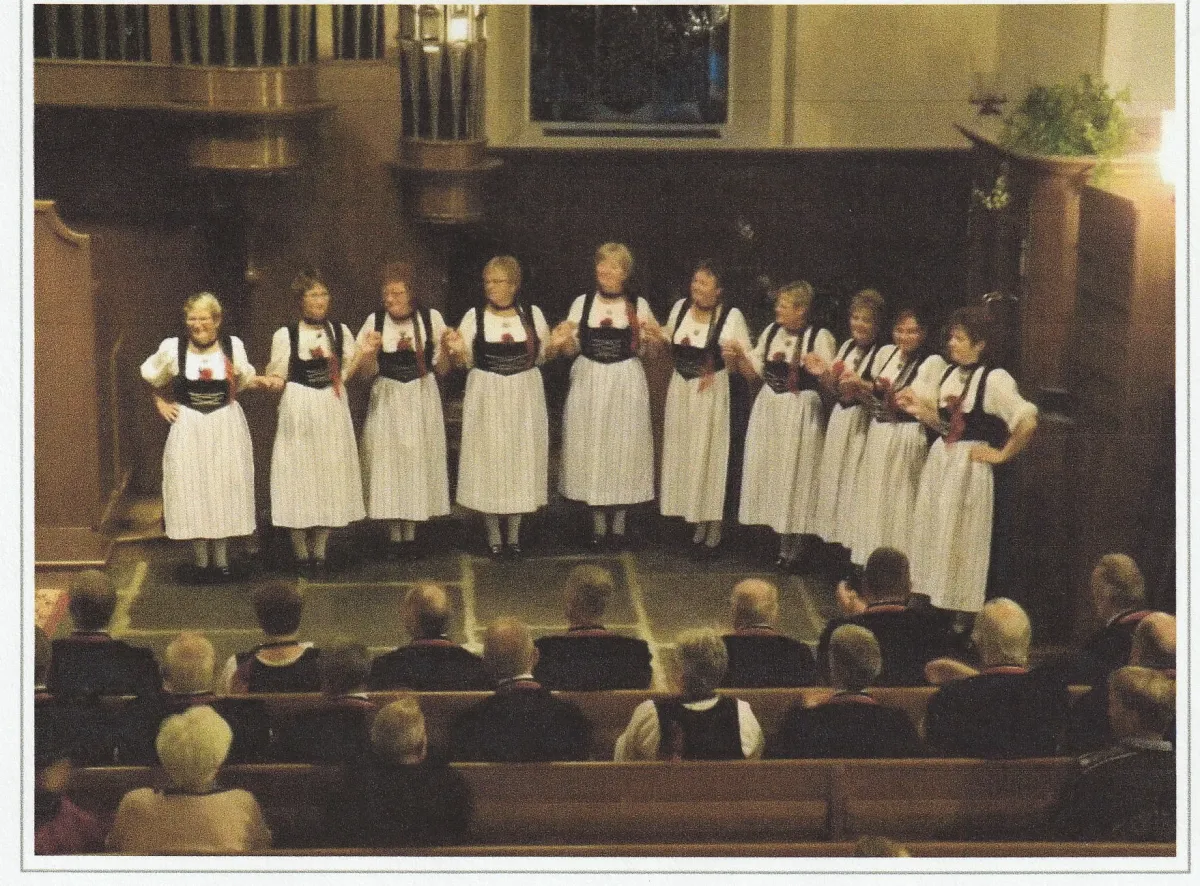
An outdoor folklore program was scheduled for that evening. Because of the rain, it was moved to the church, right next to our hotel. It was a delightful program featuring a Swiss band, yodelers, flag swingers, and alphorns. What a nice ending to our time in the Lauterbrunnen Valley.
Departure Day. Gute Fahrt und auf Wiedersehen. A final indignity on the train to the airport, I found the hotel room key in my pocket. We mailed it back to the hotel.
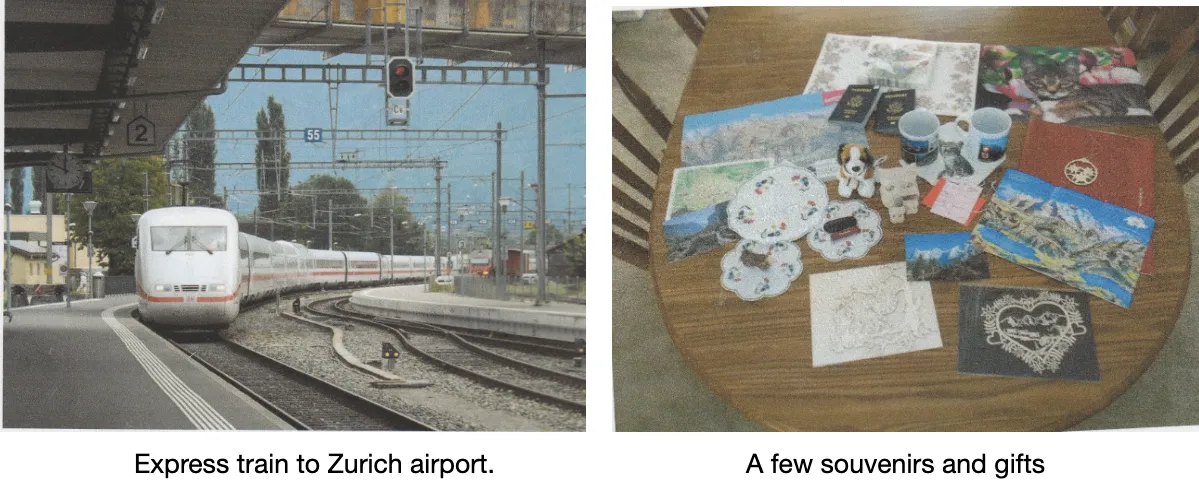
At the airport, we found the lost and found office and my jacket, which they had been holding for me. All’s well that ends well!
Continue Reading!
© Copyright 2026. AEM World Travels - informal entity. All rights reserved.